While looking through a mid 70’s Wimbeldon programme, we came across this nice puzzle.
Can you name the brands behind the stencil? There are plenty more I am sure.
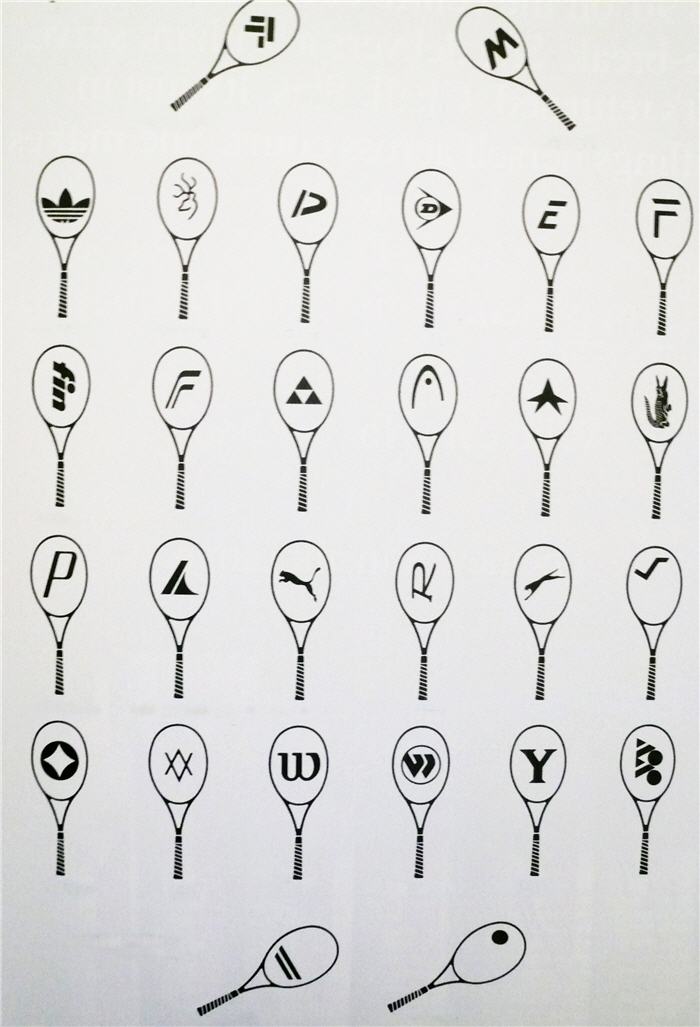
While looking through a mid 70’s Wimbeldon programme, we came across this nice puzzle.
Can you name the brands behind the stencil? There are plenty more I am sure.
If you have viewed the sections on W.V.Eaves and E.B.Dewhurst, you will learn of some early Australian players who travelled back to the UK and USA respectively and accounted themselves on the tennis scene very well.
Recently, one of our researchers and tennis book collector, Keith Jenkins, uncovered the story of yet another Australian that may well have had a significant influence on tennis in the 1890’s in England, not just directly by his own hand, but in deeds which influenced others. I say uncovered because a mention in one sentence in a book was made about an Australian player named Robert B Scott and from there considerable research effort by Keith brought the following story to light.
Thanks Keith, for your stirling investigative journalism.
Robert was born at Geelong, Victoria, Australia, 11 Feb. 1868. He was the son of Thomas King Scott of Kenley, Melbourne, and Emmeline Fincham Baldock. The family owned properties in Buninyong, Victoria, and Walgett, NSW and on the death of Thomas the probate on his will was some 20,369 pounds, which was a huge amount in those days.
Being obviously from a very wealthy family, Robert was educated at Toorak and Scotch Colleges, attending Scotch from 1876 -1882 [where he also won the Bible Prize in 1880] and then attended Ormond College, Melbourne.
In relation to tennis, Robert was already playing at a top grade in Australia before leaving for the UK. An R.B.Scott was playing doubles with his brother in an Adelaide tournament at aged 15 and is recorded as playing for Victoria in 1890 in an early Interstate carnival event. While not quite in the top rank, he was a competent all round player.
As many Australian lads did, he travelled back to the UK to further his education and entered Trinity College at Cambridge on 7 Oct. 1892. He graduated with a BA in 1895, but he is not listed among the students who took honours. He is also listed as having studied at Edinburgh.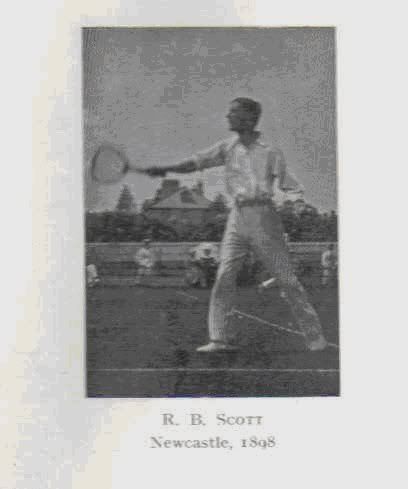
At Trinity, there is an early record of an R.B.Scott playing for the second tennis team (Grasshoppers) in 1893 and then going on to play for the first team in the Varsity match. In the 1893 Varsity Match he beat W.V.Doherty 6-4, 7-5, beat J.W.Steadman 6-2, 4-6, 10-8 and lost to A.D.Kelly 2-6,4-6.
He also won two out of three doubles rubbers playing with H.V.Fedden (also of Trinity). They lost to Doherty and Kelly 13-15, 1-6, beat Hinde and Steadman 6-2,6-4 and beat Pritchard and Mears 6-2, 6-4.
While at Cambridge University, R.B. Scott was Hon. Secretary of CULTC (Lawn tennis club) and in 1894-1895 R.B.Scott was President of CULTC. In the following years, R.F. Doherty was President in (1896) and H.L. Doherty in 1897. Both of these gents after the Renshaw brothers, virtually dominated tennis for a decade and in the process with a huge public following stimulated ongoing interest and growth in Wimbledon and the first Davis Cup matches.
As to Robert Scott’s involvement with these champions, in reading the book, “Fifty Years of Lawn Tennis in Scotland” edited by A.Wallace MacGregor in 1927, Scott is first mentioned as an “Australian player” in the 1892 Scottish Championships. Then MacGregor tells of the 1895 Champs where he played with “RB Scott, then President of Cambridge, one of the finest doubles players I have ever been privileged to partner, and one to whose enthusiasm and advice at Cambridge much of the Dohertys’ devotion to the game was ascribable”.
Apart from a huge enthusiasm for the game, Robert played at Wimbledon (at the same time as Eaves) in 1894 losing in the second round to Harry Barlow 11-9, 4-6, 2-6, 4-6. In 1896 he lost in the first round against top player Charles Allen 6-3, 0-6, 4-6, 6-1, 4-6 and then teamed with H.L.Doherty to lose in the 3rd round against the Allen brothers 6-3, 1-6, 1-6, 2-6.
In the Scottish Championships of 1897, Scott and his partner, R. Hamblin Smith were beaten by the Doherty brothers in the semi finals, losing 1-6, 13-15, 0-6.
Robert was licensed by the Presbyterian Church of Edinburgh May 1899; assistant at St Cuthbert’s, Edinburgh, North Berwick, and to garrison chaplain, Edinburgh; ordained minister at Humbie, 18 Jan. 1905 and was transferred to Rhu 9 Nov. 1922 and died there 7 May 1924.
To assist relatives in contacting us with additional information, our Robert Scott married on 31 Aug.1904 an Alexa Evelyn MacLeod, born 21 Feb. 1872 died 18 Mar. 1937. She was the daughter of Rev. John Macleod, D.D., minister of Govan.
Children of RB & Alexa – Mary Alexa Baldock, born 12 Aug. 1908; Celia Helen Baldock, born 9 July 1911.
We only have the one photo and any new information would be gratefully received.
References:
“Fifty Years of Lawn Tennis in Scotland” edited by A.Wallace MacGregor. 1927 [photo]
Cambridge University Lawn Tennis Club – contact Nick Jenkins [no relation!!]
Jonathan Smith – Trinity College Archivist, Cambridge University.
Scottish Ministers – Humbie p.377
“The MacLeods-the Genealogy of a Clan” by Rev. Dr. Donald MacLeod/Alick Morrison 1970, p.33
“Wimbledon Championships” by John Barrett
“50 Years of Wimbledon” by A. Wallis Myers p.37, p.92.
Dr. Jim Mitchell – Scotch College Archivist
The Argus – 4 Jan. 1868 [List of old colonists]
The Argus – 17 Dec. 1880 [Scotch College prize]
The Argus – 27 Aug. 1889 [TK Scott – death notice]
The Sydney Morning Herald 27 Aug. 1889 [TK Scott – death notice]
The Argus – 8 Nov. 1889 [TK Scott – probate]
The Argus – 3 April 1890 [Ormond College concert]
Sydney Morning Herald – 13 Nov. 1890. [Intercolonial Tennis results]
The Argus – 2 Sept. 1904 [Wedding notice]
Six times Australian Champion, Nancye Wynne Bolton was a powerhouse in Australian tennis from the mid 1930’s to early 1950’s.
Inducted into the International Hall of Fame and of course into Australia’s tennis hall of fame with other greats such as Laver, she was an inspiration not only to her own generation, but to those who followed in the late 50′ and 1960’s.
Nancye was born in Melbourne on December 2nd 1916. Her first foray into tennis began at aged 10 on a bitumen court located on the roof of an office block in the city where a coach by the name of Leo Guiney.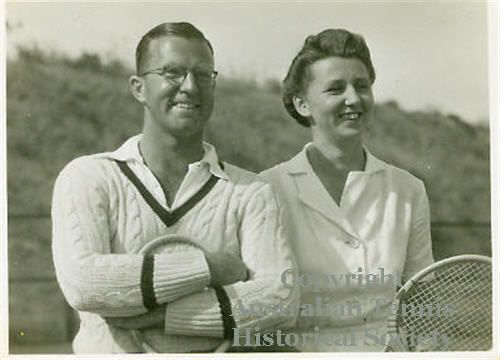
In 1933 as a very tall 5’10” sixteen year old she won the Victorian schoolgirl tennis championships which was followed by a couple of seasons playing A grade pennant for St Kilda. In 1936 she entered the Australian championships and made the final against previous winner, Joan Hartigan, losing 6-4, 6-4. In doubles she played with Thelma Coyne from NSW, who like Nancye had been winning state events, and surprisingly at 18 and 17 years old respectively won the event.
In singles, Nancye lost only one other match over the next 12 months. Overall, Nancye won six Australian singles titles and when you consider that WW2 interrupted tournament play for 5 years, you can only imagine what the record books may have been like had play been continuous.
In doubles, Nancey and Thelma formed a lifelong friendship which saw them take out the Australian doubles title 10 successive times and with another partner Thelma won an 11th. In mixed doubles she played with Colin Long (pic) and they went onto win 4 successive Australian titles together.
With continuing good form, Nancye defeated Thelma in the 1937 semi final in a match that up to that point had them head to head 2-2. The match was a see sawing event but the win 7-5, 4-6, 6-4 was exciting tennis and Nancye went on to win the final against Westacott 6-3, 5-7, 6-4, another tight match which showed the highly competitive level of tennis within the women’s ranks. Nancye was the #1 ranked player in 1937 and please note the section on mens and womens player rankings in a different section.
In 1938, once again the LTAA was requested to send a Women’s team overseas and once again, as in 1925 they declined and even still more strangely, since the LTAA sanctioned the 1928 Women’s team which created a massive amount of interest along with a world class performance against all comers with only a major defeat at the hands of the Americans. After much consternation and a generous expenses allowance paid for by the overseas associations who wanted the Australians, did the LTAA permit the tour to proceed with Nancye, Nell Hopman, Thelma Coyne and Dot Stevenson.
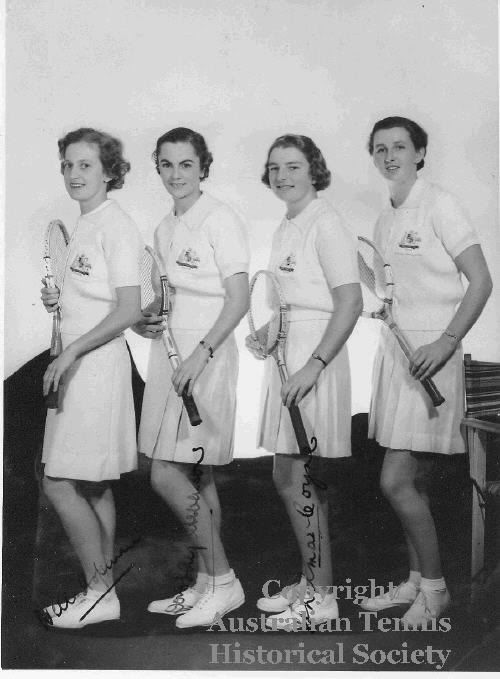
1938 Womens Tennis Team for Overseas Tour
L-R Nell Hopman, Dot Stevenson, Thelma Coyne, Nancye Bolton
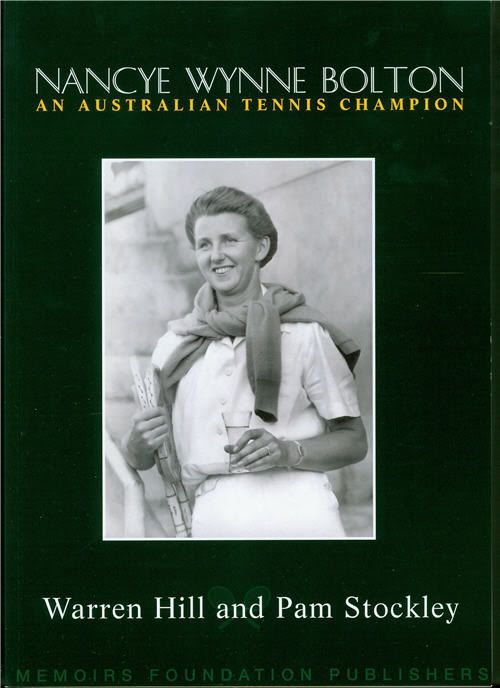
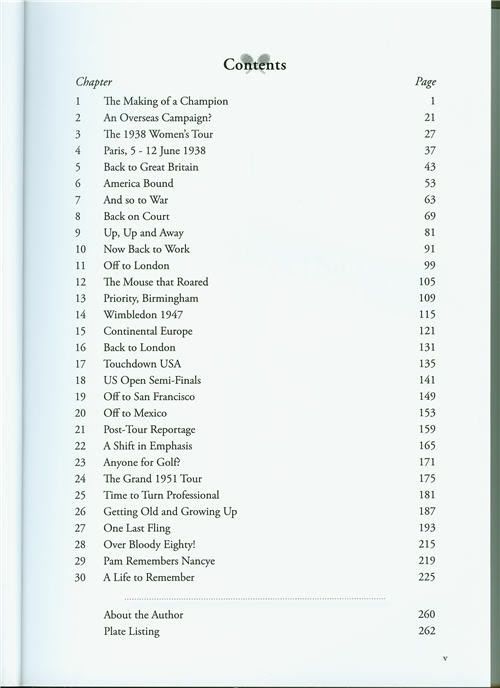
In 1947 Nancye went on another tour, but rather than give you to much detail in this article, we would like to assist Pam Stockley, Nancye’s daughter, with the sale of a magnificent book which covers Nancye’s tennis career and includes an excellent transcription of Nancye’s 1947 tour diary. The book is extremely well written with heaps of photos and does take the reader back to the 1940’s when the “team” and friendships were in full swing. There are only 196 copies left from a 400 limited run.
Please click this link to see a video clip of Nancye’s playing style CLICK HERE
Please contact Pam on Australia 61 3 9872 5486 or email pstockle at bigpond.net.au
Occasionally a racquet style will come up for sale which perplexes both buyer and seller. These racquets are the same length as a standard racquet, much the same width but have a narrower frame and lighter weight. They’re not squash racquets either because the shaft is not as slim.
The answer is these racquets belong to another form of tennis usually played in Asia, called SOFT TENNIS.
It was introduced by a western missionary in Japan in the late 1800’s and given the history, Soft Tennis has become the choice version of tennis for about 40% of tennis players in Japan. It is also becoming increasingly popular in other areas of the world. A slowed down and more strategic version of the standard tennis game, Soft Tennis emphasizes longer rallies and a more exciting performance that is accessible to every age and ability level right from the very first serve.
The key to Soft Tennis is the use of an inflatable soft, rubber ball. Unlike the standard felt-covered version, the pressure can be adjusted. Players can speed up or slow down the game to suit their ability and training objectives. Its composition also makes it more difficult to generate as much force when hitting the ball. This keeps the ball on the court. The result is longer rallies and a focus on cardiovascular fitness, hand-eye coordination, ball placement and footwork.
The racquets are made by many Asian based makers and we have not seen any examples produced by local companies.
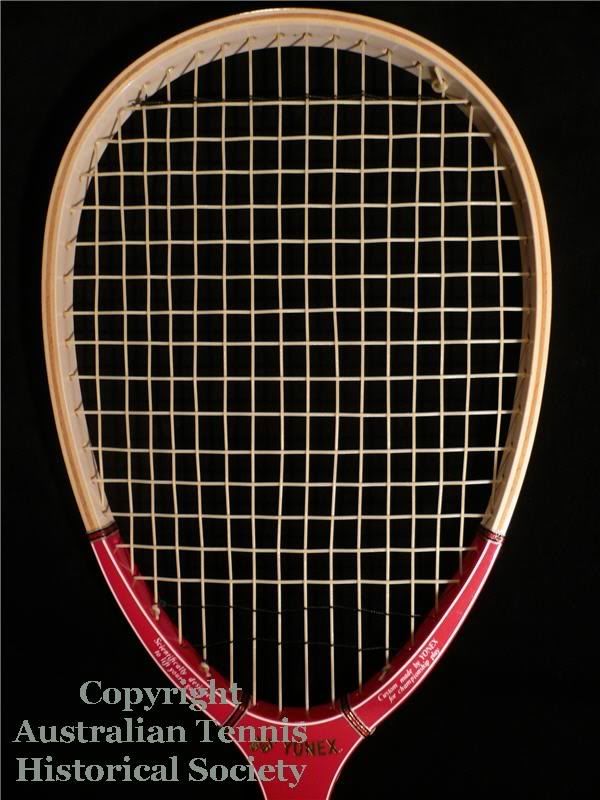
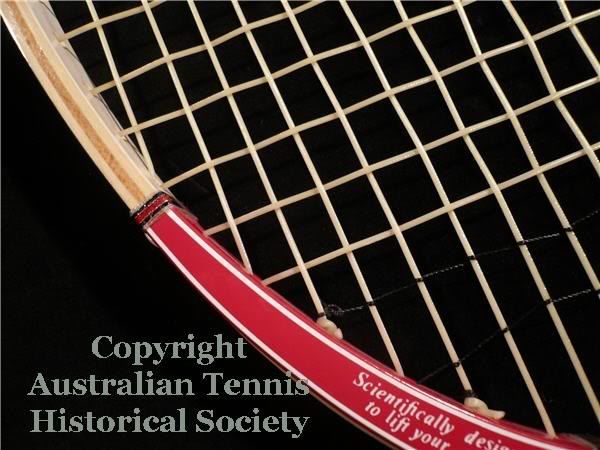
This is the YONEX TS 7000 and the thinner frame is evident. Weight is about 10oz.
A google search will find additional information.