Anderson Racquets

In August 2025,  we received an email from a family in NSW regarding a previously unknown racquet making firm called C.O.F.Anderson from Vale lane, Auburn.

Colin Olsen Flett Anderson must have commenced his racquet making skills with another local firm prior to setting up his own company.  In 1925, he applied to complete a business course in preparation for the big step forward and you can see he added tennis racquet maker as his career on the course application form.

The firm must have survived for a quite a few years guessing the 1928-1932 era but we do know that the depression forced the closure.   Searching Trove for old ads from the company or retailers hasn’t led to any confirmation of the models produced but we do have an actual racquet called the SPECIAL and a sales card referring to the SWIFT.    Both Chesterfield NSW and Hedley VIC had a Swift model so it is quite possible that Anderson may have been acquired by one of them.

The racquet is well made with a wood scored grip.

Thanks to Robin Buchanan for the information, another addition to the development of  the Australian Industry.

ANDERSON 1925 Dec JPEG

1000010193

1000010192

C.O.F. ANDERSON RACQUET MAKER AUBURN ADVERTISING CARD

Tennis Heritage Australia 2023

Apologies for being lax in posting an update, however this year was a really interesting one mainly due to the number of interesting items which came up, some of which I never expected to ever see and some I have never even imagined existed.

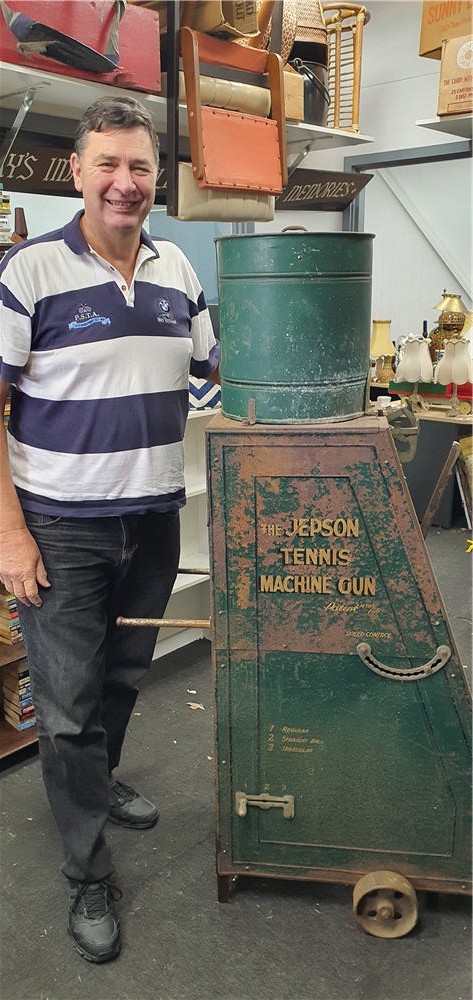
From the Australian innovations perspective let’s start with the Jepson Machine Gun Ball machine.  First marketed in 1928 this all electric unit could shoot balls on different angles, spins and speeds.  Details are in the main pages.
Here I am next to it.  It was sold from 1928 to 1935 and units went around the world to the main clubs and were demonstrated locally in the major department stores.

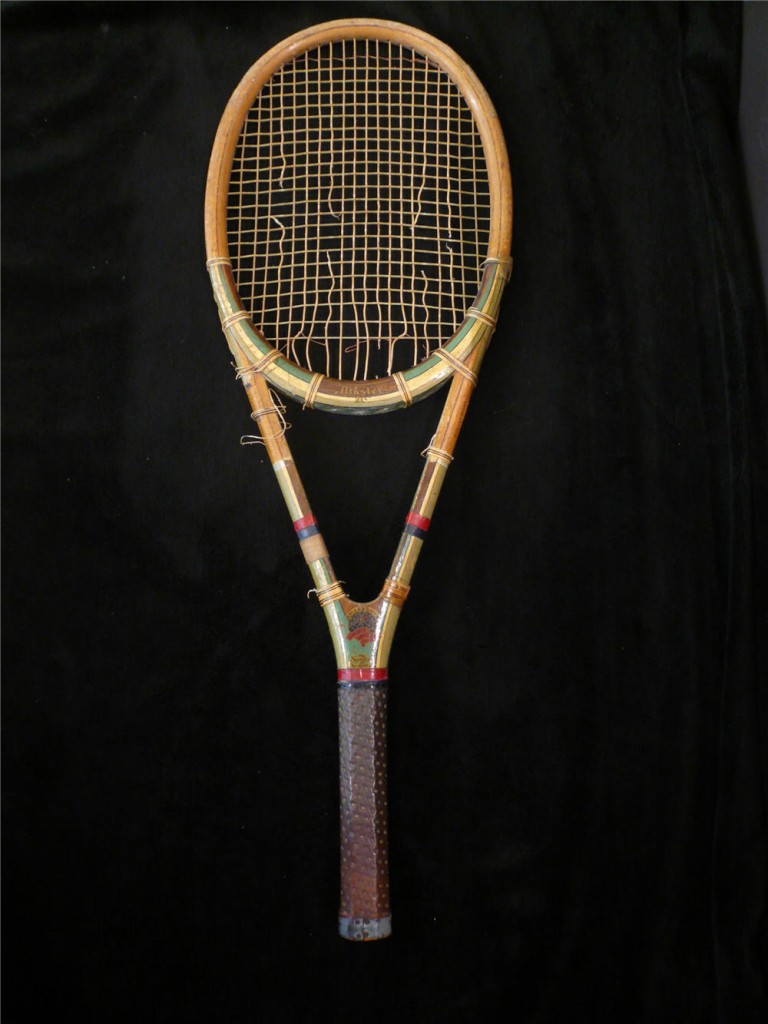
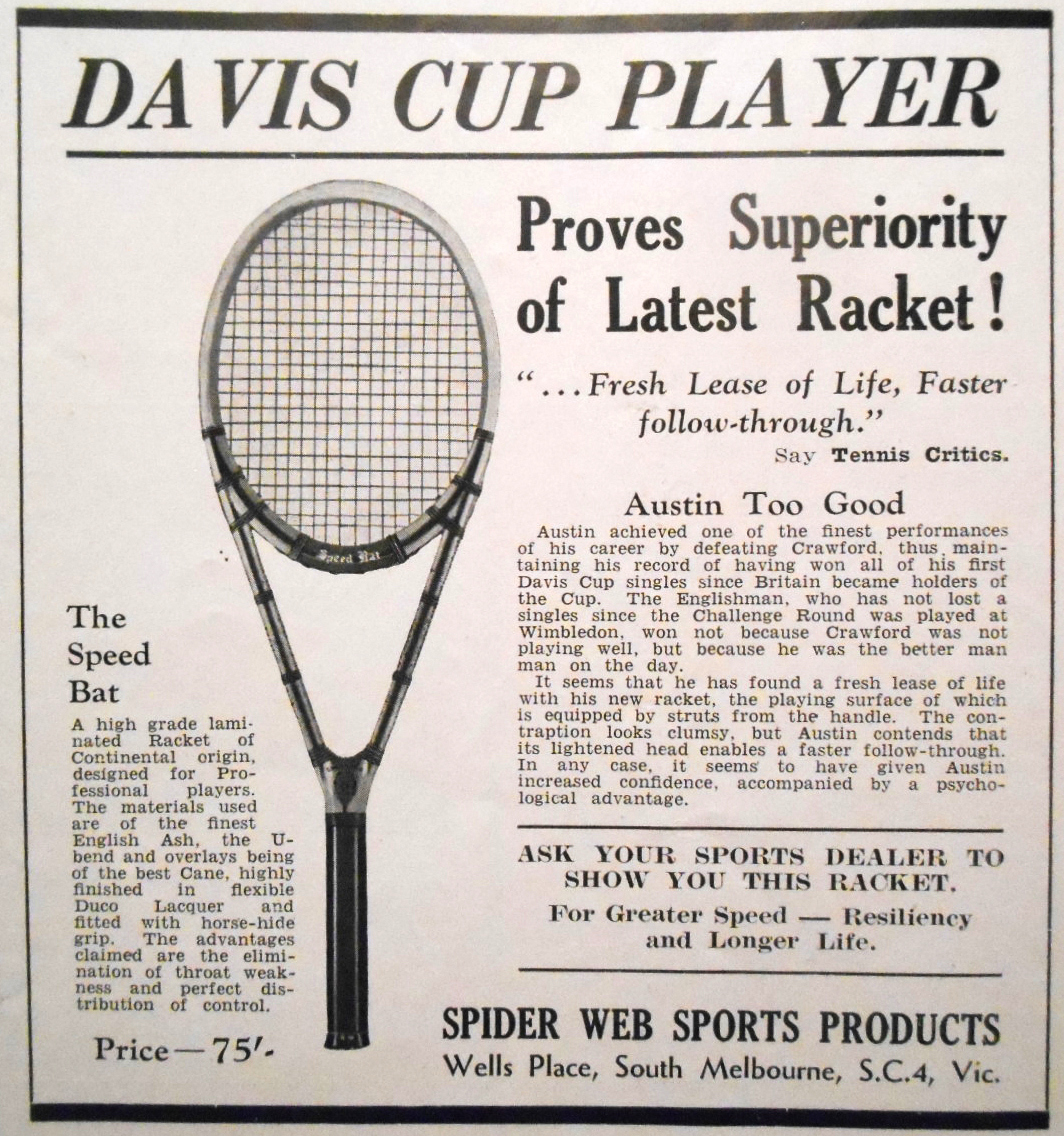
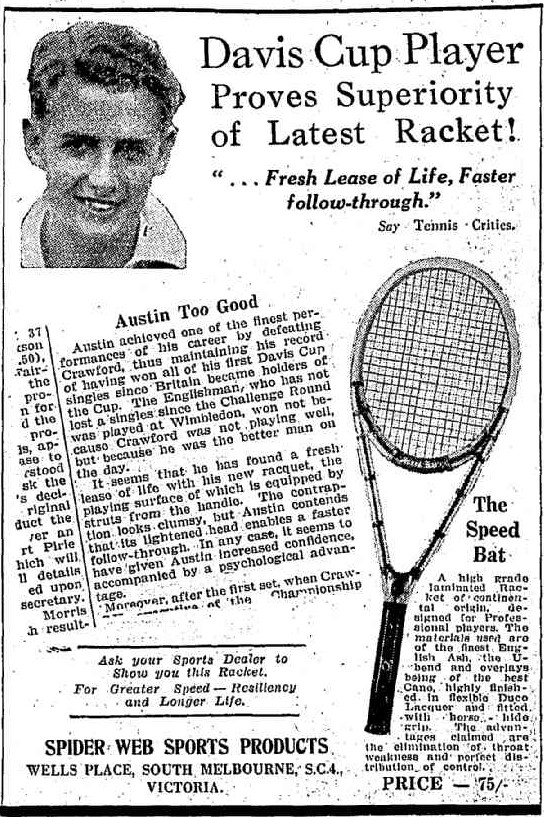
About 7 years ago I came across an article in a 1935 newspaper about this weird open throat racquet which appeared at a Toowoomba tournament that was dubbed Mary. The model was imported from Continental Europe into Australia by Spider Web in South Melbourne and decorated and strung as the SPEED BAT. It is a truly modern looking frame which back then was considered quite outlandish even next to the Hazell SpeedShaft used by UK Davis Cup player Bunny Austin.

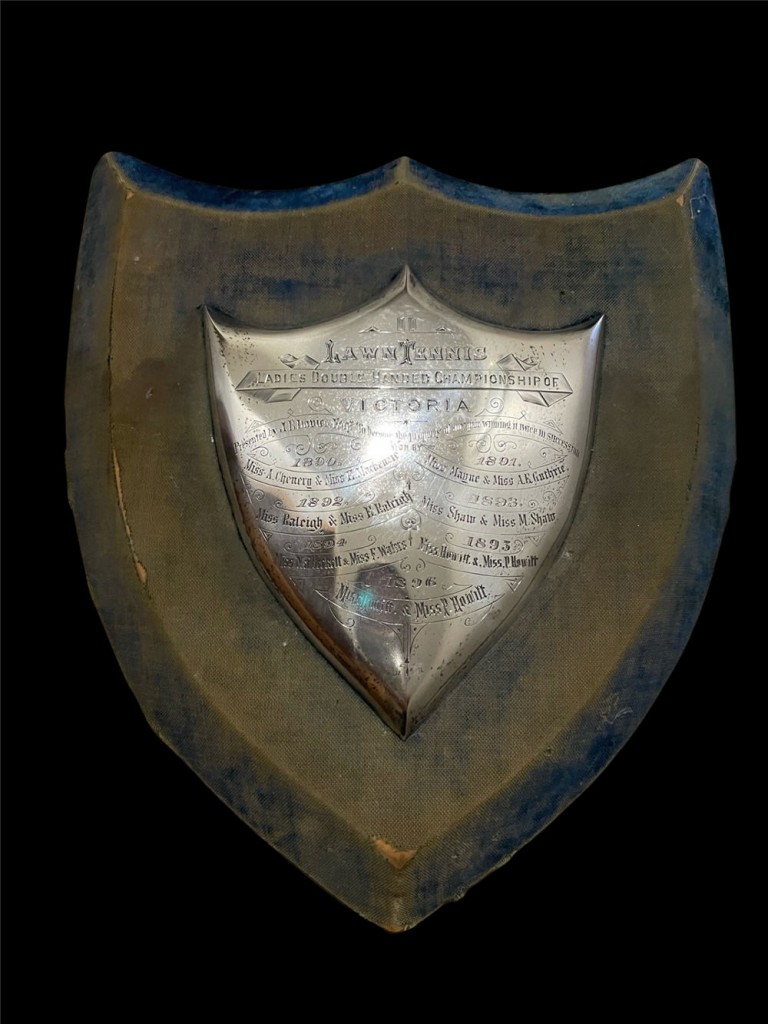
A trophy shield arrived. The Victorian Championships Ladies Doubles title shield presented from 1890 to 1896 until being retired by the Howitt sisters. Phoebe Howitt was also the Victorian and New South Wales singles champion and was known as the Australasian Champion for a couple of years.

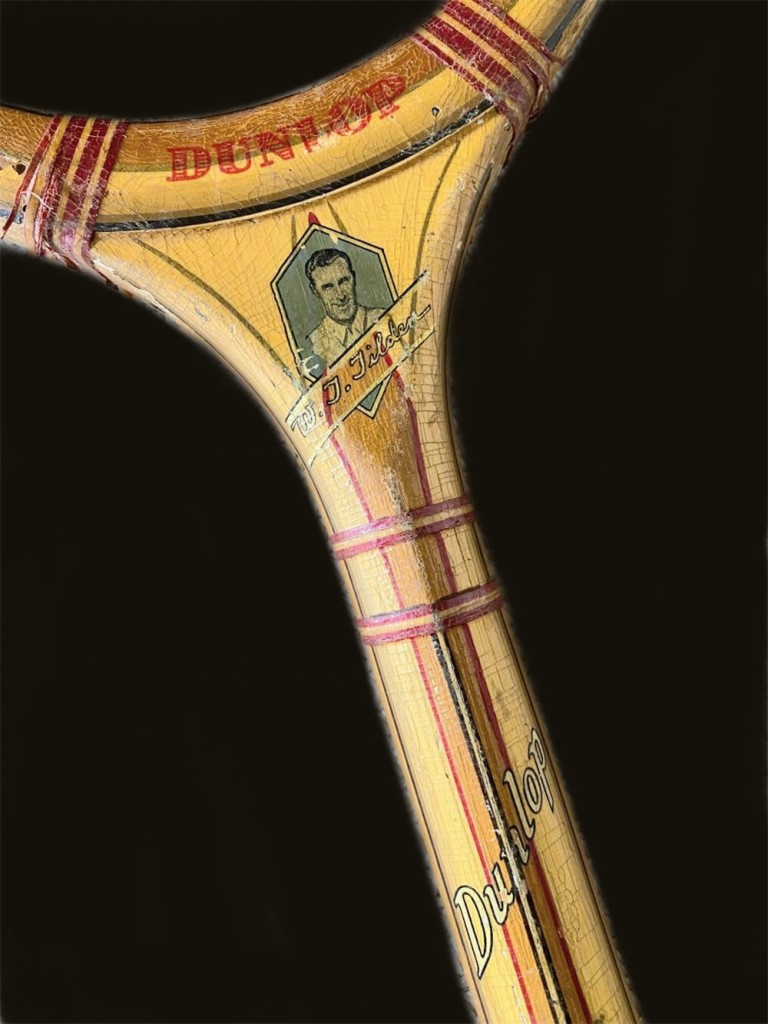
We also found a rare photo decal model exclusive to Australia featuring William Tilden in later years around 1938-1942 on a DUNLOP 5 STAR model. It is the only known example.

Over in France another highly unique racquet was found and sold on ebay for $4000. The Kateb, Paris expanded shaft also circa 1935-1940. Never seen anything like this before.

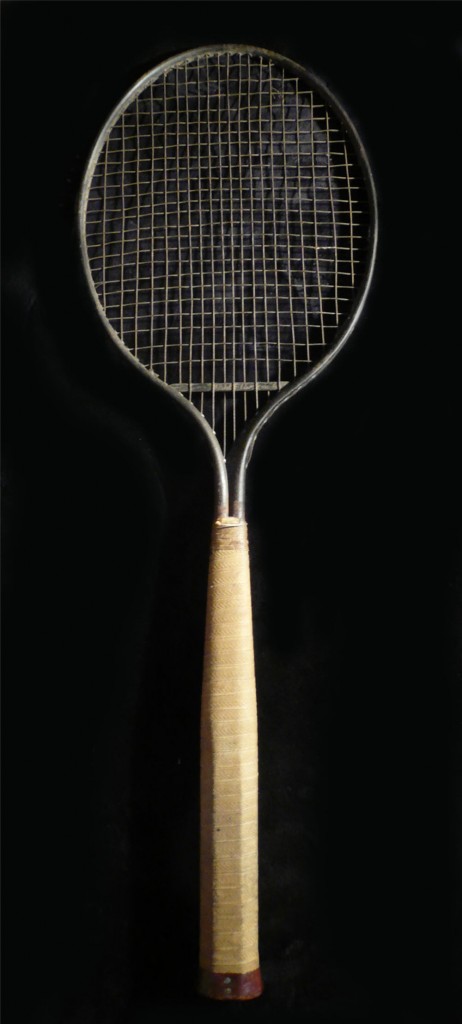
From the UK in the early 1920’s comes this all metal, bandage grip, steel strings model from HOBBIES who made other home handyman tool kits and homewares. They had quite and extensive catalogue.

Tennis Heritage Australia Newsletter 2021

Well COVID has certainly impacted on our normal outgoing planning for tennis displays, meetings and player events etc.

Yet behind the scenes,  some interesting things have been developing.  Not least, is the rise of Ash Barty as a firm #1 and we just love watching her carve up the game plans of opponents with her all court game.

From a collecting perspective, there are now a growing number of Chinese Tennis Collectors entering the market as the game blossoms over there.  Having taken displays to Beijing in 2013 and Hong Kong in 2018, we have learned that tennis stadia like Rod Laver arena are being built in most provinces and the pressure to build tournaments at an international level has become a major focus.

Sadly, the Tennis Museum space at the NSW centre in Parramatta at Olympic Park was replaced by a gym and all the memorabilia is in storage.

This  means there is no significant tennis museum or display with the exception of the Margaret Court and Rod Laver arena displays focussing on there careers.

In the meantime, Kooyong has expanded its facilities and is also expanding the foyer display areas which are very nice covering tennis racquets (20) and quality displays for various Aussie greats…..

It is still an ambition to find a location in Melbourne at the tennis or nearby where fans could view Tennis Heritage Australia collections and, or combined with Tennis Australia’s stored collection which never sees the light of day.

Over 5000 items from the TA Collection can be viewed online  here https://victoriancollections.net.au/organisations/tennis-australia

Please subscribe on our website to receive future newsletters and we do a lot more these days on Facebook.


Walbow Racket Company

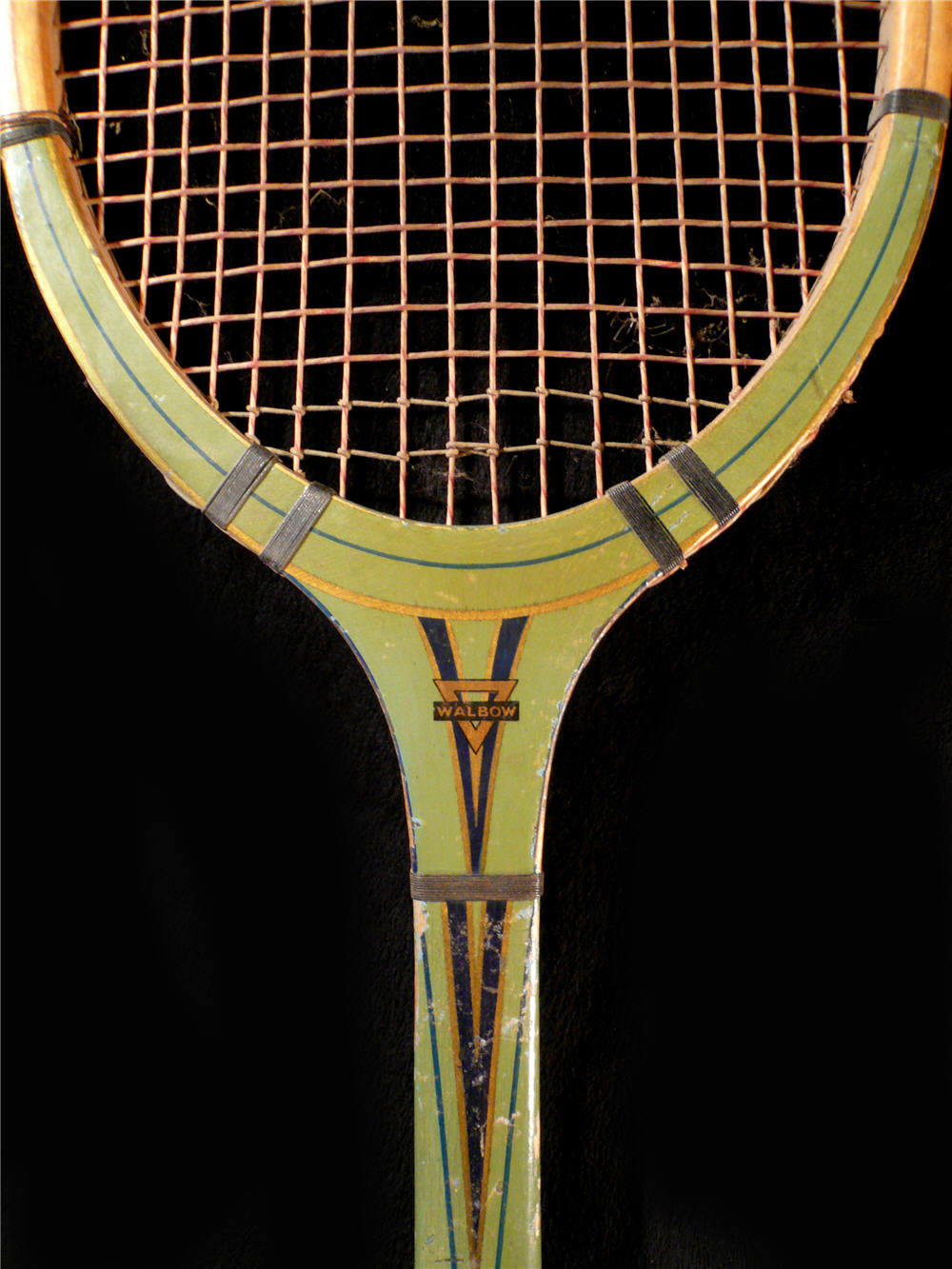
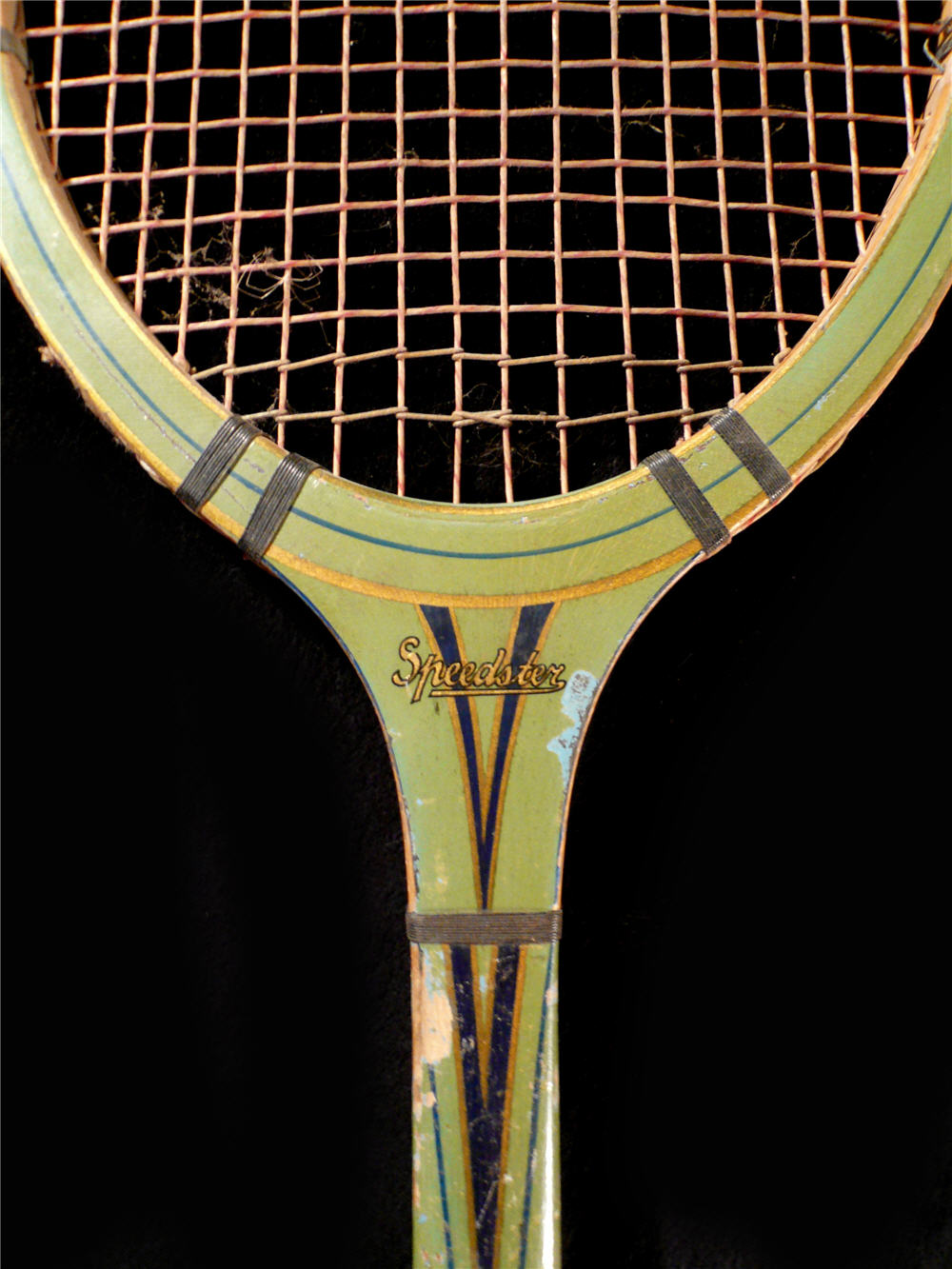
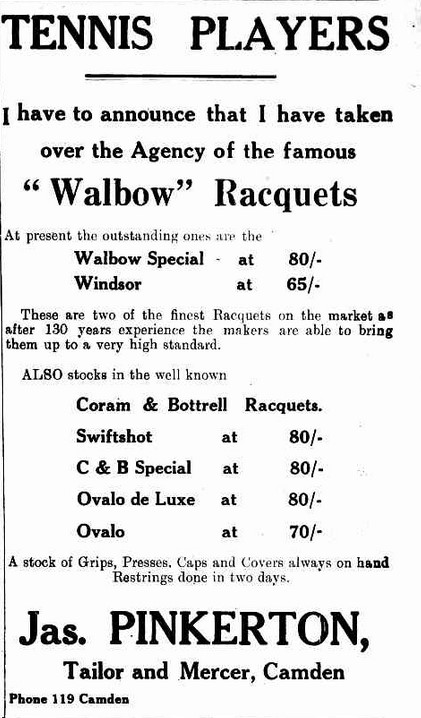
The boom in tennis being played in Australia saw a host of new entrants enter the manufacturing sector.   Walbow Racket Company must have started in the  1920’s since the first ad, below comes from 1928.  In the mid 30’s it was owned by Lionel Walsh  and operated from 20 Alfred St Mascot.  It was quite the hub for sporting goods manufacture with Slazenger and Waddell’s in nearby Alexandria.  According to the business directory of 1936 there were two new owners Thomas Mitchell and David Chrystal. Later this partnership was dissolved in favour of the Chrystal father and son.

The only example known to date is this nicely produced Walbow Speedster.

WALBOW SPEEDSTER NSW (26) USE WALBOW SPEEDSTER NSW (23) USE

1928 walbow racquets


Waddell’s Sporting Goods (NSW)

Always interesting to find new information about tennis racquet makers.

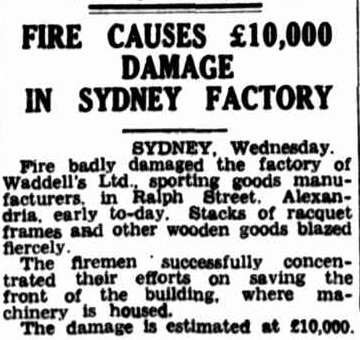
Waddell’s Lt d manufactured sporting goods from a factory in Ralph Street, Alexandria around the corner from Slazenger.

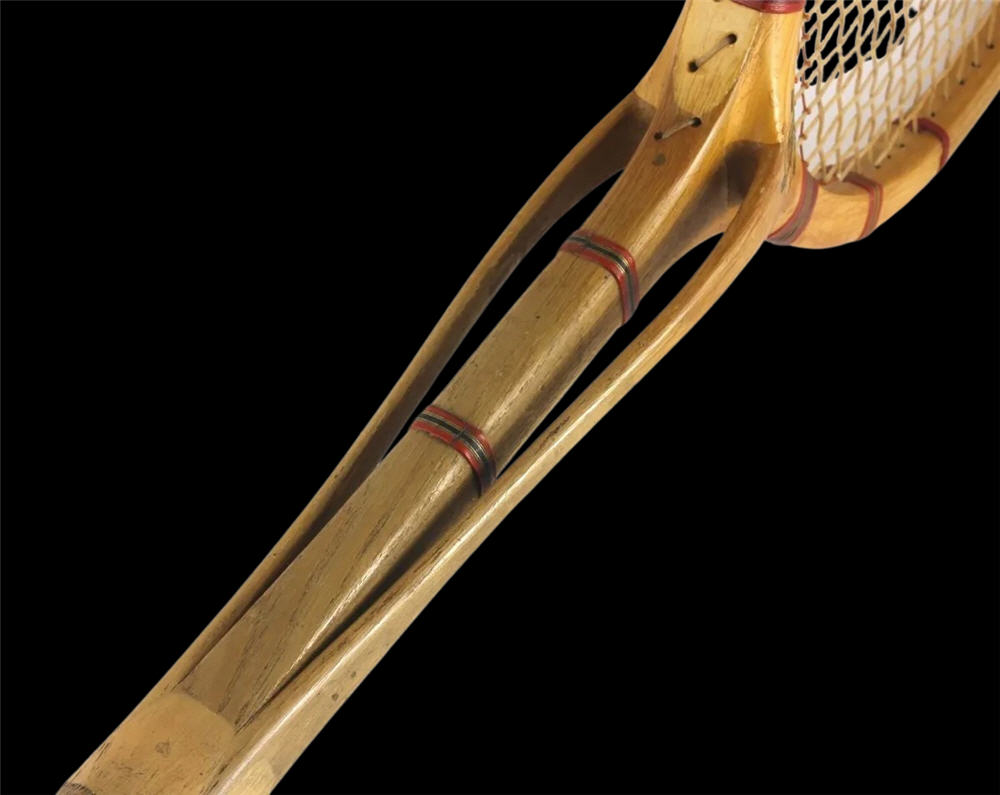
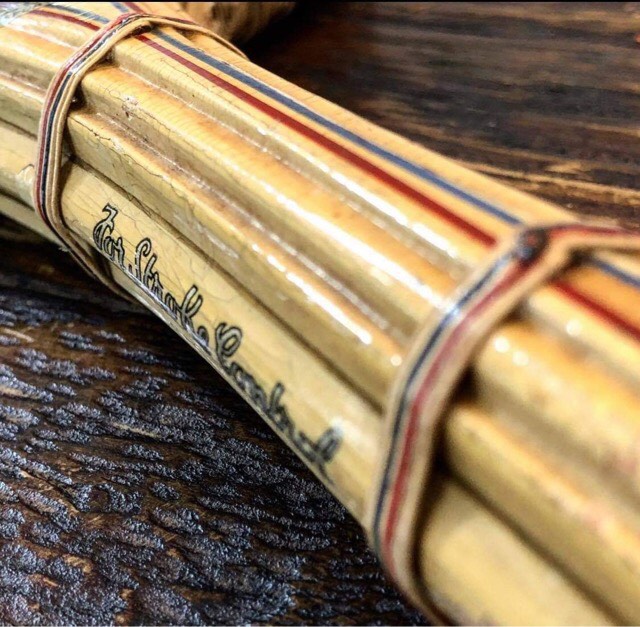
This wonderful example, the Royal Sovereign,  shows a very intricate shaft design not appearing on other competitive models.

The logo on this racquet shows a variety of  sports so presumably, they made a range of equipment which was sold throughout Australia based on advertising.

Typically, these work places contain some flammable materials and in 1939 they suffered a quite extensive fire and local reports confirm both the factory street address and that racquet frames were damaged.

Waddell's Sporting goods factory Ralph St Alexandria

Waddell's Royal Sovereign Tennis Racquet Sydney factory 1939

Waddell's Royal Sovereign Tennis Racquet Sydney factory 1939 3

Waddell's Royal Sovereign Tennis Racquet Sydney factory 1939 2

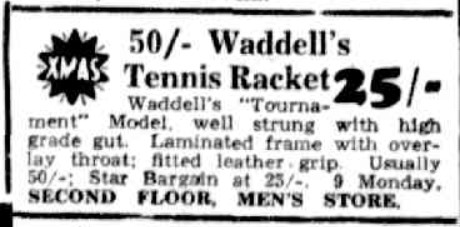
Waddell rackets ad.2 Myers

Tennis Heritage Australia Newsletter 2019

Dear Tennis Heritage fans,

The last time we corresponded was prior to our second National Meeting conducted at Albury last year where we met with 1950’s tennis great Rex Hartwig so this newsletter is a bit of a catch up.

2018 was a fun year thanks to this meeting and a Hong Tennis Heritage Trip pictured later in the newsletter.

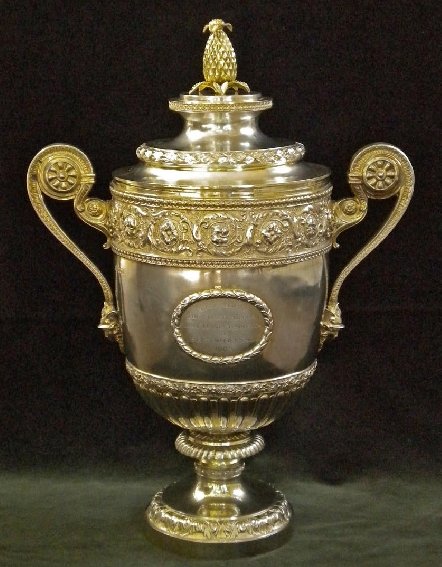
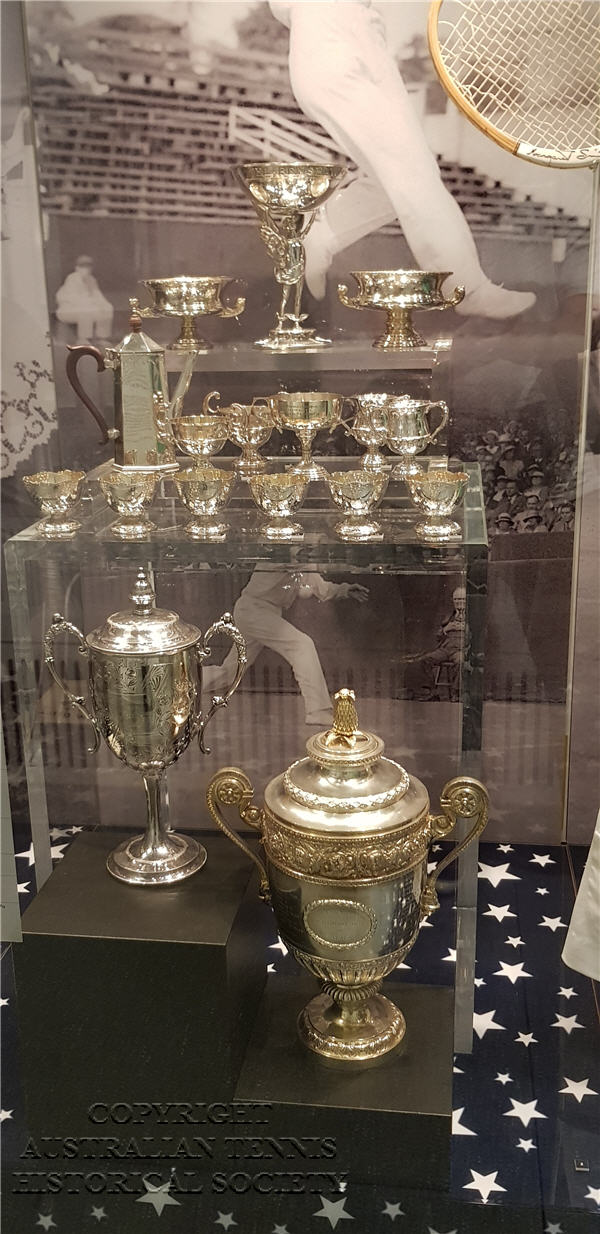
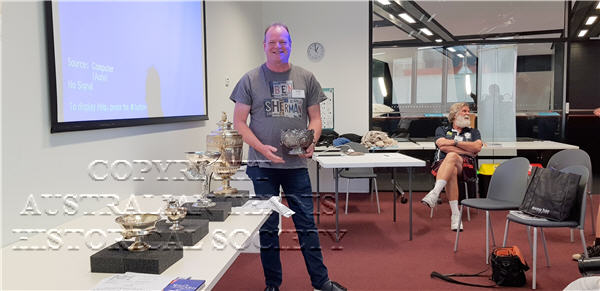
At the Albury event, we had about 20 people attend the meeting to see the fabulous presentation of the (long missing) Jack Crawford trophies which were in fact thought to have been melted down. Thankfully not.  One of these was the original Australasian trophy donated by Slazenger UK back in 1905 for the men’s singles championship.  Remarkably, it looks exactly like the gold trophy we now see being presented at Wimbledon.  As an aside, you will often find early 60’s photos of the winners being presented a silver trophy but the committee thought the gold one looked better on TV.

The Australasian trophy 1905 until being retired by Jack Crawford for winning 193,32 & 33.
It was replaced by the current Norman Brookes Challenge Cup.

The wonderful trophies owned by Jack Crawford were saved by a jeweller family in Sydney and donated to the museum.

They include Australian Championships, Wimbledon and Davis Cup  trophies.  Tom, above also brought the Jack Crawford junior championship trophy he won outright in the mid 20’s) It was great to see them all together.

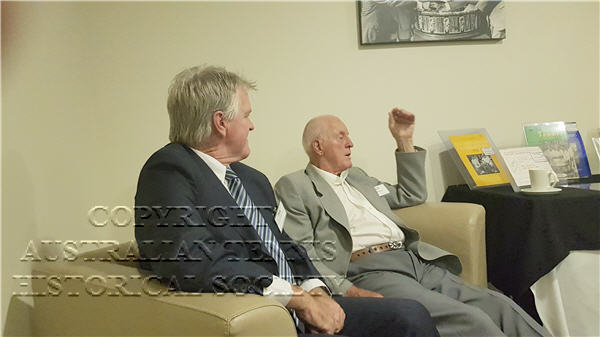
Below is Rex Hartwig being interviewed by organiser and Albury Coach Phil Shanahan at our dinner, ( a huge thanks to Phil and the Margaret Court Tennis Academy, Albury).
Rex played around the globe for Australia in the 1950’s including Davis Cup. He was runner up in the 1954 Australian and US singles and won 4 Major Doubles Titles including the Australian, Wimbledon and US tournaments.

20180428_212621

20180428_140541

They also have a wonderful Margaret Court collection, although much of her major collection is on display around the Melbourne Park, Margaret Court arena.
Margaret and Rex both grew up and learned their tennis in the Albury region.

20180428_145300

We also enjoyed presentations about the Alexander Patent Tennis Racket Co. by family relative Peter Dowling, which dominated the local racquet making scene from 1923 through to the 1950’s and a great review of a new tennis book, The PROS by Peter Underwood which follows the careers of some of the early overseas and Australian players who moved from amateurs into the pro scene to develop a well paid career.

20180428_142609

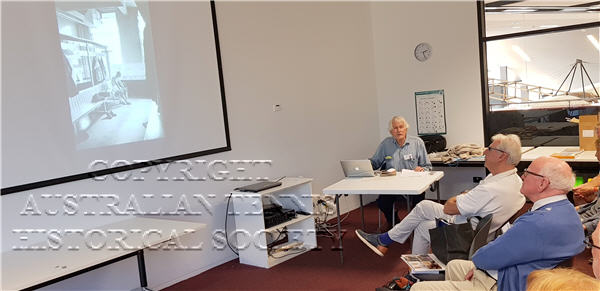
A slide show from Peter about the Pros.

This 2019 year  also marks the start of an Australian celebration of the Rod Laver 50th anniversary of his 1969 proper Grand Slam win achieved in the OPEN ERA.

It has been great to see Rod received the accolades at the majors he has attended so far which will conclude with the US Open.

Congratulations to Rod on what was his second Grand Slam and of course to Margaret who next year celebrates her 1970’s Grand Slam victories. Hopefully Margaret will receive the same accolades and respect for her sporting achievements without the gay marriage debate being the ongoing argument…..Not sure this will go smoothly despite my hopes for some peace. Tennis Australia needs to take a strong lead on this.

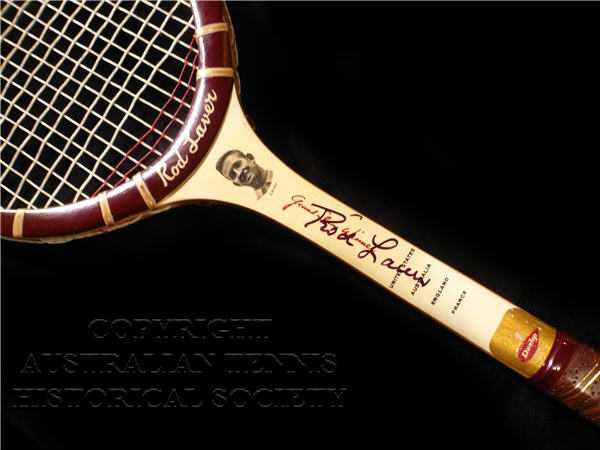
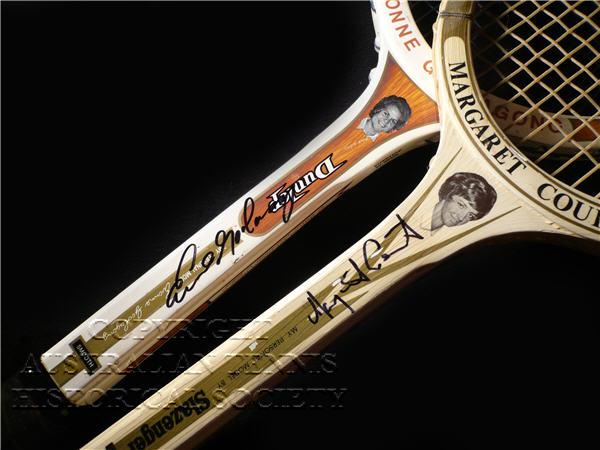
Rod Laver signed racquet

A very nice Japanese made Dunlop Rod Laver Grand Slam tribute model.

signature tennis racquets evonne margaret (8) USE

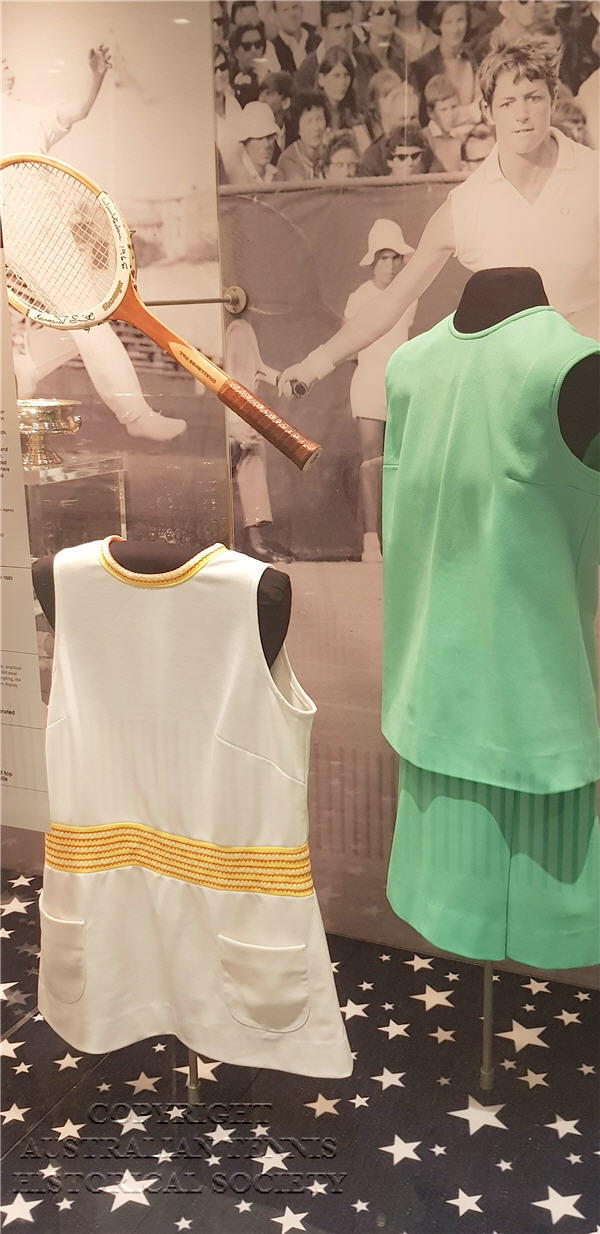
A couple of other mid 70’s Championship winning models used by Evonne and Margaret.

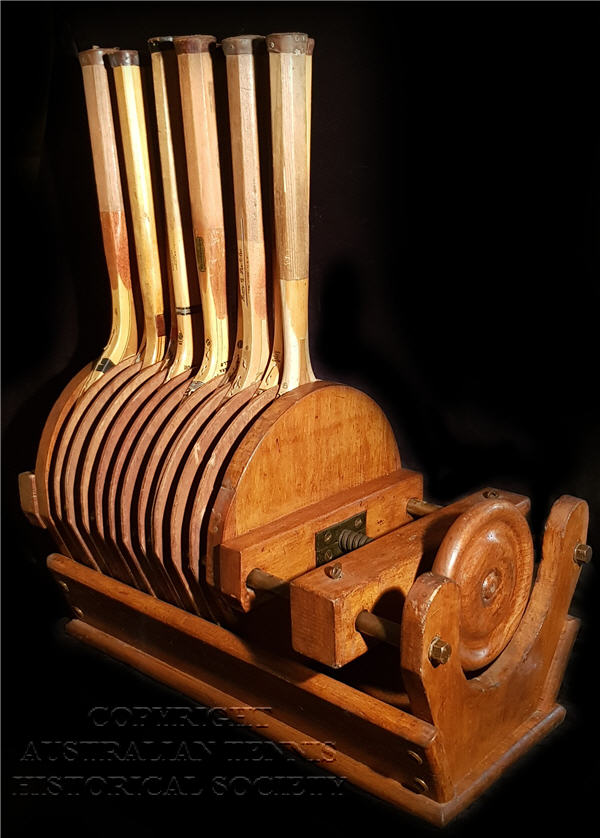
Moving along to some other interesting collectibles found over the last 18 months we have a likley French (unbranded multi press).
Not many of these exist in Australia so you need to allow a large freight bill……they do make amazing displays though.

12 racquet multi press.2

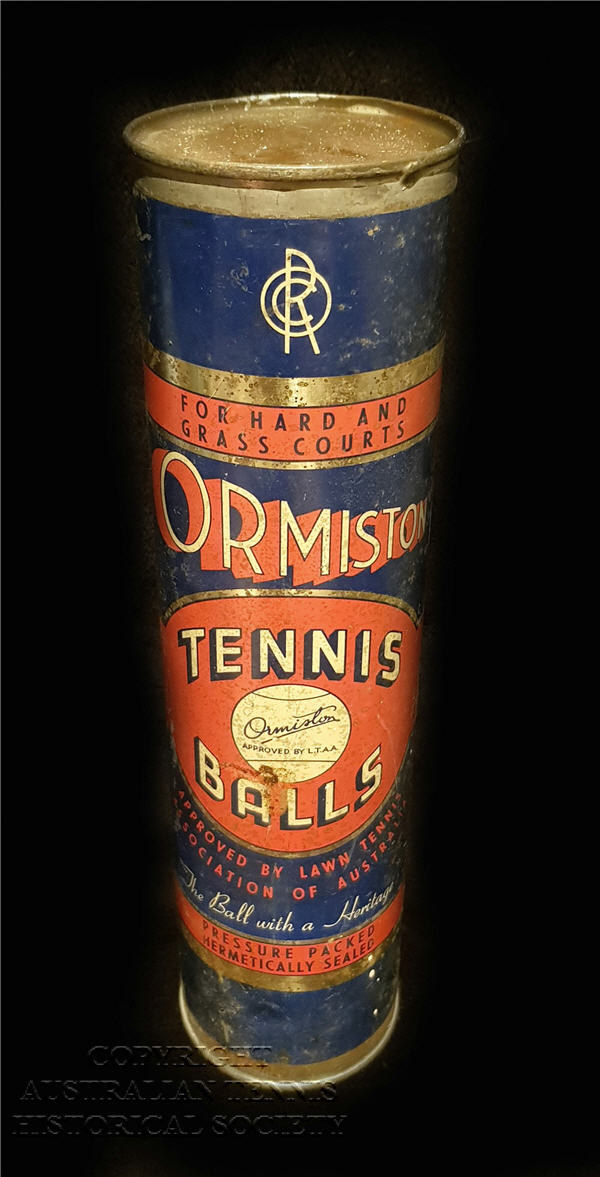
At a local antique centre we found this unopened mid 1930’s can of Ormiston Rubber Tennis Balls. They will remain unopened to protect the value plus there is a picture on the side at any rate.

ormiston tennis ball can (2)

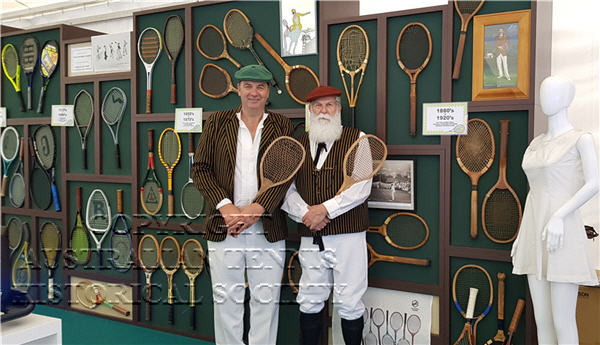
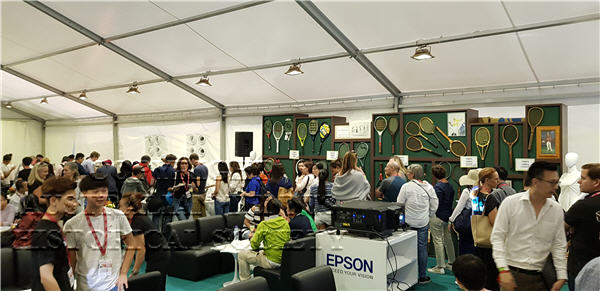
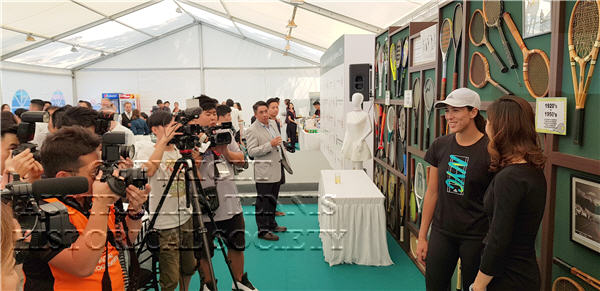
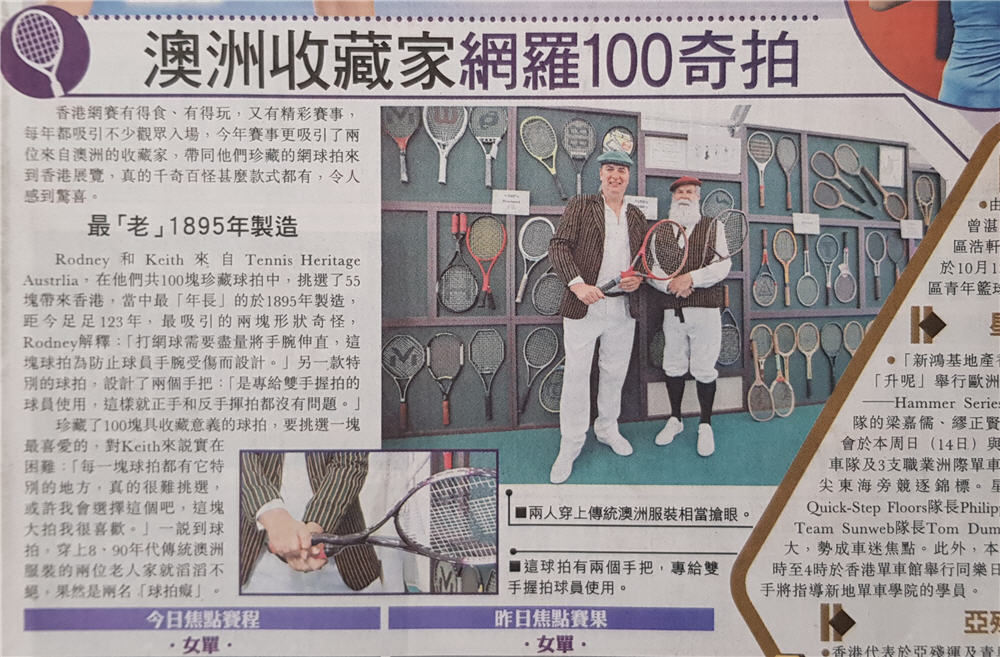
In October 2018, Keith and I were invited to the Hong Kong WTA Open Tournament to display a small part of our collection. This was a lot of fun and follows from our 2013 experience at the Beijing, China Open for their 10th anniversary.

The display frames were built by the organisers so we really only had to mount our racquets.  We were very well looked after and attended the player welcome dinner and had a few players pop in for media shots. Overall we must have seen close to a 1000 people….

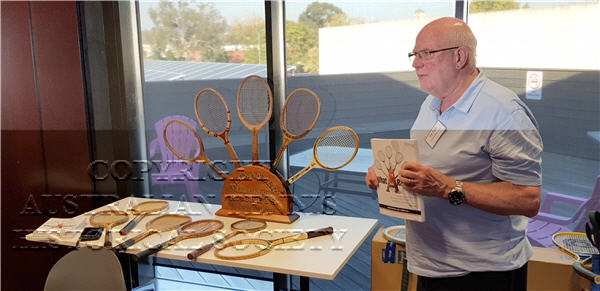
As you can see we take the time to dress up and “show and tell” the history to those who come up to say hi……so we manned the stand from 10am to 9pm….. We even made the local papers!!!!!

Hong Kong trip 2018

20181012_193601

20181008_122036

20181012_154809

20181012_144243

Ok well happy collecting.  If anyone has any questions regarding the history of the game in Australia or elsewhere please sing out.

We do follow up alot on Facebook…….

Cheers for now Rod

Spider Web

Spider Web Sport Products introduced tennis racquets into the range of archery and  hockey equipment in the early to mid 1930’s to take advantage of the games rapidly growing popularity.  Spider Web’s owner William Respini was a cabinet maker by trade and the factory was located at 133 Wells Place, South Melbourne, or as it was then known, City South.  His son John advises, that he recalls William had to buy some racquets being made at the time and steam them apart to learn how they had been constructed so he could copy them.

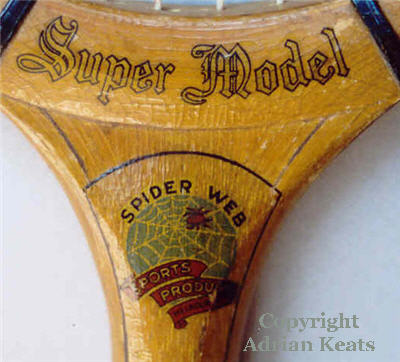
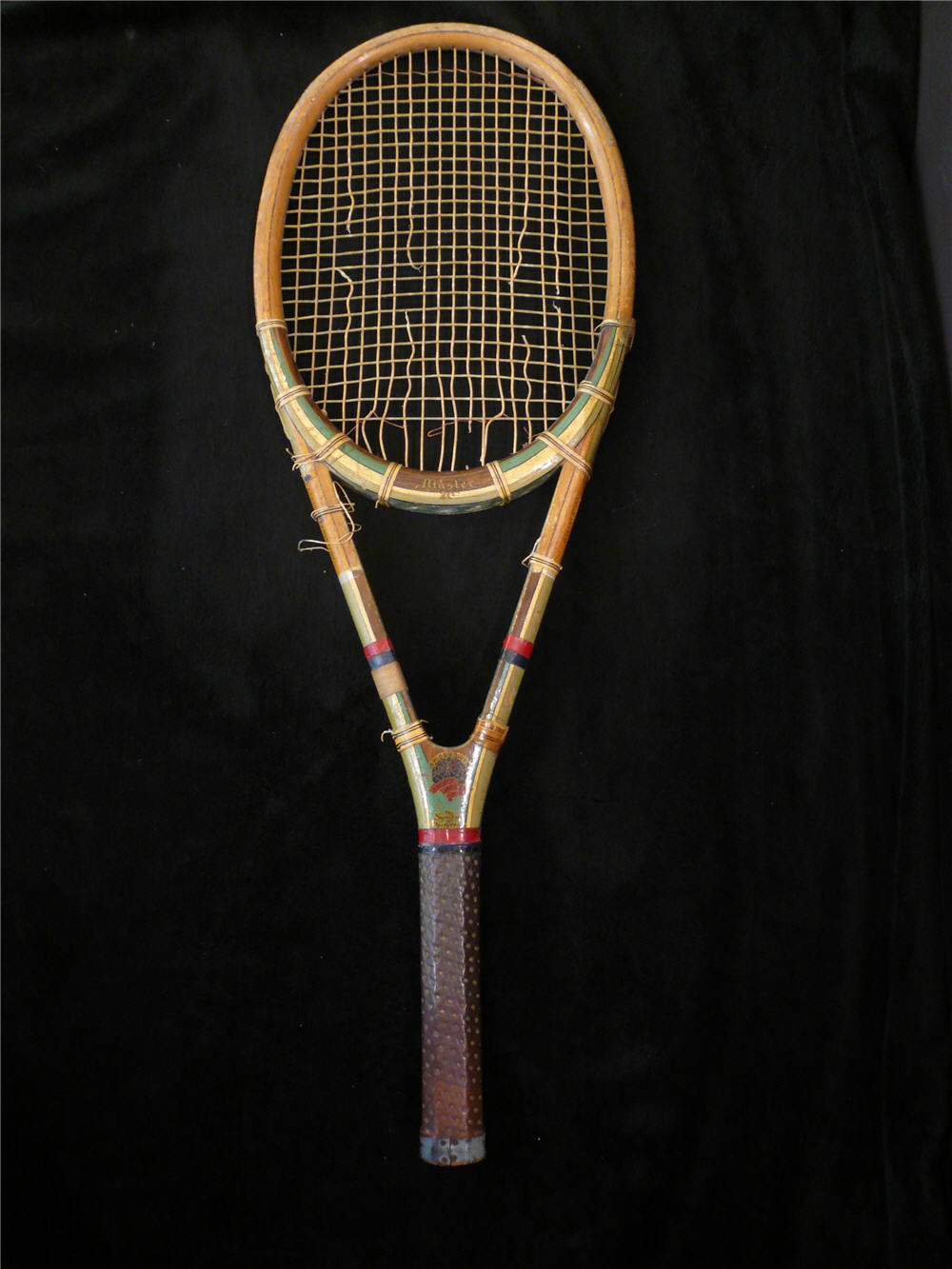
Given the trading Cartel of Spalding, Slazenger, Dunlop and Alexander,  as a boutique maker creating a distribution channel would have been very difficult.  Under the cartel and their Australian Racquet Manufacturers Association ARMA all of the branded 5 Star models were priced the same in all retail stores to prevent price cutting wars. On the only known example of a Spider Web racquet, you will see a cheeky reference to the cartel and one-upmanship where the number 6 appears in a star on the handle.

To differentiate, Spider Web also imported a model from Spain, we believe, called the Speedbat which was used by H.W. Austin who made the tri shaft Hazell Streamline famous. Perhaps the designer Donisthorpe also had a hand in the design of the Speedbat but to be sure it was far in advance design wise and towards the current shapes than any other racquet seen from the 1930’s.  We finally uncovered an example in 2023 donated to Kooyong via a former president.  What a gem!!

In South Yarra, the large retail store Maples in Victoria and Tasmania carried the Spider Web racquets for at least 4 years as evidenced by newspaper advertising, however with the onset of war all racquet makers couldn’t source the Ash timber and much of the production capacity was diverted to the war effort.

Myer Melbourne may also have been a retailer and in those days, and arguably nothing has changed today,  retailers had the power and basically told the manufacturers what they would pay for a product and even took settlement discounts when none were offered.

William was also selling direct to a number of tennis centre owners. who by comparison to manufacturing were looking very successful as more and more people played tennis, so he decided to diversify into tennis court management which involved building courts with lights. He also had a hairdressing/ tobacconist business.  The tennis enterprise, in these pre television times (1938-1955), was a huge success being open to midnight 6 days a week with no play on Sundays. On weekends people would wait all afternoon and get maybe 2 sets and pay sixpence a set. Frank Sedgman played an exhibition match at the Merri Creek centre and Nancye Wynn Bolton played a season.

Due to high demand he then took on a partner in about 1938 or 1939 to build an additional two courts which were also lit.
His partner was George Cochrane, one of the first professional coaches in Melbourne.

In the mid 60’s William bought out George Cochrane’s share and once again had sole ownership of the centre.

The accounting books for the tennis centre show that purchases were made from Spider Web Sports to the tennis centre from the late 30’s and into the early ‘40s.

We thank John for his recollections and hope to add more information as we find it.

The racquet photos come courtesy of Adrian Keats, Australian Racquet Collector. Click here for Adrian’s website

Spider Web racquet 2

Spider Web racquet 3

P1550459

P1550488-002

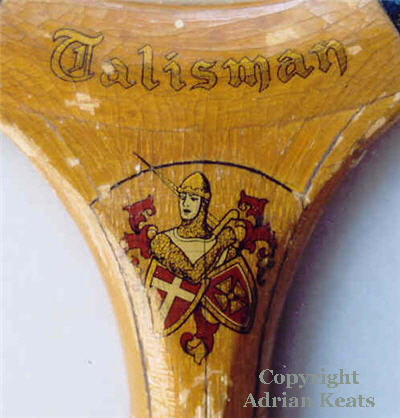
The Spider Web Sport “Talisman”. Looking very much like a Hedley racquet
the workmanship and decorative finishing look great. Note the 6 star decal
to combat the 5 star branding of the major manufacturers under the ARMA banner, representing the
best quality racquets.

Donisthorpe Speed Bat 1936 ad Mary

jul 1936 SPIDER WEB SPEED BAT MARY

Spider Web MSD Court Master Model (19)aaaa Spider Web MSD Court Master Model (4)aaa

Arthur B Carvosso Earliest Australian Winner Overseas

In the early 1890′s an ex student of Brisbane Grammar was reported in Scottish literature playing for Edinburgh University and achieving some pretty good results.

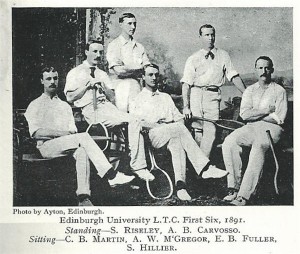
This was Arthur B Carvosso who was a student from 1876 to 1881 which corresponds with a new tennis set arriving with  new English head master Reginald Roe. After completing his BA in Sydney he returned to the school as a science teacher from 1884 to 1888. He decided to further he career by becoming a doctor and so headed for Edinburgh University to gain this qualification. Newspaper articles show that he was regarded as an excellent player prior to leaving and when attending EU quickly adopted tennis as his main pursuit joining the University Team and the famous Whiteside TC.  In his first year 1890 he was in the University second team but by 1891 had been promoted to the front rank.

DR A.B Carvosso

Courtesy Brisbane Grammar School

1891 qld player AB Carvosso2

In a stellar year, Arthur entered and won the Open Singles of the Scottish Tennis Championships (but lost in the Challenge round against the defending champion), followed by the South of Scotland Championships a feat he repeated in 1892 along with the North of Scotland championships and Universities of Edinburgh championships.

As such, we cannot record any earlier “major” tournament win overseas by an Australian. Dr. Wilberforce Eaves was only just commencing his tournament journey and played his first Wimbledon in 1892 and was probably the most prominent Australian expat during this era.  Carvosso, was reported to have a very strong forehand and deadly overhead smash.

In 1893, Arthur was a team member of the successful Whiteside TC in the all of England inter-club championships played in London which was a highly regarded event containing many of the top rank players.

Having qualified, Arthur returned to Australia in 1894 and was an active community doctor and parent on the Brisbane Grammar School Old Boys Association committee for many years.

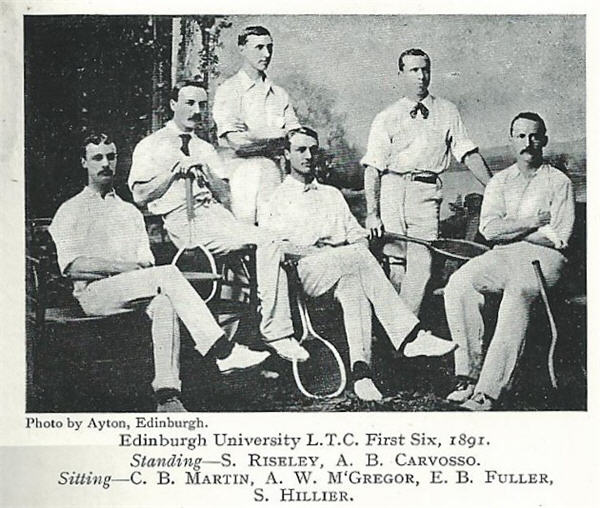
As an historian half the fun is locating information and in this case we contacted Brisbane Grammar School, who kindly supplied the photo and some excellent pics came from a very rare book called Apsects of Scottish Lawn Tennis in which a mention of an Australian was made in the text accompanying the team photo. Edinburgh University had little information and the Wimbledon Museum as able to find some valuable snippets. The most significant project was to find some Carvosso relatives here in Australia. With such a distinctive name  within a couple of phone calls I found a granddaughter who put me in touch with other family members. The hope to find old trophies and photos was dashed when we learnt that many of the silver trophies were melted to produce a silver tray in return for a debt arising from Arthur attending Edinburgh.

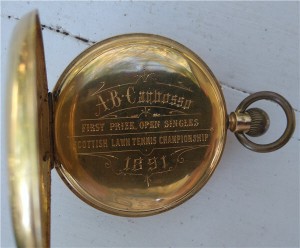
Luckily however we did receive this fantastic photo of the only surviving 1891 trophy, courtesy of the Carvosso family.

DSC_0413

Tennis Heritage Australia 2016 year to date

Hi Tennis History lovers,

Another fascinating year with a few historical dots joined together.

In the first book ever written about the sport, “Lawn Tennis in Australasia” by the Referee aka Robert Kidston he partially tells of John O’Hara Wood’s story relating to the first tennis games being played in Australia, frustratingly without going in to any detail. John James O’Hara Wood was the father of Australian Tennis Champions Arthur and Pat. We discovered this year that he grew up in Queensland and attended the Brisbane Grammar School. Around this time, in 1876, a new headmaster named Reginald Roe, arrived from England complete with a new lawn tennis set which was quickly adopted as a school activity and with other influential adults by the end of the year the Brisbane Lawn Tennis Club was formed. Consequently, we now believe we can close the loop on the story mentioned in Kidston’s book.

Delving into the Brisbane Grammar School for the above story was not the only lead we had to follow. In the early 1890’s another ex student was reported in Scottish literature playing for Edinburgh University and achieving some pretty good results.

This was Arthur B Carvosso who was a student at Brisbane Grammar from 1876 to 1881 which corresponds with the new tennis set arriving. After completing his BA in Sydney he returned to the school as a science teacher from 1884 to 1888. He decided to further he career by becoming a doctor and so headed for Edinburgh University to gain this qualification. Newspaper articles show that he was regarded as an excellent player prior to leaving and when attending EU quickly adopted tennis as his main pursuit joining the University Team and the famous Whiteside TC.  In his first year 1890 he was in the University second team but by 1891 had been promoted to the front rank.

Courtesy Brisbane Grammar School
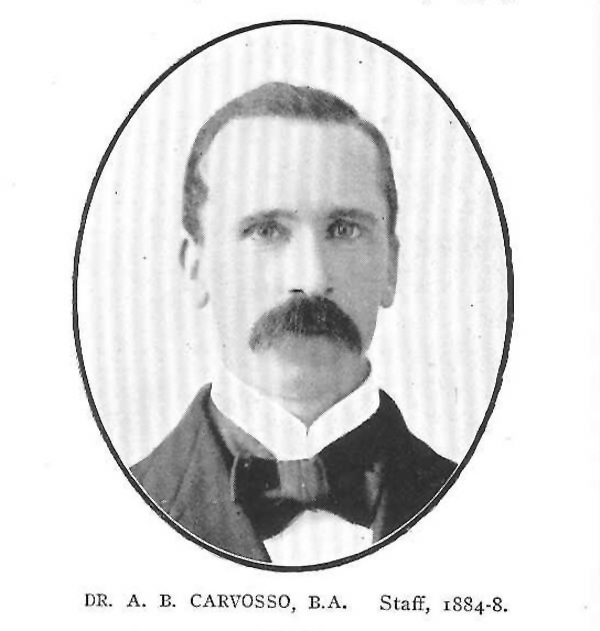
 

DR A.B Carvosso

An article by a former Brisbane Grammar student recollecting the early tennis days

Daily Mercury 22nd June 1937
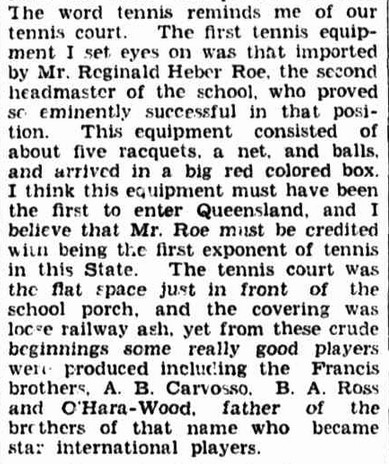
1937 student recount Brisbane Grammar

Courtesy of the Wimbledon Museum this original Wingfield set with the red box supports the Reginald Roe, Brisbane Grammar news article above.
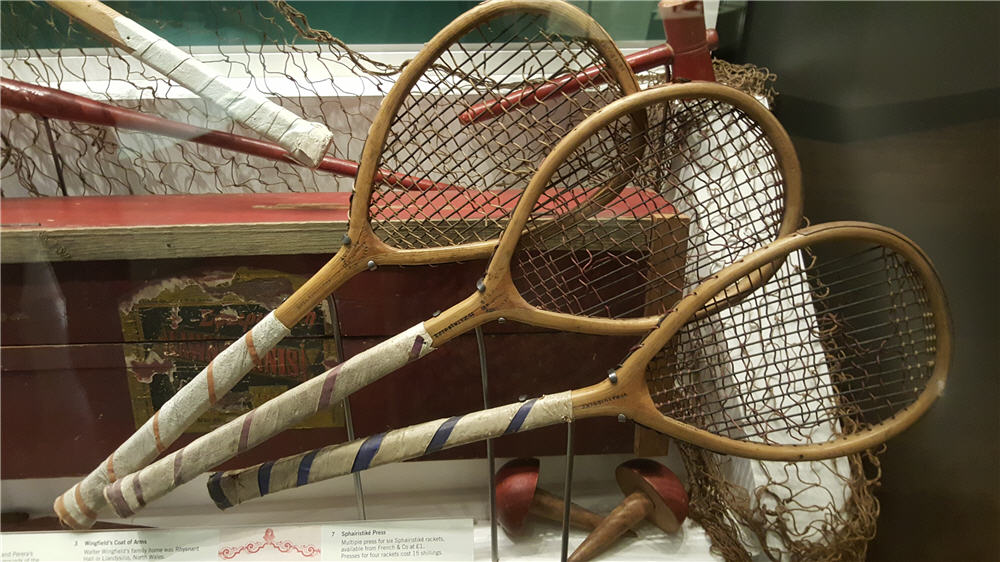
wimbledon visit 2016 (12)


In a stellar year, Arthur entered and won the Open Singles of the Scottish Tennis Championships (but lost in the Challenge round against the defending champion), followed by the South of Scotland Championships a feat he repeated in 1892 along with the North of Scotland championships and Universities of Edinburgh championships.
1891 qld player AB Carvosso2

As such, we cannot record any earlier “major” tournament win overseas by an Australian. Dr. Wilberforce Eaves was only just commencing his tournament journey and played his first Wimbledon in 1892 and was probably the most prominent Australian expat during this era.  Carvosso, was reported to have a very strong forehand and deadly overhead smash.

In 1893, Arthur was a team member of the successful Whiteside TC in the all of England inter-club championships played in London which was a highly regarded event containing many of the top rank players.

Having qualified, Arthur returned to Australia in 1894 and was an active community doctor and parent on the Brisbane Grammar School Old Boys Association committee for many years.

As an historian half the fun is locating information and in this case we contacted Brisbane Grammar School, who kindly supplied the photo and some excellent pics came from a very rare book called Apsects of Scottish Lawn Tennis in which a mention of an Australian was made in the text accompanying the team photo. Edinburgh University had little information and the Wimbledon Museum as able to find some valuable snippets. The most significant project was to find some Carvosso relatives here in Australia. With such a distinctive name  within a couple of phone calls I found a granddaughter who put me in touch with other family members. The hope to find old trophies and photos was dashed when we learnt that many of the silver trophies were melted to produce a silver tray in return for a debt arising from Arthur attending Edinburgh.

Luckily however we did receive this fantastic photo of the only surviving 1891 trophy, courtesy of the Carvosso family.
DSC_0413


Also from Queensland came another interesting story.

This arose due to the discovery of a 1930’s slotted shaft tennis racquet called the Bluebird and the name E.T.Rowe who was a prominent South Australian Champion tennis player. Perhaps the racquet had an Oliver connection?

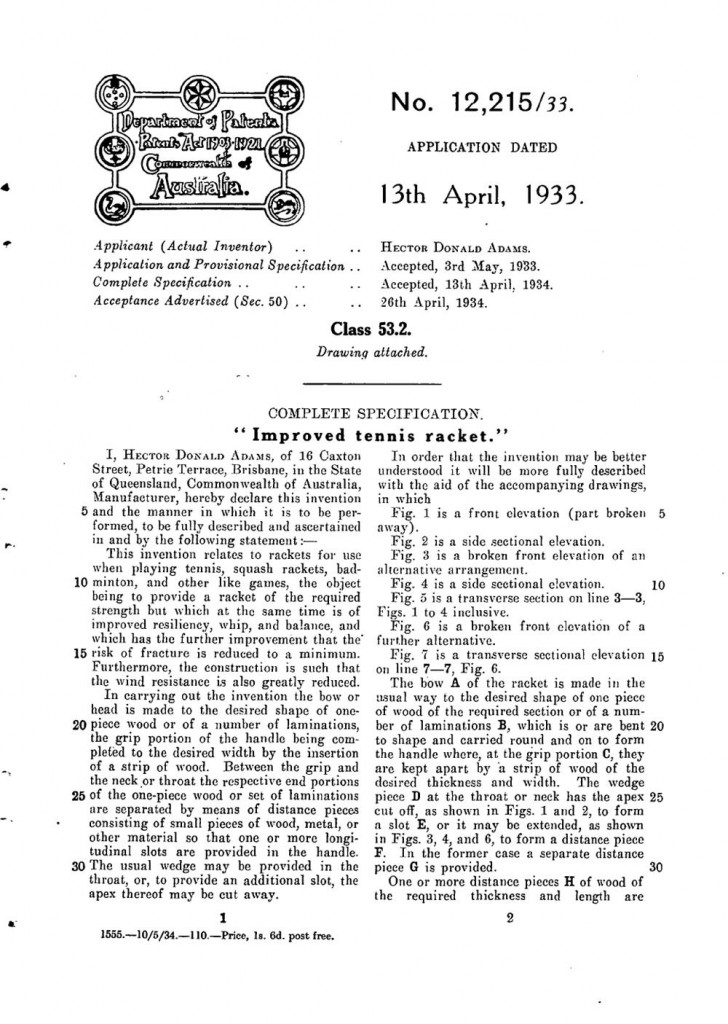
Newspaper searches relating to slotted shaft racquets revealed that this new design was invented by a Queenslander Hector Donald Adams and patented here in Australia in 1933/1934 patent number 12215/33.
slotted handle patent 19331

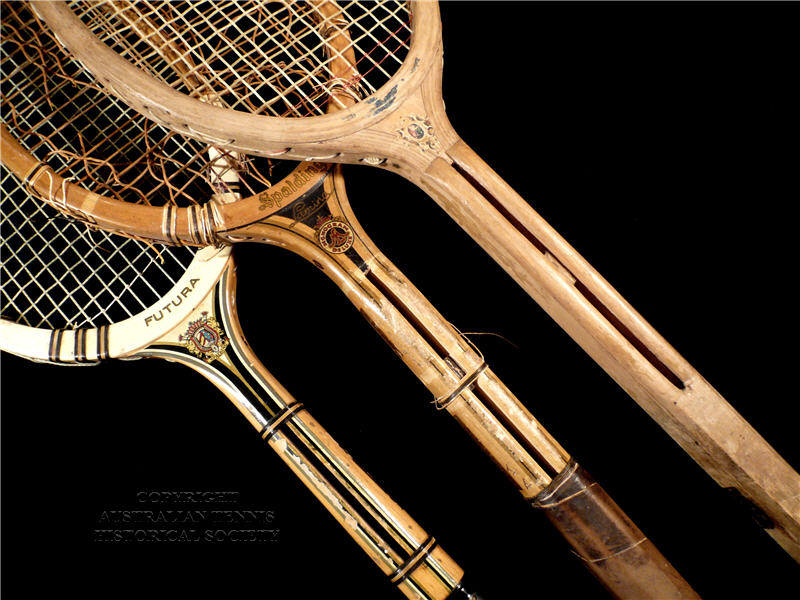
The model in Rowe’s possession is likely to have been a production model made in Queensland because in 1935 Spalding Australia and then worldwide adopted the patent for its up-market range of slotted shaft racquets.

slotted throat spalding bluebird (8)


Bluebird design at top with Spalding production models including the patent.
slotted throat spalding bluebird (4)


Another nice uncovering this year was this mid 1930’s Spalding retail store display stand used to hold 5 racquets.
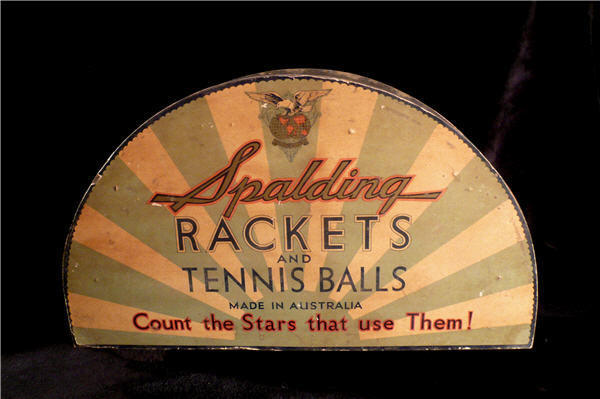
spalding racquet display (5)

At the start of the year Tennis Heritage Australia (Victoria) was invited to place a small display in the hugely popular MCC Sports Museum during the Australian Open. Hopefully we can develop an arrangement with the MCC to place a much larger display which can be promoted to the Australian Open visitors who park their cars nearby and stroll past.

wimbledon visit 2016 (4)

On a recent overseas grand tour it was a delight to catch up with the Wimbledon Museum, Manfred Schotten, Chris and Sue Elks, Robert Holland, Siegfried Kuebler, Urs Peter Inderbitzen and others with a love of tennis.

Catching up with the Wimbledon Museum team pre the 2016 tournament was a highlight. Thanks for the hospitality and tour.

Needless to say I saw some wonderful pieces of history that I doubt exist in Australia at all.
UK visit 2016 (198)

Great to meet Siegfried Kuebler from Kuebler Rackets and also author of our collecting bible, the BOOK OF TENNIS RACKETS. We have been emailing information to and fro for over 10 years so to meet Sigi in person was great. A special thanks to Urs Peter Inderbitzen for taking care of me in Switzerland and driving over to Germany to see Sigi.

sigi 2016