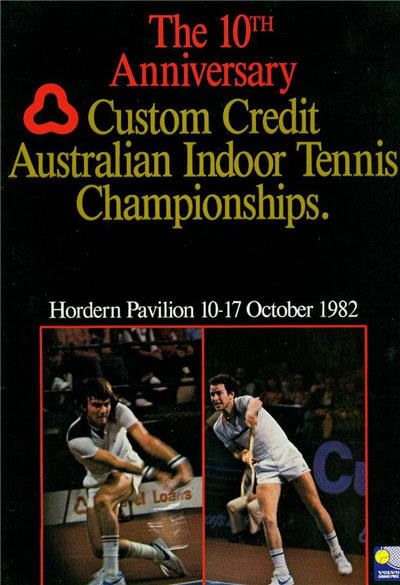
Custom Credit Indoor

While the Australian Championships held at Kooyong was the premier event in Australia, the tournament through the 1970’s and 1980’s was losing its way within the global community. Reasons for this was the timing of the event being late December early January which led to many top players deciding to skip from attending.

Apart from the threat of losing grand slam status, unless the tournament changed which it did with the merging of woman’s and men’s events into the one two week event and the move to Rod Laver arena (Flinders Park), this situation presented an opportunity to create a tournament which did attract the best players to Australia.

Enter, astute tennis player, promoter John Newcombe.

John was totally in tune with the tennis public and was the brainchild behind the creation of a new Indoor Tournament which began in 1973, the Custom Credit Indoor Tennis Championships.

Typically, John took the financial risk before the sponsors were signed by underwriting the event and John himself would use his connections to encourage sponsorship and negotiate the television rights. Custom Credit’s support and that of the LTAA enabled the prize money to be maintained at levels attractive to players.  John had been appearing in Custom Credit commercials and had suggested the idea to extend their involvement with tennis by sponsoring the indoor event and a junior development program which they did. Further initial support came from the Prime Minister Malcolm Fraser who with speech writer Alan Jones, broadcaster and handy tennis player himself,  organised for an additional $60,000.

Not short on a few mates,  John played in the first tournament with Rosewall, Roche and Laver as major drawcards.

Undoubtedly, the presence of Laver at this inaugural contest was a delight for the Australian public.  At 35, Rod had not been back to Australia for three years and so his presence became a point of great interest.

From a field of 32 players split into two sections, the groups consisted of many of the top Davis Cup players from a variety of Nations. The tournament comprised Mens Singles and Doubles.

As far as a first tournament went,  even with prize money of US$50,000 up for grabs, public awareness and interest was sporadic.  At one match between Kim Warwick and Jas Singh there were fewer than 100 spectators, yet the grand final was one of the most spectacular games featuring Rod Laver and his (boss/promoter) John Newcombe.

To get to the finals Rod had to beat Ken Rosewall which he did in three sets 6-4, 3-6, 8-6 and John beat Phil Dent 6-3, 6-4 in what was an all Australian affair. Despite their ages, these champions also won the Davis Cup in 1973 forming one of the oldest teams ever assembled.  The only conceivable explanation apart from keeping fit, was their exceptional experience in pro tennis events and play over the years which was tennis at the highest level.

The grand final was a top notch thriller with Rod beating Newk in five sets 3-6, 7-5, 6-3, 3-6, 6-4. Together they went onto to win the doubles and this set the path for Rod Laver to play in his last Davis Cup Final with Newk in the USA where they won 5-0.

After a precarious start, the following year audiences of 3000 flocked to the event and television coverage ensured that it was a commercial success.

When Custom Credit pulled out in 1984, John immediately turned to McDonalds for support of the programme at Junior and tournament levels.

Throughout this period the efforts of Newcombe and sponsor support helped impress upon the need for strong junior programmes and events which would attract the top name players.

1973

Australia Rod Laver defeated Australia John Newcombe 3–6, 7–5, 6–3, 3–6, 6–4

Australia Rod Laver / Australia John Newcombe defeated Australia Mal Anderson / Australia Ken Rosewall 7–6, 6–2


1974

Australia John Newcombe defeated United States Cliff Richey 6–4, 6–3, 6–4

Australia Ross Case / Australia Geoff Masters defeated Australia John Newcombe / Australia Tony Roche 6–4, 6–4


1975

United States Stan Smith defeated United States Robert Lutz 7–6, 6–2

United States Brian Gottfried / Mexico Raúl Ramírez defeated Australia Ross Case / Australia Geoff Masters [8–6]


1976

Australia Geoff Masters defeated United States James Delaney 4–6, 6–3, 7–6, 6–3

Egypt Ismail El Shafei / New Zealand Brian Fairlie defeated Australia Syd Ball / Australia Kim Warwick [9–8]


1977

United States Jimmy Connors defeated Australia Ken Rosewall 7–5, 6–4, 6–2

Australia John Newcombe / Australia Tony Roche defeated Australia Ross Case / Australia Geoff Masters 6–7, 6–3, 6–1


1978

United States Jimmy Connors defeated Australia Geoff Masters 6–0, 6–0, 6–4

Australia John Newcombe / Australia Tony Roche defeated Australia Mark Edmondson / Australia John Marks 6–4, 6–3


1979

United States Vitas Gerulaitis defeated Argentina Guillermo Vilas 4–6, 6–3, 6–1, 7–6

Australia Rod Frawley / Paraguay Francisco González defeated India Vijay Amritraj / United States Pat Du Pré by Default


1980

United States John McEnroe defeated United States Vitas Gerulaitis 6–3, 6–4

United States Peter Fleming / United States John McEnroe defeated United States Tim Gullikson / South Africa Johan Kriek 4–6, 6–1, 6–2


1981

United States John McEnroe defeated United States Roscoe Tanner 6–4, 7–5, 6–2

United States Peter Fleming / United States John McEnroe defeated United States Sherwood Stewart / United States Ferdi Taygan 6–7, 7–6, 6–1


1982

United States John McEnroe defeated United States Gene Mayer 6–4, 6–1, 6–4

United States John McEnroe / United States Peter Rennert defeated United States Steve Denton / Australia Mark Edmondson 6–3, 7–6


1983

United States John McEnroe defeated France Henri Leconte 6–1, 6–4, 7–5

Australia Mark Edmondson / United States Sherwood Stewart defeated United States John McEnroe / United States Peter Rennert 6–2, 6–4


1984

Sweden Anders Järryd defeated Czechoslovakia Ivan Lendl 6–3, 6–2, 6–4

Sweden Anders Järryd / Sweden Hans Simonsson defeated Australia Mark Edmondson / United States Sherwood Stewart 6–4, 6–4


1985

Czechoslovakia Ivan Lendl defeated France Henri Leconte 6–4, 6–4, 7–6

Australia John Fitzgerald / Sweden Anders Järryd defeated Australia Mark Edmondson / Australia Kim Warwick 6–3, 6–2


1986

West Germany Boris Becker defeated Czechoslovakia Ivan Lendl 3–6, 7–6, 6–2, 6–0

West Germany Boris Becker / Australia John Fitzgerald defeated Australia Peter McNamara / Australia Paul McNamee 6–4, 7–6


1987

Czechoslovakia Ivan Lendl defeated Australia Pat Cash 6–4, 6–2, 6–4

Australia Darren Cahill / Australia Mark Kratzmann defeated West Germany Boris Becker / United States Robert Seguso 6–3, 6–2


1988

Socialist Federal Republic of Yugoslavia Slobodan Živojinović defeated United States Richard Matuszewski 7–6, 6–3, 6–4

Australia Darren Cahill / Australia John Fitzgerald defeated United States Martin Davis / Australia Brad Drewett 6–3, 6-2


1989

Czechoslovakia Ivan Lendl defeated Sweden Lars-Anders Wahlgren 6–2, 6–2, 6–1

United States David Pate / United States Scott Warner defeated Australia Darren Cahill / Australia Mark Kratzmann 6–3, 6–7, 7–5


1990

West Germany Boris Becker defeated Sweden Stefan Edberg 7–6, 6–4, 6–4

Australia Broderick Dyke / Sweden Peter Lundgren defeated Sweden Stefan Edberg / Czechoslovakia Ivan Lendl 6–2, 7–6


1991

Sweden Stefan Edberg defeated United States Brad Gilbert 6–2, 6–2, 6–2

United States Jim Grabb / United States Richey Reneberg defeated United States Luke Jensen / Australia Laurie Warder 6–2, 6–3


1992

Croatia Goran Ivanišević defeated Sweden Stefan Edberg 6–4, 6–2, 6–4

United States Patrick McEnroe / United States Jonathan Stark defeated United States Jim Grabb / United States Richey Reneberg 7–6, 6–3


1993

Peru Jaime Yzaga defeated Czech Republic Petr Korda 6–4, 4–6, 7–6 (7–4), 7–6 (9–7)

United States Patrick McEnroe / United States Richey Reneberg defeated Germany Alexander Mronz / Germany Lars Rehmann 6–3, 7–5


1994

Netherlands Richard Krajicek defeated Germany Boris Becker 7–6 (7–5), 7–6 (9–7), 2–6, 6–3

Netherlands Jacco Eltingh / Netherlands Paul Haarhuis defeated Zimbabwe Byron Black / United States Jonathan Stark 6–4, 7–6


Wilberforce Eaves

Within the history of tennis in Australia many simply start with Norman Brookes remarkable win at the All England Championships and Davis cup wins in 1907 or his earlier visit in 1905 to attempt to win the Davis Cup for the first time.

However, Australian tennis history can claim some connection with a remarkable man named Wilberforce Eaves, who not only had an excellent tennis record in the UK where he lived much of his middle aged life, but he also traveled extensively to Australia and had a significant impact on the way tennis developed and was played here in the years leading up to Norman Brookes successes in the UK. In fact he had a huge impact on the playing style of Norman Brookes.

Born on 10th December 1867, in St Kilda, Melbourne, the same suburb as Brookes and Randolph Lycett, he was 10 years older than Brookes.  His parents William and Eunice and older brother William returned to England c1881 where they appeared on the British census. Wilberforce was then 14.  No doubt, English schooling and local social activities introduced him to tennis  and after becoming a Doctor at University College and a member of the Royal College of Physicians, must have been quite proficient since he played in his first Wimbledon tournament aged 23 in 1890, where he was beaten in the second round.

Tragically, also, in 1890 his father William senior, passed away and his mother then decided to return to Australia with both boys, given her family had grown up in the Colac region of Victoria.

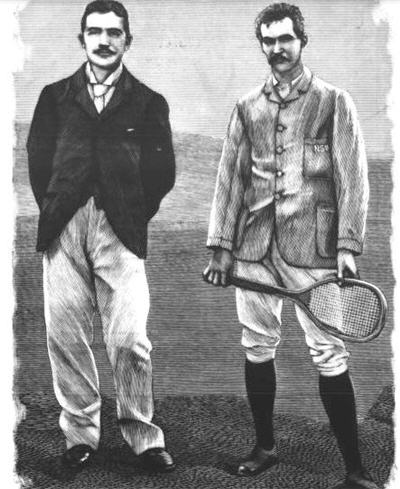
Eaves & Webb 30-05- 1891 Syd Mail

This wonderful line drawing of Eaves (left) and Dudley Webb comes from the Sydney Mail 1891.

Over the course of 1891, he played competitive tennis here with some of Australia’s best players who competed in the Intercolonial competitions for Victoria. His inclusion in the Victorian intercolonial side raised eyebrows since he just arrived from the UK but when it was confirmed that he was born in Victoria he was immediately accepted. A significant win for Wilberforce was the Buckley Cup which also carried with it the title of the Victorian Grass Championships and he also won the doubles with Alexander Chomley.  In the keenly challenged NSW championships, he partnered with Victorian champion Ben Green to win the doubles and in the much anticipated singles final defeated (ex Victorian) Dudley Webb, breaking what was Webbs only loss between 1890-1894. He really had proved himself against the best of the locals.

In what was his first influence on the game here, Wilberforce had demonstrated the need for the server in doubles to come to the net and volley instead of playing a baseline game. This method of play with increased focus on effective volleying became a prevalent difference between Victorian and NSW styles and probably helped our overall doubles tactics and techniques which has been a hall mark of Australian doubles tennis since.  He also suggested that if the states could conduct their tournaments in close date proximity then some of the best English “cracks” may well make the trip out, but not for one tournament.  He also stressed that proper covered lawn tennis should always be used, as in NSW not the uncovered ball as used in Victoria, where he stated the game could hardly be called tennis.

After 6 months his desire to get back to England and Europe where tennis championships were flourishing, saw him enter the 1892 Queens covered tournament doubles event as a member of the renowned Hyde Park Tennis club. From there he entered Wimbledon for a second time where he improved his performance to a 3rd round defeat.

During the next ten years, his feats in tennis were quite extraordinary.  However, because he never won a “major event” and  typically the runners up tend to disappear unfairly into obscurity very little has been published about him.  There is little doubt that many Australian tennis fans will know little of or anything about Wilberforce Eaves.

To summarise his results:

Queens Covered court tournament

Singles runnerup 1895, Winner 1896,1897,1899  Doubles winner with C.H.Martin 1895, 1896

Irish Championships

Won 1897

Scottish Championships

Won 1901

Wales Championships

Won 1895

Wimbledon Championships

1895 Runner up in 5 sets to Wilfred Baddeley (who’s book Lawn Tennis contains these results) There was only a few key points in this match 4-6, 2-6, 8-6, 6-2, 6-3 and he was leading two sets to love.

1896 All comers final, defeated by Mahony who was the eventual champion.

1897 All comers final beaten (retired) against Reg. Doherty the eventual winner over Mahony and major champion of the UK for many years with his brother Laurie Doherty.

1899 and 1905 Winner of the All England Plate which was a secondary singles event open to those players who were defeated in rounds one and two. As such this may well be considered the first major Wimbledon tournament won by an Australian. The event was conducted up into the 1970’s at least for both men and women.

French Covered Court Championships

Over in France Wilberforce won the French Covered Court Championships in 1892, 1893 and 1894 and like many of the other top rank English players traveled the area widely and no doubt this early experience gained by Wilberforce rubbed off on players like NZ Anthony Wilding, Norman Brookes and other leading Australian players who traveled extensively throughout Europe/UK in the early 1900’s.

US Open Championships

In 1897,  Wilberforce represented the UK in a four man tour to the United States in an attempt to encourage greater visitations of players between the two nations which, if you like, was a key forerunner to the decision to commence the Davis Cup in 1900.

While there, he entered the US Open Championships and in an unfortunate repeat performance at Wimbledon 1895, lost the grand final in 5 sets 4-6, 8-6,6-3,2-6,6-2 to Robert Wrenn.

W.D.EAVES from lawn tennis h &a by wallis myers p317    VAILE WVEAVES UK pic of him playing

In 1902, Wilberforce returned to Australia to visit family and participate in the local tennis scene. Once again he joined the Victorian Intercolonial team and it was here that he most likely met the up and coming Norman Brookes along with Rodney Heath, Alf Dunlop and others. Norman Brookes had won the Victorian Championships and the big test for Australian tennis,  compared to overseas standards, was going to be the NSW championships. It was here that Brookes and Eaves met in the final and Eaves won in a tight come back match of 5 sets (again)  12-14, 4-6, 6-4, 6-4, 6-3.  It was a turning point in Brookes career because he realised that he needed to change his game from being somewhat erratic basher at the baseline to one, like Eaves who used a net rushing strategy, or as Brookes summed up ” It’s time I used my head as well as my racquet”.

In addition, this was also the point at which Wilberforce educated the Australians and Brookes in particular, in the art of the American Twist serve which Brookes was later to become renowned as the “wizard” given the amazing spin and placement he could get on the served tennis ball. It would also appear that Eaves did coach Brookes and no doubt had an impact on his preparedness for the 1905-1907 contests.

Back in the UK, Wilberforce clearly, and in hindsight, accurately marked the Australians as future contenders in the Davis Cup and at Wimbledon in a tennis newspaper article published in 1903.   In fact the first Davis Cup team to play in the UK may well have been Wilberforce and Brookes because Eaves had invited Brookes over to create an Australian team in 1904.  This didn’t eventuate, but in 1905  Brookes did travel to the UK and with Wilding (NZ) and Dunlop (not Eaves) playing in the Davis Cup Australasia Team.  Eaves along with B.Murphy and H.A.Parker did however made up the Australasian International team, combined with the Davis Cup team members to  play in the first of a series of test matches against an English side.

The friendship with the Australians and in particular Brookes can only be measured by the fact that Wilberforce was the best man at Norman Brookes wedding and frequently visited Australia to catch up with his mates. In 1913, Wilberforce even played with Brookes in the Australian Open Golf Championships at Royal Melbourne.

Throughout the early 1900’s Wilberforce continued to play at major tournaments. In the year that Brookes won his first Wimbledon title (1907) Wilberforce lost in the semi finals to English champion A.W.Gore 9-7, 7-5, 6-2 who then went onto play and lose to Brookes in the final (no challenge round). So with a few games either way Wilberforce may well have been playing his mate Norman for the title adding to the three previous times when he was ever so close.  His last Wimbledon was in 1911 which meant that he was a regular there from 1890-1911, a sensational period remembering he was 40 in 1907 and 10 years older than Brookes.

While often considered an Englishmen in much of the tennis literature owing to the fact that he returned there to study and did spend much of his life living there, this was commonplace in those days for many Australians with English backgrounds to do. He represented the UK on various occasions including his bronze medal in the 1908 Olympics and the UK representative teams he joined that played in South Africa, Ireland and the USA. He was also intending to play for the UK in a side planned for a (non-eventual) trip to Australia, such was his desire to bring top players out to build player exposure to the top ranks.

Yet, he also joined teams under the Australasian banner at tournaments in the UK and Europe.

What a great tennis career and given his birth here and local family and sporting connections,  his deeds to assist Australian tennis players when he played here and when abroad permits this writer to claim Wilberforce Eaves to be a very important and largely unrecognised person within Australia’s Tennis history.

He died in England in 1920 aged 52.

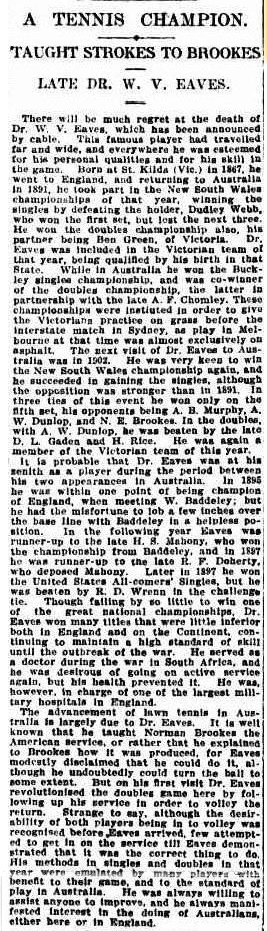
The top photo comes from the Wallis Myer book Tennis at Home & Abroad, the second from P.A.Vailes Modern Lawn Tennis and the article from the Sydney Morning Herald Feb 20th 1920.

W EAVES DIES feb 20 1920 obituray

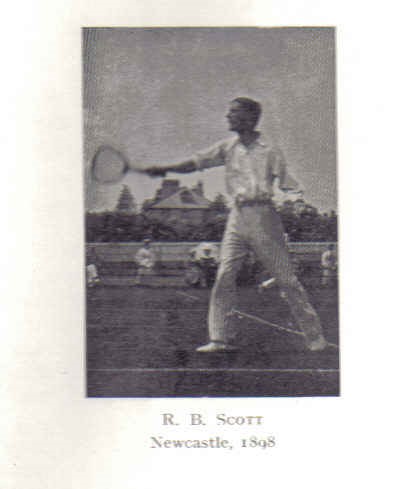
Also of interest within this era, is another Australian playing a part in the development of tennis. I include it here because Robert Scott, while not a champion per se, did play at around the same time as Eaves and would no doubt have played against each other at some tournaments in the 1890’s.

This article was kindly researched by tennis book collector/ historian, Keith Jenkins,who uncovered the story due to the mention of an Australian player named Robert B Scott in a book and from there considerable research effort by Keith brought the following story to light.

Robert was born at Geelong, Victoria, Australia, 11 Feb. 1868. He was the son of Thomas King Scott of Kenley, Melbourne, and Emmeline Fincham Baldock. The family owned properties in  Buninyong, Victoria, and Walgett, NSW and on the death of Thomas the probate on his will was some 20,369 pounds, which was a huge amount in those days.

Being obviously from a very wealthy family, Robert was educated at Toorak and Scotch Colleges, attending Scotch from 1876 -1882 [where he also won the Bible Prize in 1880] and then attended Ormond College, Melbourne.

In relation to tennis, Robert was already playing at a top grade in Australia before leaving for the UK.  An R.B.Scott was playing doubles with his brother in an Adelaide tournament at aged 15 and is recorded as playing for Victoria in 1890 in an early Interstate carnival event. While not quite in the top rank, he was a competent all round player.

As many Australian lads did, he traveled back to the UK to further his education and entered Trinity College at Cambridge on 7 Oct. 1892. He graduated with a BA in 1895, but he is not listed among the students who took honours. He is also listed as having studied at Edinburgh.

robert baldock scott

At Trinity, there is an early record of an R.B.Scott playing for the second tennis team (Grasshoppers) in 1893 and then going on to play for the first team in the Varsity match. In the 1893 Varsity Match he beat W.V.Doherty 6-4, 7-5, beat J.W.Steadman 6-2, 4-6, 10-8 and lost to A.D.Kelly 2-6,4-6.

He also won two out of three doubles rubbers playing with H.V.Fedden (also of Trinity). They lost to Doherty and Kelly 13-15, 1-6, beat Hinde and Steadman 6-2,6-4 and beat Pritchard and Mears 6-2, 6-4.

While at Cambridge University, R.B. Scott was Hon. Secretary of CULTC (Lawn tennis club)  and in 1894-1895 R.B.Scott was President of CULTC. In the following years, R.F. Doherty was President in (1896) and H.L. Doherty in 1897. Both of these gents after the Renshaw brothers, virtually dominated tennis for a decade and in the process with a huge public following stimulated ongoing interest and growth in Wimbledon and the first Davis Cup matches.

As to Robert Scott’s involvement with these champions, in reading the book, “Fifty Years of Lawn Tennis in Scotland” edited by A.Wallace MacGregor in 1927, Scott is first mentioned as an “Australian player” in the 1892 Scottish Championships. Then MacGregor tells of the 1895 Champs where he played with “RB Scott, then President of Cambridge, one of the finest doubles players I have ever been privileged to partner, and one to whose enthusiasm and advice at Cambridge much of the Dohertys’ devotion to the game was ascribable”.

Apart from a huge enthusiasm for the game, Robert played at Wimbledon (at the same time as Eaves) in 1894 losing in the second round to Harry Barlow 11-9, 4-6, 2-6, 4-6. In 1896 he lost in the first round against top player Charles Allen 6-3, 0-6, 4-6, 6-1, 4-6 and then teamed with H.L.Doherty to lose in the 3rd round against the Allen brothers 6-3, 1-6, 1-6, 2-6.

In the Scottish Championships of 1897, Scott and his partner, R. Hamblin Smith were beaten by the Doherty brothers in the semi finals, losing 1-6, 13-15, 0-6.

Robert was licensed by the Presbyterian Church of Edinburgh May 1899; assistant at St Cuthbert’s, Edinburgh, North Berwick, and to garrison chaplain, Edinburgh; ordained minister at Humbie, 18 Jan. 1905 and was transferred to Rhu 9 Nov. 1922 and died there 7 May 1924.

To assist relatives in contacting us with additional information,  our Robert Scott married on 31 Aug.1904 an Alexa Evelyn MacLeod, born 21 Feb. 1872 died 18 Mar. 1937.  She was the daughter of Rev. John Macleod, D.D., minister of Govan.

Children of RB & Alexa – Mary Alexa Baldock, born 12 Aug. 1908; Celia Helen Baldock, born 9 July 1911.

We only have the one photo and any new information would be gratefully received.

References:

“Fifty Years of Lawn Tennis in Scotland” edited by A.Wallace MacGregor. 1927 [photo]

Cambridge University Lawn Tennis Club – contact Nick Jenkins [no relation!!]

Jonathan Smith – Trinity College Archivist, Cambridge University.

Scottish Ministers – Humbie p.377

“The MacLeods-the Genealogy of a Clan” by Rev. Dr. Donald MacLeod/Alick Morrison 1970, p.33

“Wimbledon Championships” by John Barrett

“50 Years of Wimbledon” by A. Wallis Myers p.37, p.92.

Dr. Jim Mitchell – Scotch College Archivist

The Argus – 4 Jan. 1868 [List of old colonists]

The Argus – 17 Dec. 1880 [Scotch College prize]

The Argus – 27 Aug. 1889 [TK Scott – death notice]

The Sydney Morning Herald 27 Aug. 1889 [TK Scott – death notice]

The Argus – 8 Nov. 1889 [TK Scott – probate]

The Argus – 3 April 1890 [Ormond College concert]

Sydney Morning Herald – 13 Nov. 1890. [Intercolonial Tennis results]

The Argus – 2 Sept. 1904 [Wedding notice]

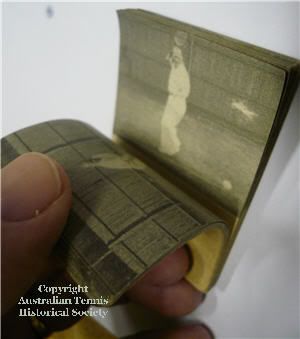
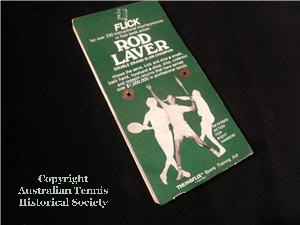
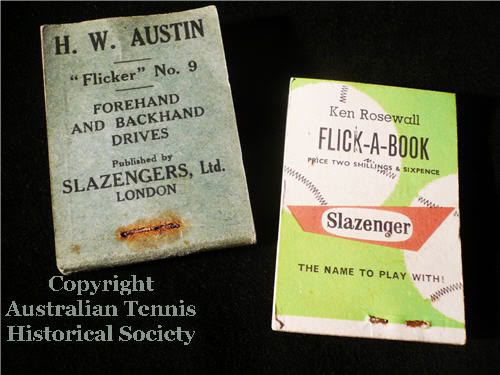
Tennis Action Flicker Books

Pre videos and DVD’s the way to show a tennis shot in motion was via Flicker books. By grabbing the corner and flicking quickly through 40-50 images you will see how the players moved to the ball, set their back swings, follow through and finish.

These go back to the mid 1920’s and were popular up to the late 1960’s, early 1970’s.

The first shot is of P.O’Hara Wood c mid 1940’s, maybe earlier.  The books were made in such a way that you could see 4 different strokes, 2 shots top and 2 shots bottom.

The Rod Laver book is a chuckle because being a left hander and to suit a majority right hand playing audience, they reversed all the photos to show Rod as a right hander. Published by Thumbflix it shows a serve,smash, forehand and backhand (c maybe early 70’s).

The lower shot shows the 1930’s version from Slazenger UK for Bunny Austin (Davis Cup player) and our own Ken Rosewall.

Australian Top 10 Rankings Men and Women

Australian Tennis player rankings were publicised from 1930 through to the mid 1970’s when the International Tennis Ranking system was largely adopted as the measure.

The information below does provide some interesting reading in relation to the longevity of some players and highlights some famous married couples like Jack Crawford and Marjorie (ne Cox) both number 1 in 1934 and Harry Hopman and wife Nell (ne Hall). Please do note that Thelma Coyne Long was not married to Colin Long but his brother, a point which is often confused.

Australian Rankings sometimes went past the top ten and so we have included a full list to expose the excellent performances of these individuals.

Thanks to Andrew Tasiopoulos for supplying the data.

Another note is that in the 1938/39 season officials decided to change the criteria of the men’s rankings to include only tournaments both overseas and in Australia which involved 5 set matches, as a measure of strength and stamina.  This meant that some 3 set match results from key metro or interstate tournaments etc. were not counted and hence some of the players moved positions (with not all the public agreeing with this change in precedent).

1930 (To 31st March 1930)
Mens
1. EF Moon
2. J Crawford
3. H Hopman
4. J Willard
5. RO Cummings
6. C Sproule
7. J Clemenger
8. R Dunlop
9. RE Schlesinger
10. AH Hassett
11. JB Hawkes
12. DP Turnbull

Womens
1. D Akhurst
=2. RR Harper
=2. L Bickerton
4. M Molesworth
5. E Hood
6. M Cox
7. K Le Messurier
8. G Toyne
9. U Valkenburg
10. D Dingle

1931 (To 31st March 1931)
Mens
1. J Crawford
2. H Hopman
3. EF Moon
4. RO Cummings
5. DP Turnbull
6. J Clemenger
7. J Willard
8. A Willard
9. C Sproule
=10. RE Schlesinger
=10. R Dunlop
=10. C Donohue

Womens
1. M Cox Crawford
2. C Buttsworth
3. M Molesworth
4. RR Harper
5. L Bickerton
6. U Valkenburg
7. F Hoddle Wrigley
8. K Le Messurier
9. J Hartigan
10. V Westacott

1932 (To 31st March 1932)
Mens
1. J Crawford
2. H Hopman
3. C Sproule
4. A Willard
5. VB McGrath
6. DP Turnbull
=7. EF Moon
=7. RO Cummings
9. AH Hassett
10. R Dunlop

Women
1. C Buttsworth
2. J Hartigan
3. M Molesworth
4. K Le Messurier
5. F Hoddle Wrigley
6. V Westacott
7. M Cox Crawford
8. GB Toyne
9. N Hall
10. D Weston

1933 (To 31st March 1933)
Mens
1. J Crawford
2. H Hopman
3. VB McGrath
4. A Quist
5. C Sproule
6. DP Turnbull
7. EF Moon
8. AH Hassett
9. BG Tonkin
10. LA Schwartz

Women
1. J Hartigan
2. M Cox Crawford
=3. C Buttsworth
=3. M Molesworth
=3. V Westacott
6. N Hall
7. K Le Messurier
8. F Hoddle Wrigley
9. N Lewis
10. U Valkenburg

1934 (To 31st March 1934)
Mens
1. J Crawford
2. VB McGrath
3. A Quist
4. H Hopman
5. DP Turnbull
6. EF Moon
7. EW Ewin
=8. R Dunlop
=8. WB Walker
10. LA Schwartz

Women
1. J Hartigan
2. M Molesworth
3. L Bickerton
4. V Westacott
5. N Chitty
6. N Hall Hopman
7. D Weston
8. F Hoddle Wrigley
9. K Le Messurier
10. A Hattersley

1935 (To 31st March 1935)
Mens
1. J Crawford
=2. VB McGrath
=2. A Quist
4. DP Turnbull
5. J Bromwich
6. H Hopman
7. EF Moon
8. D Thompson
9. RO Cummings
=10. AA Kay
=10. BG Tonkin

Women
1. J Hartigan
2. V Westacott
3. N Hall Hopman
4. L Bickerton
5. T Coyne
6. A Hattersley
7. N Chitty
8. M Blick
9. J Walters
=10. D Stevenson
=10. N Wynne

1936 (To 31st March 1936)
Mens
1. A Quist
2. J Crawford
=3. J Bromwich
=3. H Hopman
5. VB McGrath
6. AA Kay
7. DP Turnbull
=8. LA Schwartz
=8. EF Moon
10. D Thompson

Women
=1. J Hartigan
=1. T Coyne
3. N Wynne
4. N Hall Hopman
5. M Blick
=6. A Hattersley
=6. D Stevenson
8. G Griffiths
9. D Weston
=10. M Hardcastle
=10. J Wilson

1937 (To 31st March 1937)
Mens
1. A Quist
2. VB McGrath
=3. J Crawford
=3. J Bromwich
5. H Hopman
6. LA Schwartz
7. DP Turnbull
8. D Thompson
9. JE Harper
10. AA Kay

Women
1. N Wynne
2. T Coyne
3. V Westacott
4. J Hartigan
5. N Hall Hopman
6. D Stevenson
7. M Wilson
8. M Blick
9. V Selwin
10. M Hardcastle

1938 (To 31st March 1938)
Mens
1. J Bromwich
2. A Quist
3. VB McGrath
4. J Crawford
5. LA Schwartz
6. H Hopman
7. DP Turnbull
8. M Newcombe
9. R Ewin
=10. JE Harper
=10. GA Holland

Women
1. N Wynne
2. T Coyne
=3. N Hall Hopman
=3. D Stevenson
5. J Hartigan
6. M Hardcastle
7. V Westacott
8. M Blick
9. G O’Halloran
10. V Selwin

1939 (To 31st March 1939)
Mens
1. J Bromwich
2. A Quist
3. H Hopman
4. J Crawford
5. J Gilchrist
6. VB McGrath
7. LA Schwartz
8. L Brodie
9. CF Long
10. DP Turnbull

Women
1. V Westacott
2. N Hall Hopman
3. N Wynne
4. T Coyne
5. J Hartigan
6. D Stevenson
7. A Hattersley
8. M Blick
9. M Hardcastle
10. S Berryman

1940 (To 31st March 1940)
Mens
1. J Bromwich
2. A Quist
3. J Crawford
4. H Hopman
5. VB McGrath
6. M Newcombe
7. J Gilchrist
8. L Brodie
9. CF Long
=10. W Sidwell
=10. D Pails

Women
1. N Wynne Bolton
2. T Coyne Long
3. N Hall Hopman
4. J Hartigan
5. J Menzies
6. M Hardcastle
7. Mrs Waddell
8. A Hattersley
9. D Maugher
10. G O’Halloran

1945/ 1946
Mens
1. John Bromwich
2. Dinny Pails
3. Adrian Quist
4. Geoff E Brown
5. Harry Hopman
6. Lionel Brodie
7. Jack Crawford
8. Jack Harper
9. Robert R Barnes
=10 Max Bonner
=10 Frank Sedgman

Womens
1. Nancye Wynne Bolton
2. Nell Hall Hopman
3. Thelma Coyne Long
4. Joyce Fitch
5. Constance Coate Wilson
6. Alison Hattersley
7. Patricia Jones
8. Marie Toomey
9. Joan Hartigan
10. Dulcie Whittaker

1946/ 1947
Mens
1. John Bromwich
2. Dinny Pails
3. Geoff E Brown
4. Adrian Quist
5. Colin Long
6. Bill Sidwell
7. Lionel Brodie
8. Jack Crawford
9. James Gilchrist
10. Frank Sedgman

Womens
1. Nancye Wynne Bolton
2. Thelma Coyne Long
3. Nell Hall Hopman
4. Joyce Fitch
5. Patricia Jones
6. Constance Coate Wilson
7. Marie Toomey
8. Sadie Berryman Newcombe
9. Dulcie Whittaker
10. Mary Bevis

1947/ 1948
Mens
1. Adrian Quist
2. John Bromwich
3. Bill Sidwell
4. Frank Sedgman
5. Geoff E Brown
6. Colin Long
7. James Gilchrist
8. Jack Dart
9. Lionel Brodie
10. Robert McCarthy

Womens
1. Nancye Wynne Bolton
2. Thelma Coyne Long
3. Mary Bevis
4. Marie Toomey
5. Dulcie Whittaker
6. Esme Ashford
7. Nell Hall Hopman
8. Sadie Berryman Newcombe
9. Dorothy Jenkins
10. Patricia Jones

1948/ 1949 (issued April 11, 1949)
Mens
1. John Bromwich
2. Bill Sidwell
3. Frank Sedgman
4. Geoff E Brown
5. Adrian Quist
6. George Worthington
7. Colin Long
8. Robert McCarthy
9. Ken McGregor
10. Tom Warhurst

Womens
1. Nancye Wynne Bolton
2. Thelma Coyne Long
3. Joyce Fitch
4. Mary Bevis Hawton
5. Marie Toomey
6. Dulcie Whittaker Young
7. Esme Ashford
8. Alison Burton Baker
9. Nell Hall Hopman
10. Sadie Berryman Newcombe

1949/ 1950
Mens
1. Frank Sedgman
2. John Bromwich
3. Bill Sidwell
4. Geoff E Brown
5. Ken McGregor
6. Adrian Quist
7. George Worthington
8. Colin Long
9. Mervyn Rose
10. Don Candy

Womens
1. Nancye Wynne Bolton
2. Joyce Fitch
3. Thelma Coyne Long
4. Mary Bevis Hawton
5. Esme Ashford
6. Nell Hall Hopman
7. Sadie Berryman Newcombe
8. Marie Toomey Martin
9. Clare Proctor
10. Gwen Thiele

1950/ 1951
Mens
1. Frank Sedgman
2. Ken McGregor
3. Mervyn Rose
4. John Bromwich
5. Bill Sidwell
6. George Worthington
7. Adrian Quist
8. Don Candy
9. Brian Strofeldt
10. James Gilchrist

Womens
1. Nancye Wynne Bolton
2. Joyce Fitch
3. Esme Ashford
4. Mary Bevis Hawton
5. Beryl Penrose
6. Nell Hall Hopman
7. Sadie Berryman Newcombe
8. Dorn Fogarty
9. Pam Southcombe
10. Beverley Mance

1951/ 1952 (Released June 16 1952)
Mens
1. Frank Sedgman
2. Ken McGregor
3. Mervyn Rose
4. Ian Ayre
5. Ken Rosewall
6. Lewis Hoad
7. Rex Hartwig
8. Don Candy
9. Geoff E Brown
10. George Worthington

Womens
1. Thelma Coyne Long
2. Nancye Wynne Bolton
3. Helen Angwin
4. Mary Bevis Hawton
5. Beryl Penrose
6. Esme Ashford
7. Clare Proctor
8. Pam Southcombe
9. Beverly Mance Rae
10. Gwen Thiele

1952/ 1953 (Released on May 18 1953)
Mens
1. Mervyn Rose
2. Ken Rosewall
3. Lewis Hoad
4. Ian Ayre
5. Rex Hartwig
6. John Bromwich
7. Clive Wilderspin
8. Geoff E Brown
9. Bill Sidwell
10. Don Candy

Womens
1. Mary Bevis Hawton
2. Beryl Penrose
3. Dorn Fogarty
4. Helen Angwin
5. Pam Southcombe
6. Loris Nichols
7. Jenny Staley
8. Mary Carter
9. Norma Ellis
10. Gwen Thiele

1953/ 1954 (Issued May 17 1954)
Mens
1. Lewis Hoad
2. Ken Rosewall
3. Mervyn Rose
4. Rex Hartwig
5. George Worthington
6. John Bromwich
7. Clive Wilderspin
8. Ian Ayre
9. Neale Fraser
10. Don Candy

Womens
1. Thelma Coyne Long
2. Jenny Staley
3. Mary Bevis Hawton
4. Beryl Penrose
5. Mary Carter
6. Fay Muller
7. Helen Angwin
8. Norma Ellis
9. Loris Nichols
10. Daphne Seeney

1954/ 1955 (Issued May 16 1955)
Mens
1. Ken Rosewall
2. Lewis Hoad
3. Rex Hartwig
4. Mervyn Rose
5. Neale Fraser
6. Don Candy
7. George Worthington
8. Ashley Cooper
9. Mal Anderson
10. Roy Emerson

Womens
1. Beryl Penrose
2. Thelma Coyne Long
3. Jenny Staley
4. Mary Carter
5. Mary Bevis Hawton
6. Fay Muller
7. Elizabeth Orton
8. Margaret Hellyer
9. Loris Nichols
10. Daphne Seeney

1955/ 1956 (Issued April 16 1956)
Mens
1. Lewis Hoad
2. Ken Rosewall
3. Ashley Cooper
4. Neale Fraser
5. Mervyn Rose
6. Don Candy
7. Mal Anderson
8. Roy Emerson
9. Brian Tobin
=10. Neil Gibson
=10. Warren Woodcock

Womens
1. Mary Carter
2. Mary Bevis Hawton
3. Beryl Penrose
4. Fay Muller
5. Daphne Seeney
6. Loris Nichols
7. Lorraine Coghlan
8. Margaret Hellyer
9. Maureen McCalman
10. Beth Jones

1956/ 1957 (Issued May 20 1956)
Mens
1. Lewis Hoad
2. Ashley Cooper
3. Neale Fraser
4. Mal Anderson
5. Roy Emerson
6. Warren Woodcock
7. Bob Howe
8. Don Candy
9. Bob Mark
=10. Rod Laver
=10. Phillips Moore

Womens
1. Beryl Penrose Collier
2. Lorraine Coghlan
3. Mary Carter Reitano
4. Margaret Hellyer
5. Mary Bevis Hawton
6. Fay Muller Robinson
7. Beth Jones
8. Jenny Staley Hoad
9. Beverley Mance Rae
10. Pat Parmenter

1957/ 1958 Australian Rankings (Issued April 21 1958)

Mens
1. Ashley Cooper
2. Mal Anderson
3. Neale Fraser
4. Mervyn Rose
5. Roy Emerson
6. Robert Howe
7. Bob Mark
8. Rod Laver
9. Warren Woodcock
10. Neil Gibson

Womens
1. Lorraine Coghlan
2. Beryl Penrose Collier
3. Mary Carter Reitano
4. Mary Bevis Hawton
5. Jan Lehane
6. Maureen McCalman
7. Betty Holstein
8. Margot Rayson
9. Pat Parmenter
10. Beth Jones

1958/ 1959 Rankings (Issued April 19 1959)
Mens
1. Neale Fraser
2. Roy Emerson
=3. Rod Laver
=3. Bob Mark
5. Martin Mulligan
6. Ken Fletcher
7. Don Candy
8. Warren Woodcock
9. Bob Howe
10. Bob Hewitt

Womens
1. Mary Carter Reitano
2. Jan Lehane
3. Lorraine Coghlan
4. Mary Bevis Hawton
5. Beverley Mance Rae
6. Thelma Coyne Long
7. Betty Holstein
8. Maureen Pratt
9. Noelene Turner
10. Lesley Turner

1959/ 1960
Mens
1. Neale Fraser
2. Rod Laver
3. Roy Emerson
4. Bob Hewitt
5. Bob Mark
6. Martin Mulligan
7. Ken Fletcher
8. Bob Howe
9. Warren Woodcock
10. Francis Gorman

Womens
1. Jan Lehane
2. Margaret Smith
3. Mary Carter Reitano
4. Lorraine Coghlan Robinson
5. Lesley Turner
6. Beverley Mance Rae
7. Fay Muller Robinson
8. Betty Holstein
9. Margaret Hellyer
10. Madonna Schacht

1960/ 1961 (Issued April 18 1961)

Mens
1. Neale Fraser
2. Rod Laver
3. Roy Emerson
4. Bob Mark
5. Bob Hewitt
6. Fred Stolle
7. Barry Phillips Moore
8. Marty Mulligan
=9. Ken Fletcher
=9. Brian Tobin

Womens
1. Margaret Smith
2. Jan Lehane
3. Lesley Turner
4. Mary Carter Reitano
5. Mary Bevis Hawton
6. Maureen McCalman Pratt
7. Fay Muller Robinson
8. Robyn Ebbern
9. Jill Blackman
10. Madonna Schacht

1961/62 (Issued April 16 1962)

Mens
1. Rod Laver
2. Roy Emerson
3. Neale Fraser
4. Bob Hewitt
5. Fred Stolle
6. Ken Fletcher
7. John Newcombe
8. John Fraser
9. Owen Davidson
=10. Alan Lane
=10. William Coghlan

Womens
1. Margaret Smith
2. Jan Lehane
3. Lesley Turner
4. Mary Carter Reitano
5. Robyn Ebbern
6. Judy Tegart
7. Madonna Schacht
8. Jill Blackman
9. Norma Marsh
10. Fay Muller Robinson

1962/63 (Issued April 24 1963)

Mens
1. Roy Emerson
2. Neale Fraser
3. Ken Fletcher
4. Robert Hewitt
5. Martin Mulligan
6. Fred Stolle
7. John Newcombe
8. John Fraser
9. Anthony Roche
=10. Owen Davidson
=10. Robert Howe

Womens
1. Margaret Smith
2. Lesley Turner
3. Jan Lehane
4. Robyn Ebbern
5. Jill Blackman
6. Madonna Schacht
7. Kay Dening
8. Judy Tegart
9. Carol Newman
10. Joan Gibson

1963/64 (Issued April 20 1964)

Mens
1. Roy Emerson
2. Fred Stolle
3. Martin Mulligan
4. John Newcombe
5. Ken Fletcher
6. Robert Hewitt
7. Neale Fraser
8. Anthony Roche
9. Owen Davidson
=10. Barry Phillips Moore
=10. Warren Jacques

Womens
1. Margaret Smith
2. Lesley Turner
3. Jan Lehane
4. Robyn Ebbern
5. Judy Tegart
6. Madonna Schacht
7. Kay Dening
8. Gail Sherriff
9. Joan Gibson
=10. Kerry Melville
=10. Helen Gourlay

1964/ 1965 Australian Rankings (Issued April 26 1965)

Mens
1. Roy Emerson
2. Fred Stolle
3. John Newcombe
4. Anthony Roche
5. William Bowrey
6. Owen Davidson
7. Barry Phillips Moore
8. John Cottrill
9. William Coghlan
10. Ray Ruffels

Womens
1. Margaret Smith
2. Lesley Turner
3. Robyn Ebbern
4. Judy Tegart
5. Madonna Schacht
6. Gail Sherriff
7. Jill Blackman
8. Joan Gibson
9. Kerry Melville
10. Helen Gourlay

1965/ 1966 Australian Rankings (Issued April 27 1966)

Mens
1. Roy Emerson
2. Fred Stolle
3. John Newcombe
4. Anthony Roche
5. William Bowrey
6. Owen Davidson
7. Ray Ruffels
8. John Cottrill
9. John Cooper
=10. Barry Phillips Moore
=10. William Coghlan

Womens
1. Margaret Smith
2. Lesley Turner
3. Judy Tegart
4. Joan Gibson
5. Gail Sherriff
6. Jan Lehane
7. Madonna Schacht
8. Karen Krantzcke
9. Kerry Melville
10. Elizabeth Fenton

1966/ 1967 Australian Rankings (Issued April 17 1967)

Mens
1. Roy Emerson
2. Anthony Roche
3. John Newcombe
4. William Bowrey
5. Owen Davidson
6. Ray Ruffels
7. Allan Stone
8. Barry Phillips Moore
9. Richard Crealy
10. William Coghlan
11. Warren Jacques
12. Gary Penberthy
13. Colin Stubs
14. John Cottrill
15. Terry Addison
16. Gary Baulch
17. John Cooper
18. Phil Dent
19. Karl Coombes
20. Doug Smith

Womens
1. Lesley Turner
2. Kerry Melville
3. Judy Tegart
4. Karen Krantzcke
5. Gail Sherriff
6. Joan Gibson
7. Lorraine Coghlan Robinson
8. Jan Lehane O’Neill
9. Jill Blackman
10. Elizabeth Fenton
11. Fay Toyne
12. Helen Gourlay
13. A Lexie Kenny
14. Brenda Jenkins
=15. M Jones
=15. Mrs L Nette

1967/ 1968 (Year ending Mar 31,1968)
Mens
1. Bill Bowrey
2. Ray Ruffels
3. Barry Phillips Moore
4. Dick Crealy
5. Allen Stone
6. A John Cooper
7. Terry Addison
8. Ray Keldie
9. Phillip Dent
10. Colin Stubs
11. Rod Brent
12. Neale Fraser
13. Warren F Jacques
14. Will Coghlan
15. John Fraser
16. John Alexander
17. Bob Giltinan
18. Ray Wilson
19. Allan McDonald
20. Ian Fletcher

Womens
1. Judy Tegart
2. Lesley Turner Bowrey
3. Kerry Melville
4. Margaret Smith Court
5. Karen Krantzcke
6. Gail Sherriff
7. Helen Gourlay
8. Lesley Hunt
9. Jill Blackman
=10. Evonne Goolagong
=10. Brenda Jenkins
12. Kerry Harris
13. Elizabeth Fenton
14. Kaye Dening
15. A Lexie Kenny

1968/ 1969 (Year ending Mar 31,1969)
Mens
1. Bill Bowrey
2. Ray Ruffels
3. Dick Crealy
4. John Alexander
5. Phillip Dent
6. Barry Phillips Moore
7. Allen Stone
8. Terry Addison
9. Bob Giltinan
10. Ray Keldie
11. Rod Brent
12. Allan McDonald
13. Peter Doerner
14. Geoff Masters
15. Ross Case

Womens
1. Margaret Smith Court
2. Kerry Melville
=3. Karen Krantzcke
=3. Judy Tegart
5. Gail Sherriff Chanfreau
6. Lesley Turner Bowrey
7. Helen Gourlay
8. Lesley Hunt
9. Kerry Harris
10. Evonne Goolagong
11. Janet Young
12. Wendy Gilchrist
13. A Lexie Kenny
14. Helen Amos
15. Barbara Hawcroft

1969/ 1970  (Year ending Mar 31,1970)
Mens
1. Ray Ruffels
2. Dick Crealy
3. Allen Stone
4. John Alexander
5. Phillip Dent
6. John Cooper
7. Ian Fletcher
8. Barry Phillips Moore
9. Bob Giltinan
10. Geoff Masters
11. Colin Dibley
12. Peter Doerner
13. John Bartlett
14. Ross Case
15. Alan McDonald

Womens
1. Margaret Smith Court
2. Kerry Melville
3. Karen Krantzcke
4. Judy Tegart Dalton
5. Lesley Hunt
6. Evonne Goolagong
7. Kerry Harris
8. Wendy Gilchrist
9. Janet Young
10. Jan Lehane O’Neill

1970/ 1971  (Year ending Mar 31,1971)
Mens
1. Colin Dibley
2. Bob Giltinan
3. Barry Phillips Moore
4. Ross Case
5. Mal J Anderson
6. Ian Fletcher
7. John Cooper
8. Frank Sedgman
9. Geoff Masters
10. Peter Doerner
11. Syd Ball
12. John Bartlett
13. Allan McDonald
14. Ray Keldie
15. Greg Perkins

Womens
1. Margaret Smith Court
2. Evonne Goolagong
3. Lesley Hunt
4. Helen Gourlay
5. Kerry Harris
6. Barbara Hawcroft
7. Patti Coleman
8. Anne Coleman
9. Pat Edwards
10. Wendy Turnbull

1971/ 1972  (Year ending Mar 31,1972)
Mens
1. Mal J Anderson
2. Colin Dibley
3. John Cooper
4. Geoff Masters
5. Barry Phillips Moore
6. Ross Case
7. Kim Warwick
8. Ian Fletcher
9. Frank Sedgman
10. Syd Ball
11. John Bartlett
12. Allan McDonald
13. Greg Perkins
14. Cliff Letcher
15. Alvin Gardiner

Womens
1. Evonne Goolagong
2. Helen Gourlay
3. Patti Coleman
4. Barbara Hawcroft
5. Kerry Harris
6. Janet Young
7. Jan Lehane O’Neill
8. Marilyn Tesch
9. Sally Irvine
10. Pat Edwards

1972/ 1973  (Year ending Mar 31,1973)
Mens
1. John Newcombe
2. Ken Rosewall
3. Mal J Anderson
4. Colin Dibley
5. Geoff Masters
6. Ross Case
7. John Cooper
8. Barry Phillips Moore
9. Bob Giltinan
10. Kim Warwick
11. Syd Ball
12. John James
13. Alan McDonald
14. Greg Perkins
15. Michael Phillips

Womens
1. Margaret Smith Court
2. Evonne Goolagong
3. Kerry Melville
4. Karen Krantzcke
5. Patti Coleman
6. Kerry Harris
7. Helen Gourlay
8. Janet Young
9. Dianne Fromholtz
10. Barbara Hawcroft
11. Wendy Turnbull
12. Marilyn Tesch

1973/ 1974  (Year ending Mar 31,1974)
Mens
1. John Newcombe
2. Rod Laver
3. Ken Rosewall
4. John Alexander
5. Phil Dent  
6. Fred Stolle
7. Colin Dibley
8. Ross Case
9. Geoff Masters
10. Bob Giltinan
11. Dick Crealy
12. Allan Stone
13. Syd Ball
14. Barry Phillips Moore
15. Ian Fletcher
16. Kim Warwick

Womens
1. Margaret Smith Court
2. Evonne Goolagong
3. Kerry Melville
4. Lesley Hunt
5. Karen Krantzcke
6. Kerry Harris
7. Janet Young
8. Dianne Fromholtz
9. Helen Gourlay
10. Judy Tegart Dalton
11. Patti Coleman
12. Wendy Turnbull

1974/ 1975 (Year ending Mar 31,1975)
Mens
1. John Newcombe
2. Ken Rosewall
3. Tony Roche
4. John Alexander
5. Phil Dent  
6. Ross Case
7. Geoff Masters
8. Dick Crealy
9. Allan Stone
10. Colin Dibley
11. Syd Ball
12. Kim Warwick
13. Ray Ruffels
14. Bob Giltinan
15. Ernie Ewert
16. Cliff Letcher
17. Geoff Thomson
18. Peter McNamara
19. Chris Kachel
20. Bill Durham

Womens
1. Evonne Goolagong Cawley
2. Margaret Smith Court
3. Kerry Melville Reid
4. Lesley Hunt
5. Karen Krantzcke
6. Dianne Fromholtz
7. Helen Gourlay
8. Janet Young
9. Kerry Harris
10. Christine Matison
11. Wendy Turnbull
12. Lesley Turner Bowrey

1975/ 1976  (Year ending Mar 31,1976)
Mens
1. Tony Roche
2. Ken Rosewall
3. John Newcombe
4. Ross Case
5. John Alexander
6. Phil Dent
7. Ray Ruffels
8. Mark Edmondson
9. Geoff Masters
10. Dick Crealy
11. Allan Stone
12. Kim Warwick
13. Mal J Anderson
14. Paul Kronk
15. John Marks
16. Syd Ball
17. Colin Dibley
18. Peter McNamara
19. Bradley Drewett
20. Cliff Letcher
21. John James
22. Bob Giltinan
23. Peter Campbell
24. David Carter
25. John Trickey
26. Ernie Ewert
27. Trevor Little
28. Paul McNamee
29. Alvin Gardiner
30. Chris Kachel

Womens
1. Evonne Goolagong Cawley
2. Margaret Smith Court
3. Dianne Fromholtz
4. Kerry Melville Reid
5. Lesley Hunt
6. Cynthia Seiler Doerner
7. Helen Gourlay
8. Wendy Turnbull
9. Chris O’Neill
10. Lesley Turner Bowrey
11. Christine Matison
12. Judy Tegart Dalton
13. Jenny Young
14. Nerida Gregory
=15. Kaye Hallam
=15. Jan Wilton
17. Jenny Dimond
18. Kym Ruddell
19. Jenny Walker
=20. Julie Hanrahan
=20. Dianne Evers

1976/ 1977  (Year ending March 31 1977)
Mens
1. Ken Rosewall
2. Tony Roche
3. John Alexander
4. Ross Case
5. Phil Dent
6. Mark Edmondson
7. Ray Ruffels
8. Dick Crealy
9. Geoff Masters
10. Kim Warwick
11. Colin Dibley
12. John Newcombe
13. Allan Stone
14. Syd Ball
15. Paul Kronk
16. Barry Phillips Moore
17. Chris Kachel
18. John Marks
19. John James
20. Steve Docherty
21. Alvin Gardiner
22. Peter McNamara
23. Bradley Drewett
24. Terry Rocavert
25. Rod Frawley
26. Peter Campbell
27. Paul McNamee
28. Robert (Bob) Giltinan
29. David Carter
30. Warren Maher
31. Dale Collings
32. Ernie Ewert
33. Charlie Fancutt
34. John Bartlett
35. William (Bill) Lloyd
36. Graeme Thomson

Womens
1. Evonne Goolagong Cawley
2. Kerry Melville Reid
3. Dianne Fromholtz
4. Margaret Smith Court
5. Wendy Turnbull
6. Lesley Turner Bowrey
7. Karen Krantzcke
8. Helen Gourlay Cawley
9. Jan Lehane O’Neill
10. Jan Wilton
11. Mary Sawyer
12. Pam Whytcross
13. Nerida Gregory
14. Jenny Walker
15. Pam Bailey
16. Amanda Tobin
17. Kym Ruddell
18. Suzanne Saliba
19. Chris O’Neill
20. Christine Matison

1977/ 1978  (issued May,1978)
Mens
1. John Alexander
2. Tony Roche
3. Ken Rosewall
4. Phil Dent
5. John Newcombe
6. Colin Dibley
7. Kim Warwick
8. Ross Case
9. Dick Crealy
10. Allan Stone
11. Geoff Masters
12. Ray Ruffels
13. Paul McNamee
14. Bob Giltinan
15. John James
16. Steve Docherty
17. Mark Edmondson
18. John Marks
19. Rod Frawley
20. William (Bill) Lloyd
21. Bob Carmichael
22. Dale Collings
23. Noel Phillips
24. Chris Kachel
25. Paul Kronk
26. Alvin Gardiner
27. Syd Ball
28. Terry Rocavert
29. David Carter
30. Barry Phillips Moore
31. Peter McNamara
32. Brad Drewett
33. Ray Kelly
34. Charlie Fancutt
35. Peter Campbell
36. Keith Hancock
37. Warren Maher
38. Victor Eke
39. John Trickey
40. R Keighery

Womens
1. Evonne Goolagong Cawley
2. Kerry Melville Reid
3. Wendy Turnbull
4. Dianne Fromholtz
5. Helen Gourlay Cawley
6. Lesley Hunt
7. Pam Whytcross
8. Amanda Tobin
9. Diane Evers
10. Nerida Gregory
11. Suzanne Saliba
12. Mary Sawyer
13. Kym Ruddell
14. Kaye Hallam
15. Leanne Harrison
16. Keryn Pratt
17. Wendy Paish
18. Jan Wilton
19. Pam Bailey
20. Christine Matison
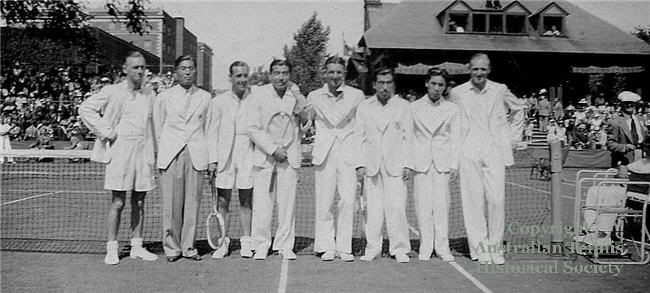
Moon

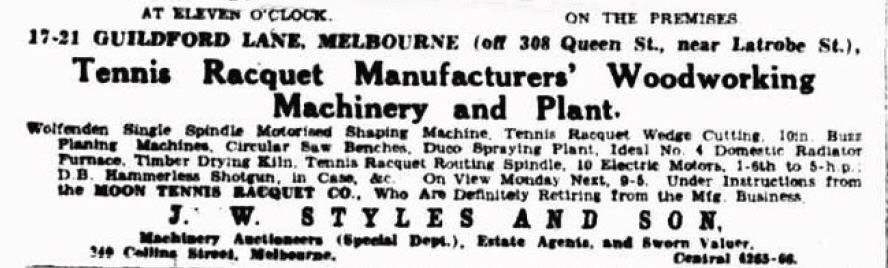
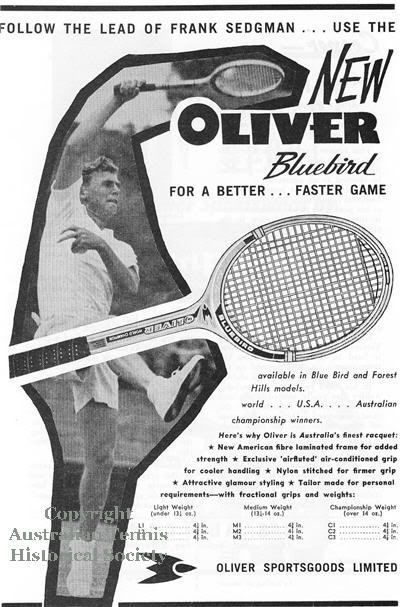
When confronted with some of the more obsure racquet companies it is very difficult to actually find out more information about them because they were often not in business long or the brands they marketed could easily have been be produced under a sub contract arrangement with a larger firm.

We thought the latter was the case in relation to Moon Racquets, from Melbourne, however they most certainly produced racquets. Our researchers found this great little ad for an auction sale on 12th February 1938 which unfortunately shows that Moon Tennis Racquet Company had to close it’s doors at their Guildford Lane workshop and sell by auction their manufacturing machinery. So in our view conclusive proof they made their own racquets.

Moon racquets

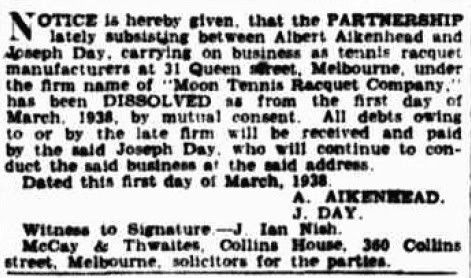
The owners of the business are listed as Albert Aikenhead and Joseph Day.  As  you read this notification, it is apparent that Joseph Day was intending to continue on with the business in another form.

Moon racquets

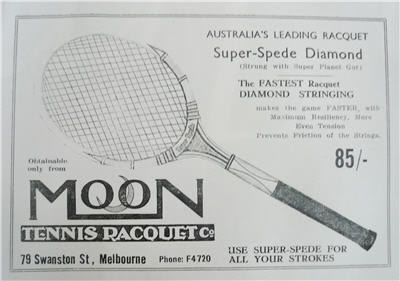
In relation to their actual racquets, we found this ad which identifies their Super-Spede Diamond strung racquets. Since the company stopped phyiscally making racquets in 1938 it would appear they had racquets like this made elsewhere as this came from a 1946 Tournament program.

Moon racquets

Intercolonial & State Championships History

The arrival of the new game of tennis saw the formation of clubs and from late 1876 onwards inter-club and other competitions soon followed.

In Victoria, the MCC was already managing cricket and numerous other club activities for Melbourne’s wealthier families and with the benefit of cash resources and management expertise became one of Tennis’ key driving forces in that state. In mid July 1879, they laid their first asphalt court within the grounds of the current MCG and by early 1880 had conducted their first 16 man competition which carried with it Victoria’s first Championship winner being Mr A.F. Robinson over H.M.Strachan 2 sets to one. (this was noted as the 1879 championship although held in 1880)

Sydney Invitation to MCC

Given the high level of interest in that event, the MCC quickly decided to organise the first Intercolonial competition to be held on lawn courts set up on the cricket ground. Event timing coincided with the Horticultural Show in November 1880, at which many potential intercolonial visitors might be in attendance and the rules simply stated that any doubles combination must be from the same colony or country.  To the singles winner, F.J.Highett, came a trophy with a hefty value of 10 pound 10 shillings and the runner up R.P. Arnold a mounted silver racquet. The doubles was won by A.F. Robinson and C.Trench. The doubles draw included two Englishmen H.Callender and H.Allison making the tournament one of the earliest “internationally” represented tennis events. Also, consider that all the states were in effect different colonies (countries), at least until federation in 1901, so you could also argue that even by being Intercolonial, tennis between Victoria and New South Wales was equivalent to tennis being conducted between France and Germany.
By way of comparison, the first Wimbledon was conducted in England in July 1877 and the first USA National Championships were conducted in 1881, so the pathway of competitive tennis was commencing on a fairly even footing across the key tennis playing Nations. It was not until 1905 that Australia truly adopted a National Championship.

In Victoria, again through efforts of the MCC, pennant tennis began in 1884 and by 1887 the growth in the number of clubs and participation in competition tennis necessitated the creation of numerous grades or levels. Woman’s pennant began in 1894.  Other Victorian Intercolonial tournaments were conducted from 1880 to 1884 with a definition that players from any state could participate.

Intercolonial Tournament 1885

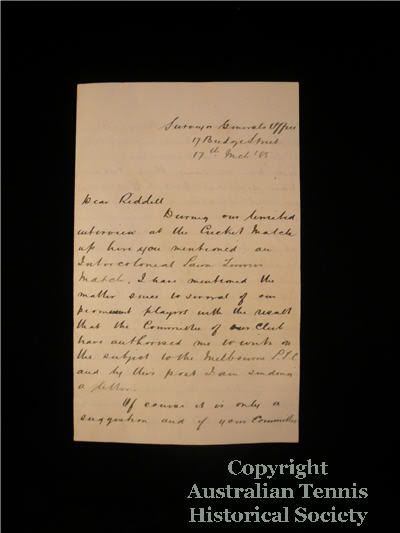
In 1885, the Lawn Tennis Club of Sydney invited the MCC/Melbourne Clubs to an Intercolonial team events match to be played on the Sydney Cricket Ground. The letter above t is the original sent by C.Cropper(NSW) to W. Riddell (VIC) and makes mention that Riddell raised this with Cropper on an earlier Cricket tour.  Amazingly, Cropper also suggests conducting an Open Championship of Australia alternating between the two cities. This did not eventuate until 1905.  The 1885 event was an outstanding success and Victoria issued a return invitation in October that year, but NSW declined due to the hosts choice of asphalt courts using uncovered balls, whereas New South Wales were playing on grass courts with covered balls, hence the advantage was always with the home team.

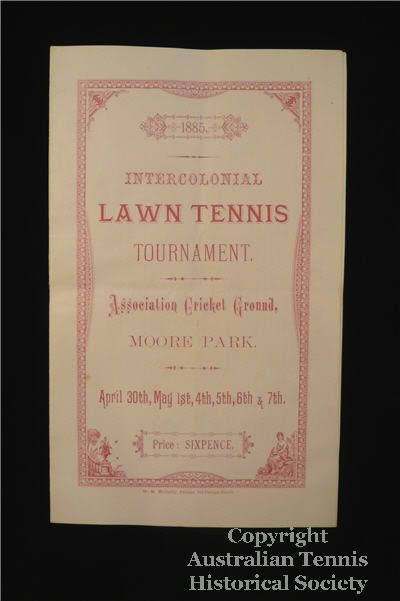
Also above is a photo of the actual 1885 programme of events.

Intercolonial tennis involved matches between neighbouring states NSW v  (VIC,QLD)  Vic v (NSW,SA) and became the breeding ground for our first champions and up and coming players like Norman Brookes, Horace Rice, Rodney Heath and Alf Dunlop.

These contests became the premiere events with some thousands attending the matches which were conducted over several days of continuous play.

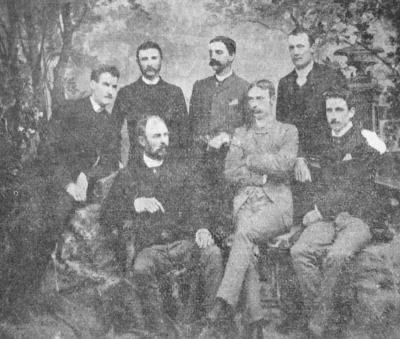
Victorian Intercolonial Tennis Team 1885

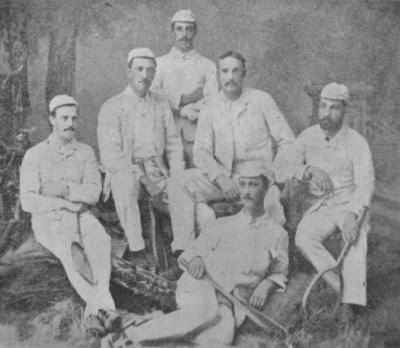
NSW Intercolonial Tennis Team 1885

The first Intercolonial tennis teams Victoria v NSW played at Sydney Cricket Ground  May 1885

Victoria: D Webb, F Highett, L White, W Coldham
Colville, W Riddell, R Martin
NSW  Back R Fitzgerald (Standing)
H Merewether, C Cropper, W Salmon. J King
Front- C Smith

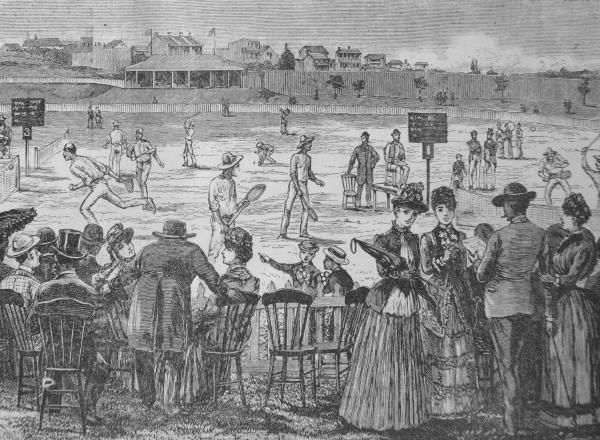
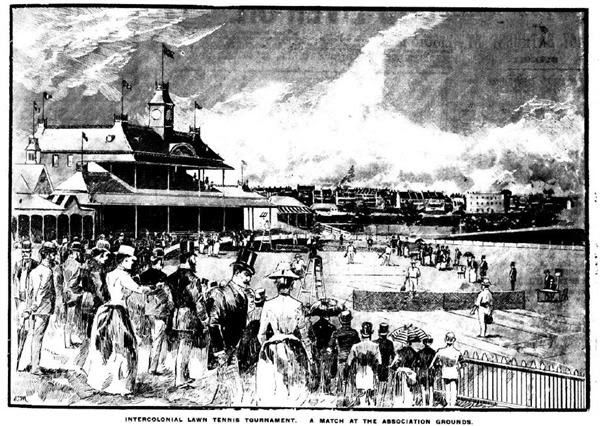
The newspapers of the day provided a couple of wonderful illustrations depicting the events held on the NSW Association (Sydney Oval) Grounds. The wealthy were the prime source of both players and spectators.
Dress codes were immaculate and the tournaments were conducted in May and November, alternating between Melbourne and Sydney.  Queensland was added to the NSW fixture and South Australia to Victoria’s.

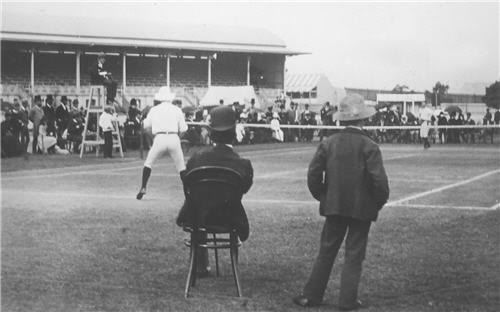
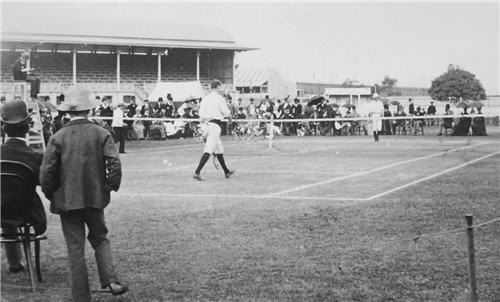
Below are some very rare original photos. They were copied from original glass plate positives
taken of the 1890 NSW v VICTORIA Intercolonial challenge played on the Sydney Cricket Ground. The Gentleman (by himself)  is Dudley Webb who won many NSW Championships from 1888, 1892, 1893 & 1894.  He competed firstly for Victoria’s intercolonial teams and them upon moving to NSW played for them from 1887-1898. The glass plates belonged to Dudley Webb’s family.

As you can see, the crowds were highly supportive and please also note the fashions on and off the court.


Dudley Webb NSW Champion and Intercolonial Representative

In addition to the 1885 letter above we also found a collection of other Inter-colonial memorabilia
located in the State Library of Victoria.


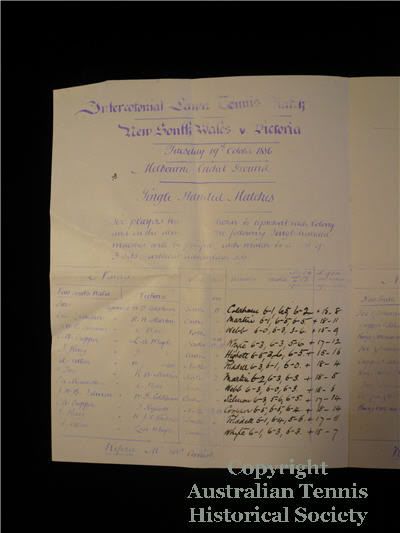
Intercolonial Tournament 1886

The Intercolonial Tournament programme and some of the results 1886


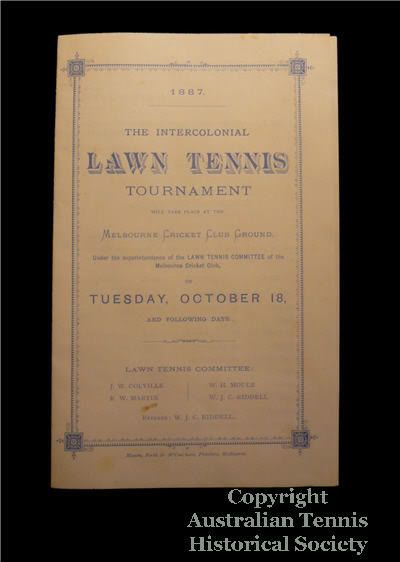
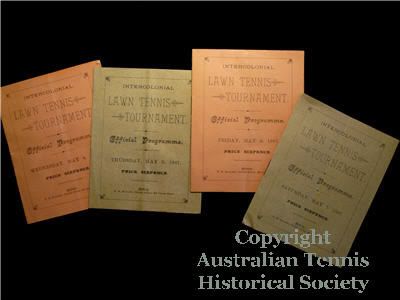
Intercolonial Tournament 1887

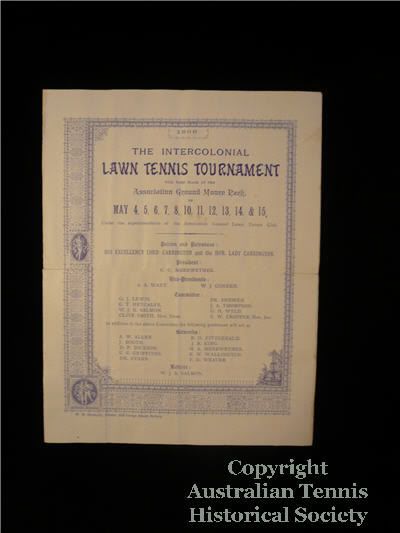
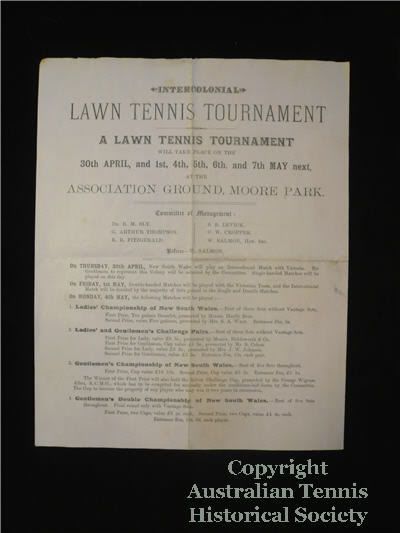
The Intercolonial Tournament Programme & daily events offical programme 1887

Apart from the Intercolonial tournaments, the state tournaments were also very popular as were some prestigious club events.

This table shows the first recorded years by state and event as indicated in the book “Lawn Tennis in Australasia” By Austral (R.F.Kidston Journalist and Intercolonial player for NSW)

Location Men’s Singles Men’s Doubles Ladies Singles Ladies Doubles Mixed Doubles
Victoria 1880* 1880 1884 1884 1884
New South Wales 1885 1885 1885 1886 1885
South Aust. 1890 1890 1892 1893 1894
Queensland 1889 1892 1892 1898 1892
West Australia 1895 1896 1897 1900 1902
Tasmania 1893 1893 1893 1901
New Zealand 1886 1886 1886 1886 1899
Buckley Tournament
Autumn Champs.
1888 1888
MAJOR CLUB TOURNAMENTS
South Yarra 1897
Grace Park 1902
Strathfield NSW Metropolitan 1892 1892 1892 1911
Geelong (VIC) 1891

* two events played in the one year.

In 1880, interclub events featuring the MCC teams (Melbourne) took place.  The Geelong Recreation Club held its inaugural bi annual Lawn Tennis Challenge Cup in Geelong around April and this was won by MCC player, W Officer. In October,  MCC player F Highett won from the locals followed by an impressive win in the widely promoted Victorian Championships.  Highett won the Geelong tournament again in 1881 and this trophy, below, is owned by the Highett family who we thank for sharing this remarkably early piece of Australian Tennis History. On a close inspection of the  tournament sheets, above, you will find Francis Highett listed as part of the first 1885 Victorian team to challenge NSW.


Francis Highett Geelong Recreation Club 1880

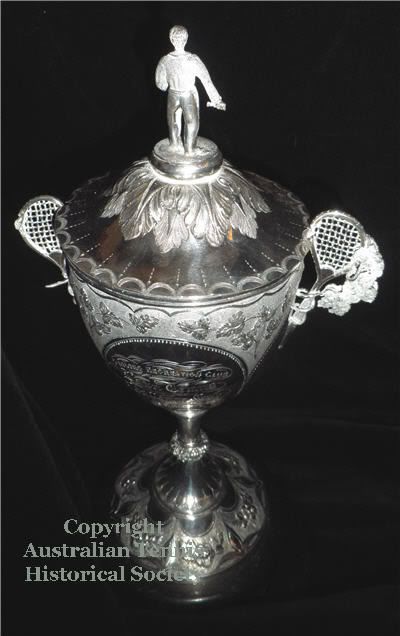
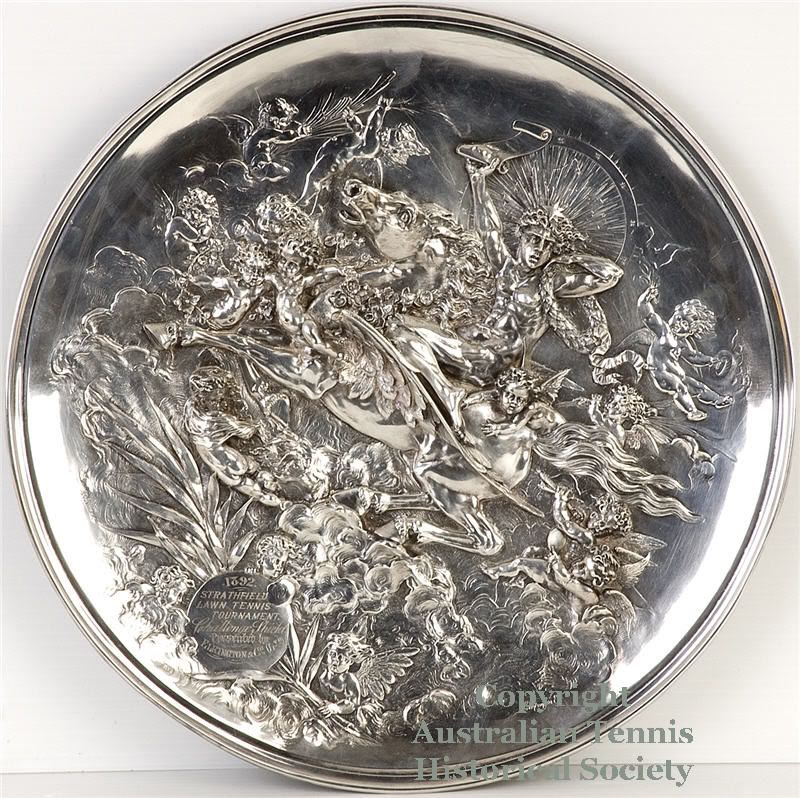
Retruning to Dudley Webb, apart from winning the NSW Championships numerous times, he won this amazing trophy in 1893 and 1894 at the Strathfield Metropolitan Championships. Edward Dewhurst won this in 1895 before heading to the USA where he won some very prestigious tennis events.

What an amazingly beautiful trophy, created by Elkington & Co. 1892.  We have left the picture as large as we can to help define the ornate work within the 3D design, approx. 300mm in diameter.  It has been acquired by Tennis Australia.


Frank Sedgman

Born in Melbourne in 1927 , Frank Sedgman was introduced to tennis through his parents association with the Blackburn Tennis Club. Playing in the popular schoolboy holiday tournaments which included Elsternwick, Glen Iris and Kooyong he learnt of Harry Hopman, who conducted coaching lessons at Kooyong. At his mothers insistence, at aged 14 Frank plucked up the courage to ring Harry and explain, quite brazenly, that he could beat most of the kids in Harry’s current clinic and wanted to join his coaching squad. With that much front, Harry permitted Frank to join and so began their amazing relationship.

Frank’s first job, like Harry’s at the Herald, was in the newspaper business and he worked for the Argus. Tennis coaching was scheduled every Thursday and the Argus structured his work hours so he could attend the lessons.

The 1945 Victorian Junior Championships was Frank’s first major win and in the seniors event he was beaten by Adrian Quist in the 2nd round. These performances led to his selection in the Linton Cup where he played interstate matches that helped him into Australia’s National Rankings as equal #10.

In 1946 he helped secure Victoria’s Linton Cup win and also won the Australian Junior Championships. One of his stand out performances that year was beating ex Wimbledon champion Jack Crawford (#7) in the first round of the NSW Championships in a tough 5 setter. In the NSW v’s VIC Mars Buckley test he lost to Geoff Brown and beat Gilchrist and so he was proving to himself and selectors that he could mix it with many of the then current Davis Cup players plus the Australian population were seeing the rising talents of a new young player.

Jumping to 1948, Frank won his first major in the West Australian Championships beating Colin Long in the singles final and with Colin also won the doubles. Frank was now the number 4 ranked Australian player behind Adrian Quist, John Bromwich and Bill Sidwell but didn’t make the 1948 Davis Cup Team, even though Bromwich withdrew because of his fear of flying, whereas the pre-war tours involved travel by sea. Instead, Bromwich planned to set sail for Wimbledon and it was felt that Frank should also go as Bromwich’s partner but couldn’t afford to fund the trip privately. Possibly with just a slight influence from Harry, the Herald ran a publicly promoted 10 day fund raising campaign which enabled Frank to go, only after the LTAA stepped in to control the fund and provided him with appropriate accreditation.

Just as well. Frank and John won the 1948 Wimbledon Doubles and Frank came runner up in the mixed finals playing with Doris Hart. Frank was also runner up in the French playing with Harry Hopman as a precursor to Wimbledon. Back then, players didn’t relate to the French Open as they do today as part of the Grand Slam and it was treated more as a warm up tournament. In fact, Frank holds the view that Doubles was very much an Australian strength mainly because many other countries focused on singles. Growing up at tennis clubs here usually meant playing plenty of club doubles and the record books stand testament to Australia’s longtime dominance of doubles events.

The other really important event in 1948, again through Harry’s stewardship, was the sponsoring of Frank to play in the USA. This was forthcoming from successful Australian Industrialist, Fred Small who lived and worked in New York. This was all about gaining experience and Frank lived near the LA Tennis Club which was a focal development point for American tennis and he played regularly with elite players including Kramer, Riggs, Budge Patty and Falkenburg. He recalls the courts to be cement and very fast and it was here that he honed his serve volley and power game.

1949 was one of Frank’s mixed performance years. Despite winning his first Australian Championship and making the Davis Cup team, he also played with Colin Long once more in the doubles to be defeated by the powerful doubles combination of Quist and Bromwich. Over at Wimbledon, he and Bromwich didn’t back up their 1948 win and in fact missed the finals. Even more demoralizing was that Frank had a match point against Ted Schroeder in a singles match and blew a second serve by running around to his forehand and hit one high for an easy put away volley. Schroeder recovered to win the match in 5 sets and then proceeded to win the championship. The USA then cleaned up Australia in the Davis Cup Challenge Round 4-1 with only the doubles win. Frank lost both singles to Schroeder and Gonzales.

Having won the 1950 Australian Open for the second time, he was now the #1 seed at Wimbledon. During the lead up trip he slipped on a sand box used on snow covered roads and injured his wrist which meant he missed playing all the warm up tournaments and literally only just made it to the opening round when his wrist started to feel better. In a great effort, he made the finals and on the way Frank recalled a remarkable match against A. Larson with the first two sets being lost in appalling, late evening wet weather conditions. It was so slippery that Frank actually decided to play in his socks. Harry Hopman sought out the referee for a postponement until the next day. Luckily, Frank came back to win the next three sets. The trend continued in the Semi’s against Drobny where, once again, from two sets down Frank fought back to win. In the grand final, Frank lost to Budge Patty in four sets. For both Frank and Budge it was tough singles match mainly because they played each other in a previous marathon 4 ½ hour doubles (with Ken McGregor) match in which the second set went 31/29 in over 2 ½ hours. This was lost in 4 sets. Frank explained that back then each set was allocated 6 new balls only and not the current 9 game rotation. Consequently, the balls became a total disaster to the point that from a serve they just shot through off the grass and so with a huge favour to the server the balls actually helped perpetuate the score.
The 1950 Davis Cup team was now captained by Harry Hopman and some younger players were promoted to join Bromwich. This was the first season for Merv Rose and Ken McGregor and the last for Bromwich who even agreed to fly to the USA in order to participate in his suspected last Cup Challenge. The Inter Zone final was a close 3-2 win over Sweden in pretty appalling wet conditions, aka, Frank played and lost to Bergelin again resorting to playing in socks in very slippery conditions. Bromwich lost to Bergelin also, but luckily they both won their singles matches against Johansson and the doubles. Norman Brookes and Harry threatened Frank that if he didn’t win the reverse singles he was on the next plane home. The Challenge Round was a great opportunity for McGregor to shine in singles and with one loss only, Australia captured the Davis Cup 4-1 against the USA. Frank played well beating Schroeder and T.P.Brown in singles and with Bromwich beat Schroeder and Mulloy in doubles. Whilst in the USA Bromwich and Frank won the US Doubles over Bill Talbert and Gardnar Mulloy.

If 1950 was good, 1951 was totally exceptional.Frank teamed up with Ken McGregor once more and won the first Men’s Doubles Grand Slam and was only the Australian Mixed Doubles final short of a Grand Slam in that event as well.He also won his first US Open singles over Vic Seixas which became his third major singles title. This was the first time an Australian player had won the event and only the fifth time for an overseas player.

The Davis Cup Challenge round in Sydney saw a controversial decision to play Rose ahead of McGregor against the USA. Although Rose had good form leading into the round, Frank always felt that McGregor was the more match fit player. The strategy back fired and with Rose losing the two singles rubbers. Sedgman won all three of his matches to secure the cup once more, but only just.

Frank was clearly established as one of the top players in 1952 and he won his second US Open Singles title and his first Wimbledon Singles title, three mixed tournaments except the Australian Open again and won three doubles events with Ken. The last “Slam” final of the USA doubles was played against Aussie Merv Rose and Vic Seixas (US). McGregor had pulled a stomach muscle and had difficulty serving so the match went to 5 sets which they lost. A win here would have meant their 8th consecutive Grand Slam doubles win in a row. Harry Hopman was so furious at Rose for siding with an American and ruining the party, that he didn’t speak to him for two months. Australian Tennis officials declared, as reported in the press, that Rose was not to play with Seixas in the 1953 US Doubles again, in preference for Aussie Clive Wilderspin. Such was the power play of officials versus players back then in trying to engineer partnerships that would assist in aiding Australia to win the Davis Cup which meant crowds and income ahead of individual tournament performances.

The 1952 Davis Cup in Adelaide was a pretty straightforward affair with good wins over Seixas and Trabert 4-1, but then every win over the Americans is good for national pride but also the cup stays in Australia for the next revenue generating year.

This third successive Davis Cup win marked the end of Frank’s amateur career. Everything changed in 1953 when he announced to the World that he was becoming a professional with the Jack Kramer Troupe and Ken McGregor joined also.

On reviewing Franks’ overall amateur performance some very unique and interesting stats appear.

Frank is the only male to have played and made the finals of every Grand Slam Event (singles. doubles and mixed). Over the three years 1950-1952 he won 11 of the 12 titles. He won a triple crown twice (singles, doubles and mixed at the US ‘51 and Wimbledon ’52) and played in 3 consecutive winning Australian Davis Cup Team 1950 -1952, plus, the prestigious achievement of winning the Doubles Grand Slam in 1951.

Turning professional was a fairly logical progression. This was hardly surprising. Back in 1950 Frank was quoted as saying he would consider becoming a professional at some point, so everyone new it was on the cards. In 1952 to keep him amateur for the Davis Cup, Frank Packer (Consolidated Press) provided a 5000 pound wedding gift to Frank’s new wife Jean and Slazenger paid for them both to travel Europe to play exhibition matches as well as the main tournaments. Naturally this blatant payment and “sporting goods employment” contracts created plenty of ill-will from the Americans yet even though the LTAA politically managed the situation, these backhand deals that many players were receiving highlighted the need for Tennis to move into an “Open” era, which still did not occur until 1967.

Kramer was a legendary tennis player.He had won Wimbledon, US championships and Davis Cup Challenge rounds in 1946 and 1947.Kramer turned pro in 1948 and set about delivering a quality road show to not only delight the fans but to create incomes for himself and other pro players. Frank had promised Kramer that he would join after the 1952 Davis Cup Tie.

The transition was rapid. On the 7th January 1953 Frank debuted against Kramer in Los Angeles in front of a 4000 plus crowd and won 3/6, 6/4. 6/4. The press were ecstatic at the win and although many felt sure Kramer had finally found a formidable opponent, Bill Tilden commented that Frank “was the fastest man he had ever seen on a court….”, however he believed “Kramer’s shots were better, but he suffers from a lack of high calibre competition”. And, indeed Frank did lead the “head to head” results early on but Kramer came back and eventually won the tour 54-41. Frank believes Kramer is the best player he has played against due to his skill and very tactical approach to the game. Gonzales had an amazing serve and power game but the ground shots weren’t as good as Kramer’s.

Professional tennis was grueling. Constant travel, new rooms every night and often low cost, self drive transportation between events. If today’s elite players don’t think they owe Jack for persevering to create an open professional stage, improve pay and conditions that allow a contemporary first class lifestyle to be derived from tennis they certainly need to. The venues could be ice skating rinks or velodromes. The court was usually a portable, taut canvas sewn in panels. The seams did create some odd bounces and while it was different Frank felt he became quite quickly accustomed to its playability. The photo right shows Pancho Gonzales, Tony Trabert, Frank and Rex Hartwig in 1955.

When quizzed about the intensity of Pro tennis, Frank said that his game went to a totally new level. Every game, although an exhibition, was played to maximum intensity. Kramer, Segura, Gonzales and even the ‘past his prime’ Don Budge never held back. Winning meant money and pride so to win the tour series, tournaments or head to head contests was a top priority. On the subject of amateur best players versus the pro’s, the pro’s standard was way above the amateur standard and of course had the era been Open the inscriptions on the Grand Slam trophies throughout this period would have been very different.

Frank nominates his best ever tennis performance was against Pancho Gonzales in the November 22nd 1953 Open Championship at Wembley UK. He blasted Gonzales off the court in a crowd stunning 49 minute display 6/1, 6/2, 6/2 to become the unofficial World Champion.

In late 1954, Frank organised a tour to Australia independently from Kramer who was taking a break after an exhausting 18 months on the road not just playing but organising two World tours. Local Australian cycling promoter, Ted Waterford managed the tour for Gonzales, Segura, Frank and Ken McGregor.

Over the next decade Frank participated in many overseas and Australian Professional tours and many top Australian players were being lured Ian Ayre, Rex Hartwig, Ken Rosewell, Lew Hoad, Ashley Cooper, Merv Rose and Mal Anderson all became Kramer Pros. The 1959 Australian Kramer tour was banned from any official LTAA venues so they played at some very obscure venues and then in 1961 the LTAA did approve play at key venues after satisfactory financial arrangements were negotiated.

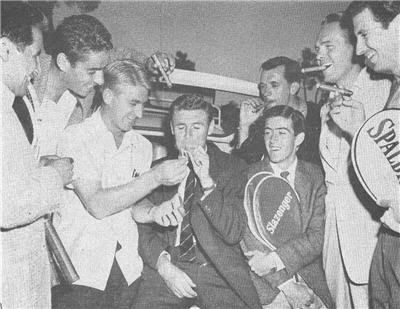
In a European tour, in 1964/65, Frank played a series of Australian Professional tournaments against Gonzales, Laver and Rosewall which were pretty much his last premier pro level tennis matches. Below is a fun shot from 1963 with a few pro’s Sugura, Gonzales, Hoad, Rosewall, Merv Rose, Kramer and Cooper lighting up Frank’s cigar.

Thanks to the Open era, a truce between the pro’s and administrators saw Frank return to club tennis, playing A grade pennant for Grace Park from 1970-1978, where it is reported he did not lose a singles match.  He rejoined the 1970 Australian Open and played against the 1968 amateur winner Bill Bowrey but missed a sitter volley on his match point to eventually lose in 5 sets 6/2, 1/6, 6/3, 4/6, 7/5. He went onto play the Australian Open until 1976 aged 48 which is a sensational effort.

We discussed the ramifications for turning professional. The power struggle between administrators and players was always brewing particularly as independently wealthy or privileged players (aka Sir Norman Brookes) were being replaced by average kids coming from the country and average suburbia. These players needed to earn a living while devoting their time to practice and overseas touring. Controlling players and money making events like the Davis Cup was the ultimate objective of the LTAA, yet by the 1960’s crowd numbers at the Cup and major tournaments were being impacted by the large number of players turning pro and the obvious lack of star quality in the amateurs.

While a pro, Frank’s membership at Kooyong was cancelled, he couldn’t play pennant or participate in any LTAA event. Looking back, the players knew what they were in for if they did turn professional, but it was a very dismal way to treat Championship winners and Davis Cup Champions. Frank ended up playing championship squash because he wasn’t allowed to play in LTAA sanctioned tennis. events anywhere.

Thankfully the open era is allowing players and tennis associations to share the revenues from a game which still excites the population via record crowds, strong media and the degree of interest in local player support. The Australian Open today is attracting crowds who flock to see the best players at one of the best venues.

In relation to racquets used, Frank started tennis with a Dunlop Maxply, then was earning 8 pounds a week from Spalding until the 1949 Australian Championships. After this Oliver paid him 20 pounds per week and Frank won the US and Wimbledon titles with the famous Oliver “BlueBird”. As a pro he used Wilson in the USA and Dunlop produced a signature /photo decal racquet in the mid 1950’s . In the mid 70’s Frank went back to Oliver and also endorsed a small Queensland racquet maker called Master. Over in New Zealand there was a signature range from Feltex.

We can only look back over the record books for Frank Sedgman and truly admire and marvel at his achievements in Tennis on the court and off.  He has won every major event across Singles, Doubles and Mixed bar the French Singles title which is an amazing effort unlikely to be seen again.  We are pleased to report also that Frank is fit and well, is still actively involved in tennis administration, goes to the gym 3 times a week and plays golf. I suspect he would still give players years younger a run for their money.

Some good books: Jack Kramer’s “The Game. My 40 Years in Tennis”1981, Harry Hopman’s “Aces and Places” 1957, “Winning Tennis” by Frank Sedgman 1955, “Our Open” Tennis Australia 2004

Thanks for taking to the time to meet with us Frank, a great privilege.

Australian Tennis Balls & Ball Machines

In this section we introduce the history of tennis ball manufacture in Australia and the invention of the first (or very early) tennis ball machines. Australian Tennis Balls began manufacture in the early 1900’s, with three companies becoming prominent. The competition was fierce with many balls being imported in both covered (lawn) and uncovered (asphalt) versions. This ad from the 1909 Davis Cup Program held in Australia is a very early example promoting Australian made balls.  They were not considered high quality and imported balls remained popular.

Many of the Australian companies were already in rubber products manufacturing such as Barnet Glass and Ormiston which produced raincoats and other waterproof clothing. Dunlop was famous for the development of the automotive tyre. The big three makers Dunlop, Barnet Glass (1876) and Ormiston virtually created a cartel to own the Australian market and you can see some of their advertisements under that section while further pictures of finished products will be sourced for this section. The Swift Tennis Ball Company, Melbourne also carved out a share of the local market employing juniors including Lionel Brodie to assist with exhibitions and orders.  Swift designed a one piece ball around 1936  and this led to some export success up to 1946.


ormiston tennis ball can (2) In 1926, Spalding also began ball manufacturing, in Melbourne, a plugless and stitchless ball. Learn more from the Spalding section. Slazenger balls made in the UK were highly regarded, since they were sponsoring Wimbledon and were imported in large quantities. In 1934, Slazenger opened a factory in Sydney and commenced both tennis racquet and ball production. Ormiston began operations around 1938 and was commenced by two brothers who had previously held executive positions at Barnet Glass. Here is an interesting article from 1924 about Tennis Ball manufacture.

In the mid 1920’s Slazenger introduced a ‘Grooved Ball’ amazingly a box has survived see below.

Ball Making was a fast growing high volume business. The pictures above show the laborious job of branding each of the balls which included adding numbers or coloured spots so that players over many courts could identify matching pairs. These shots are circa 1945. Pictures Courtesy National  Archives Australia Top ref NAA A1200, L3188   Bottom ref NAA A6180, 10/4/72/3 As the war effort caused a diversion of precious resources, people had to ration and do with whatever could be achieved. You can’t foresee this happening today. Recovering used tennis balls.

recover old tennis ball

Ball machines were on the agenda in 1927/28 and in Renee Lacoste’s ” Lacoste On Tennis” he mentions making one to improve his practice sessions, however we have found reference to one possibly created earlier by an Australian in the Gippsland Times July 1922.


Below we have an actual photo of one invented by an Australian,  Percy Jepson in 1927, who we suspect also ran an engineering firm producing Fruit Packing machinery, hence his experience with the technology. The motorised ball machine was called the “Machine Gun” and subsequent testing by Pat O’Hara Wood at South Yarra indicated it was an idea of some merit.  The unit was demonstrated in Myers retail store and invited tennis players to attend. Gerald Patterson demonstrated the unit to the  visiting French team, Brugnon and Boussus  and explained that Lacoste’s machine was hand operated and not comparable to the machine version invented by Jepson.   Lacoste’s machine was also brought to Australia to be demonstrated.  The Jepson did go offshore to the USA (Forest Hills) for evaluation in 1929 where Betty Nuthall and Vincent Richards tested it to positive reviews. We found that Jepson Fruit Packing went in to liquidation in 1931, so unfortunately this interesting model may not have survived. These articles from The Argus 1927 and All Tennis 1928.

SLAZENGER GROOVED BALL (25) EDIT

Barnet Glass tennis ball box Swift Tennis Balls

spalding tennis balls production 1
spalding racquet and box balls 2015 (8)


P1180780


Visiting French players in 1928, Brugnon and Boussus are in this shot with Patterson and the inventor Mr P Jepson (also below from the Argus)


The Jepson being tested at the then South Yarra Tennis Club


In November 1930, another Australian Inventor, Mr J.R. Black  from Adelaide (East Torrens & Interstate Player) came up with an electric motor tennis ball machine which he patented and found agents for in overseas markets.   These were being made by Newton McLaren Limited where Mr Black worked.  It held 48 balls and could toss or drive balls at 1.5,3 & 6 second intervals. Apparently his inventiveness continued for this photo is labelled as his ball machine in 1963. Photo Courtesy National Archives of Australia ref.  NAA A1200, L43279


In 1939, another Melbourne inventor created a ball machine which would deliver 50 balls as lobs, volleys or ground shots.


Extensive Australian Tournament Singles Results

Welcome to this section on Australian Singles Tennis Results starting from the earliest days through to 2000.

Via the links below you can search out singles titles by event and by winner for many state, regional and major tournaments conducted around Australia from the 1880’s for both men and women.  There are three ways you search, by event– gives a chronology of the event from inception by winner; by winner- allowing you to see all tournaments won by an individual ( a search by name will also find runner up listings separately; by year– enabling an analysis  of all tournaments in a given time period to assess the dominance of a player.

The compilation of this work has been achieved by  South Australian, Andrew Tasiopoulos who has spent countless hours poring over newspapers, association reports, club newsletters, results books etc. to develop these very important records for players and events from the 1880’s through to 2007.

We at tennishistory.com.au thank Andrew for his permission to present this work on our site as a way of helping former players, families and tennis fans gain some knowledge into the way tennis evolved in Australia from the very early days.

Country tournaments, Inter colonial matches and State competitions were well represented by many champion players of the time mixed with local and district champions. To many, some great players who were just a level below the recognised greats may be unheard of, yet you will find it fascinating to learn of champions who dominated their region for long periods or who enjoyed a rivalry with opponents where finals were often played off between the pair year after year.

There are two pdf files which are searchable by key word (Control F to bring up PDF search tab)

MENS FINALS Australian Finals Mens

WOMENS FINALS Australian Finals Women

As you can see when viewing these files, please appreciate the level of effort that Andrew and we know of others, like Clive Oliver, have spent to actually find this often missing information.

We hope that Tennis Australia finds a way to allocate funds to compensate and reward such efforts in order to continue the process to include doubles, mixed doubles and even pennant and association tennis.

Perhaps a book about the History of tennis in Australia could be published in which these results could be included as a permanent record of achievement.  It may not be a cheap exercise, however the numbers of players and clubs must surely represent a significant target market to justify such a project even if the financial outcome was a breakeven. We note with interest that Queensland have a “Century of Queensland Tennis”, ‘Tennis West’ for WA and no recent histories for NSW, Tasmania or Victoria except for some individual club productions.

If you wish to view finals results for Australian players (and all others) in Grand Slam Events, we recommend you to visit this excellent search engine site.  www.grandslamhistory.com For others as mentioned check out our links page.

PLEASE NOTE UNDER “OTHER” (LINKS)  THERE ARE SOME EXCELLENT SITES WHICH DELIVER PLAYER RESULTS IN THE GRAND SLAMS, DAVIS CUP and OTHER OS TOURNAMENTS.

To view the Australian Championships records history back to 1905 please visit the Australian Open records page click here

Here are the Australian Singles Winners of the Overseas GRAND SLAM Tournaments

Wimbledon

1907 Norman Brookes (1st OS Player)       1965 Margaret Smith (Court)

1910 Anthony Wilding (NZ)                         1970 Margaret Smith (Court)*

1911 Anthony Wilding (NZ)                         1971 Evonne Goolagong (Cawley)

1912 Anthony Wilding (NZ)                         1980 Evonne Goolagong (Cawley)

1913 Anthony Wilding (NZ)                         2021  Ash Barty

1914 Norman Brookes

1919 Gerald Patterson

1922 Gerald Patterson

1933 Jack Crawford

1952 Frank Sedgman

1956 Lew Hoad

1957 Lew Hoad

1958 Ashley Cooper

1960 Neil Fraser

1961 Rod Laver

1962 Rod Laver*

1964 Roy Emerson

1965 Roy Emerson

1967 John Newcombe

1968 Rod Laver

1969 Rod Laver*

1970 John Newcombe

1971 John Newcombe

1987 Pat Cash

2002 Lleyton Hewitt


French

1933 Jack Crawford                                    1962 Margaret Smith (Court)

1953 Ken Rosewall                                     1963 Lesley Turner Bowrey

1956 Lew Hoad                                           1964 Margaret Smith (Court)

1958 Mervyn Rose                                     1965 Lesley Turner Bowrey

1962 Rod Laver*                                         1960 Margaret Smith (Court)

1963 Roy Emerson                                     1970 Margaret Smith (Court)*

1965 Fred Stolle                                          1971 Evonne Goolagong (Cawley)

1966 Tony Roche                                        1973 Margaret Smith (Court)

1967 Roy Emerson                                      2019  Ash Barty

1968 Ken Rosewall

1969 Rod Laver*


US Open

1951 Frank Sedgman                                   1962 Margaret Smith (Court)

1952 Frank Sedgman                                   1969 Margaret Smith (Court)

1956 Ken Rosewall                                       1970 Margaret Smith (Court)*

1957 Malcolm Anderson                             1973 Margaret Smith (Court)

1958 Ashley Cooper                                      2011  Samantha Stosur

1959 Neale Fraser

1960 Neale Fraser

1961 Roy Emerson

1962 Rod Laver*

1964 Roy Emerson

1966 Fred Stolle

1967 John Newcombe

1969 Rod Laver*

1970 Ken Rosewall

1973 John Newcombe

1997 Pat Rafter

1998 Pat Rafter

2001 Lleyton Hewitt


* Grand Slams

Rod Laver 1962, 1969

Margaret Smith (Court) 1970


Anthony Wilding is listed here because NZ & Australia formed the Australasian Teams up to 1922.


Len Schwartz

Len passed away 23-11-2010 aged 97.  The article was produced in 2008.

Len Schwartz, was born in 1913 in the Barossa Valley, South Australia.  The other day Len kindly gave me some time to discuss his long and wonderful tennis career. His junior days were spent in country Strathalbyn where he practiced regularly against a brick wall and played at the Milang Tennis Club.

At 18 years old he went to search for a job in Adelaide and found himself employed by one of the largest retail groups, Harris Scarfe who still operate today in numerous states. On the very first weekend, Len dressed himself in his tennis gear, packed a racquet, jumped on his bike and began the search for a tennis club with grass courts. He found his new home at Unley Oval and promptly played in the West Torrence district team in the U21’s. Following good performances he found himself in the Linton Cup Team where he met Adrian Quist and Don Turnbull.  Quist was already a very promising junior having won the 1930 Australian Boy’s Doubles with Don Turnbull however he partnered with Len in 1932 to win the championship for the second time.

Len enjoyed more doubles success than in singles, yet he had match points to almost win the South Australian Championships at least once but appeared in the final four times against Hopman in 1933 in a massive 5 setter (10-8 in the fifth), Quist twice and Bromwich. As a demonstration of his doubles versatility, Len won the doubles event 4 times with four different partners (G.Hone, R Sheppard, John Wright and Adrian Quist) and the mixed event twice.

Len considers his best shot was the backhand volley however he played a constant serve volley attacking game.  He played for the South Australian Intercolonial team which enjoyed a massive public following and acted as an excellent lead-in tournament to the Australian Championships.

While somewhat in the shadow of Crawford who won Wimbledon in 1933, Quist, Viv Mc Grath and Bromwich, Len continued to impress and was selected as the 5th player in the 1937 Davis Cup team.  In those days with the Tennis Association picking up the overseas traveling expenses, it was decided that a five player team was not affordable and Len missed out.

In 1938, Len defeated Jack Crawford in the first round of the Australian Championships in front of his home crowd and then went on to be defeated in the quarter finals by the legendary Don Budge in his Grand Slam year 6-4, 6-3, 10-8. He recalls Budge changing ends saying something to him like “keep up the good work, you’re playing well”.

The dominance of Budge and the US team almost lead the LTAA to decide not to send a team in 1938. Luckily they approved a team and Len’s performances pushed him up the rankings and into side with Quist, Bromwich and Harry Hopman as Captain Manager. They toured the USA for 5 months.  The first round played was against Mexico in Kansas City which was a high altitude city and hot. Hopman, gave Len his chance to play his one and only singles match defeating D.Hernandez 6-4,6-1, 6-2.

After defeating Japan in the next round, the Australians went on to win the American Zone and then defeating Germany from the European Zone to meet the mighty US team in the final. It wasn’t the 5-0 whitewash many may have expected. The US team won 3-2 in Philadelphia, playing Riggs and Budge in the singles and Budge Mako in the doubles.Quist and Bromwich won the doubles and Bromwich won the only singles against Riggs.

On the tour Len and Harry used to play and practice alot against Quist and Bromwich. They were the ultimate doubles combination and from 1938 to 1950 with no play during the war, Quist and Bromwich won the Australian Doubles title 8 times (Quist won with Don Turnbull in 1936 1937 so he won it 10 times straight over 14 years. Whilst on tour the Australian team entered and played in the American National Doubles Tournament the feature event in that year.  Len and Harry were defeated by Quist and Bromwich 3-1 in the semi finals who in turn then lost to Budge and Mako in the finals.

The second most prestigious doubles tournament was held in Los Angeles.  Here Harry and Len defeated Quist and Bromwich and went on to defeat Budge and Mako.  Len not only sees this as his best series of wins, but he pointed out that in achieving their performance over the two tournaments they had defeated all four 1938 Doubles Grand Slam winners.

After the war in 1946, Len was asked to once again play in the Davis Cup team, however since he was married and needed a job, Len became a tennis coach and under the restrictive rules of the era that saw many fine players ineligible due becoming “tennis professionals” Len could not be selected.

Since we always have an interest in racquets, Len’s first racquet was an English made Prosser that his father gave him and after that as he became more prominent in South Australia he was approached by the local Slazenger representative to work for the company.  He did change to Spalding for a short time thanks to his mate Don Turnbull who worked there but went back to Slazenger and eventually moved to their head office in Alexandria, NSW where he was able to play exhibition matches and promote Slazeneger products to clubs and private homes. Len remained a coach until he was 70 and like many others demonstrated his sporting prowess by playing for the South Australian Lawn Bowling team for 10 years.

As a coach Len recalls teaching John Alexander and has enjoyed the many Davis Cup Dinners Tennis Australia invited him to and fondly remembers meeting fellow South Australian and AFL Crows supporter Lleyton Hewitt.

At 95, Len is still very with it and readily recalls his experiences in considerable detail which is a huge blessing. It was a great pleasure to talk with Len and to share these wonderful memories. He is very proud to have played in the Davis Cup team in 1938 and he and his family including 6 grandchildren and 4 great grand children should be thrilled that Len’s name is on the Cup.

Pictures show Len with Harry Hopman and the Cup.

Below, the Australian v Japan Teams in Montreal 1938. Harry Hopman far left, Adrian Quist 3rd left, Len 4th right and John Bromwich far right.