Tennis Heritage Australia 2015 Year to Date

2015 has been a great year for Tennis Heritage Australia.

In January, one of the elite USA coaches, Ken De Hart caught up with us during his time in Melbourne as guest speaker at the Australian Open Coaches conference. Ken is a collector however his reputation as a great coach and his extensive connections have been of enormous value in helping to build our Facebook presence.

We organised a lunch meeting at Kooyong thanks to Cedric Mason and we had a grand time discussing what we collected individually.

P1300648

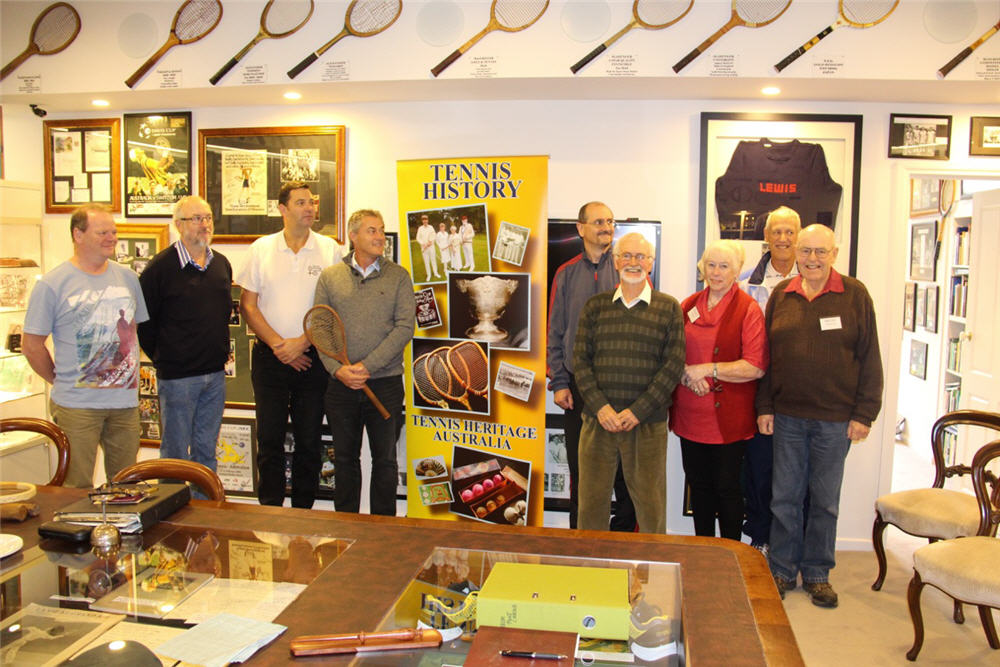
In May, we conducted our Inaugural NATIONAL MEETING down and Denis and Liz Tuckers fine Launceston home which in part contains a tennis museum focusing on Championship and Davis Cup/ Fed Cup players.
 

TAS MEET4

Special guest at this event was TENNIS COLLECTORS USA member Aldo Romeo who Denis has met on previous occasions over at the Newport Hall of Fame and Tennis Museum induction events.  Up until this point most of the rest of use had been discussing collections with Aldo over Facebook.   It was great to have his company not only in Launceston but also the following week in Melbourne where we toured a few tennis destinations that Aldo was pleased to see.

The following day we undertook a tour of the Alexander factory with the relative of the original owners, Gus Green and then played some tennis in the afternoon at the local club.

It goes without saying Aldo is quite a handy player and now has the lead against the all Australian team.

A very special thanks to Liz and Denis who opened their home to us for the weekend and also apart from Aldo coming from America, we enjoyed the company of Geoff from Perth,  Michael from NSW and some couples from Melbourne. Also Phil Bowden President of Tennis Tasmania attended the dinner which was most enjoyable.

It was a far more relaxing stay compared to our normal meetings which are usually 3-4 hour events.

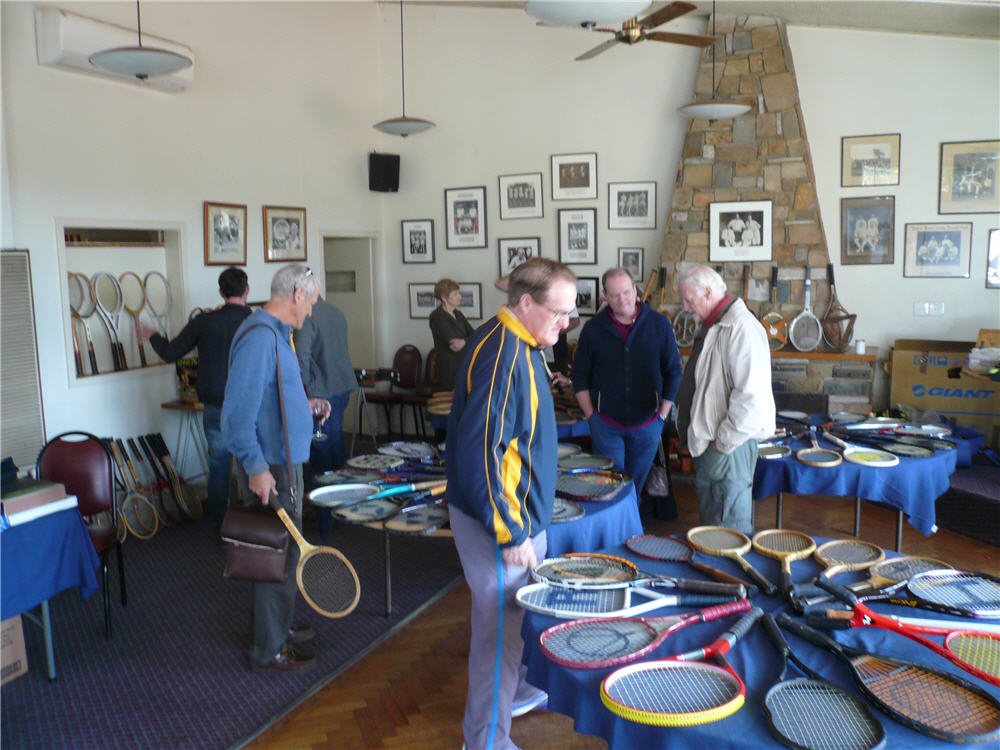
In August  we organised an impromptu TENNIS MEMORABILIA & SWAP MEET at Grace Park Tennis Club. One of our objectives as a group is to try and engage more with the pubic tennis community.  Using only social media we had the support of Tennis Victoria advising club secretaries,  Tennis Australia including the flyer on their social media,  Facebook, Ebay and Gumtree listings plus email to all our TH website database.

It was an interesting experiment with about 50 people arriving between 12-4 pm.  It was certainly a great day meeting everyone including a couple of new members who were keen to downsize their collections.

We had a large display of unusual racquets and 5 vendors selling various bits and pieces.
P1330711

Based on the success we will definitely encourage the THA Sydney group to organise an event and in Melbourne we already had an expression of interest from the KNOX CITY TENNIS CLUB to conduct an event out there which is currently being planned for November.

Special guests were Australian Fed Cup player Janet Young, Tennis Australia Director and Peter Cuxson, Tennis Victoria Director.  It was also great to meet other enthusiasts from ebay and some new potential collectors just excited to see what is out there.  1980’s player Cynthia Doerner was visiting family while in Melbourne from the USA. She has recently become connected with our ever expanding Facebook group and it was a delight to meet in person.

Our ambition is to work with Tennis Australia on developing a far more engaging display of tennis equipment and memorabilia through the Open event in 2016.  Talks with TA to continue soon.

Thanks to all the helpers with setting up the tables and equipment and to Grace Park for the venue.

Some interesting collection additions this year include an Alexander PHOTO DECAL racquet which I had only ever dreamt might exist.  The reality is that the company brought out a model in 1932 featuring James O Anderson.  This model has never been seen before by the global community of photos decal collectors and being this early as well, places it with very early models featuring Ellsworth Vines and William Tilden.

Luckily despite their being some paint loss the decal of JOA is remarkable.

alexander joa super photo model (3)

Another very rare racquet from the LILLYWHITE & FROWD UK (1939 era) was this TWINSHAFT model on the left next to an Hazell Green Star Streamline from the mid/late 1930’s


lillywhite hazell shoot (66)

Tennis History & Facebook

Owing to some recent contacts with UK & USA tennis collectors organisations,  they have decided to include separate Facebook pages in which to engage all subjects relating to tennis.

This access to expert collectors around the world is an invaluable resource.

UK Tennis Collectors’ Society

USA Tennis Collectors

Swiss Tennis History (Private collector – very knowledgeable)

Of course this website is also represented via Facebook at

Australian Tennis History

On Facebook we cover all manner of topics from history through to the latest ebay sales,  unusual items etc.

Come and join us!!!

A Welcome to Australian Tennis History

There have been many books written about the history of tennis with a focus on the UK and the USA. In Australia, unlike other local sports like Football, Rugby and Cricket, Tennis has suffered from a void where much of the history has simply vanished or focused only on the leading players of the time. Australia, does have a significant place in the annals of tennis and it a pleasure to present, in the one location, some interesting historical aspects of the game as it developed here and spawned a sporting industry which catered to the demand.

Various racquet sports have been tried over the centuries and although the modern game has its direct roots back into the Real Tennis, Rackets and Fives era it wasn’t until 1865 when Harry Gem and  A.J.Perera played an outdoor grass court game on their home court “Fairlight” and proceeded to set up a club in Leamington Spa in 1874.  Theirs was called “Pelota”.   In 1874,  Major Walter Wingfield launched his game of Lawn Tennis called “Sphairistike” and it achieved rapid buyer acceptance due his clever marketing of boxed sets and rules.

It is highly likely that many racquets were taken out onto lawns to play some form of hit to hit game, but it was the fast public acceptance of Wingfield’s boxed game that tips favour his way as the inventor of  the sport which has blossomed into the lawn tennis we enjoy today.

Below is a very rare picture from 1837, which shows an illustration of an outdoor game using the descriptive name “LONG or OPEN TENNIS”.  Not only do you witness a doubles style event, but within the text is reference to scoring in 15/30/45, advantage & deuce, rough or smooth to determine serving and even mentions volleying.

Thanks to Sebastiaan Van Hoorn for the photo and information from the book titled “Games and Sports” by Donald Walker, Published by Thomas Hurst, St Pauls Church Yard 1837.

field tennis

The Wingfield game to be marketed was also enhanced by a couple of other technological developments. First, the rubber ball was invented and then some years later cloth covered balls were developed. Second, lawn mowers now enabled the grass courts to be prepared with less effort.

Tennis created a social revolution appealing at first to women but then men as well. Courts were prepared for home entertainment, cities converted public  gardens into tennis courts, and courts were constructed within cricket clubs, croquet clubs and within the grounds of churches.  Wooden boxed sets of equipment were loaded on ships and transported toall corners of the world, including Australia, at a truly rapid pace. Tennis here spread quickly also, from homes to clubs, to far off country towns and although “Lawn tennis” was the name, Australian courts made from asphalt, sand, clay or plain dirt appeared everywhere.

A myriad of sporting goods manufacturers already producing cricket, royal tennis (UK) and in the USA baseball equipment, began designing and experimenting with new racquet designs, stringing techniques and tennis balls. Tennis fashion for the ladies and men was dashing and many clubs and local club competitions evolved. Tournaments like Wimbledon were created, The Davis Cup began in 1900, champions were held in high esteem and spectators were keen to see the best players in action.

The evolution of tennis, the playing techniques, the equipment, the stories and the memorabilia surrounding the game is remarkable. In Australia, tennis competitions evolved from club versus club to Intercolonial matches, to state championships and eventually the Australian Championships.  While much of the equipment was imported at first, the Australian Tennis racquet and ball industry developed with many brands and models that no longer exist today.  Occasionally you will find an item in a cupboard and wonder where this came from and who made it.

On this site you will learn about how tennis came to Australia, which companies made tennis equipment, how Australian players forged their reputations both here and abroad and be amazed at the memorabilia, such as vintage tennis racquets (or rackets) that collectors around the world simply adore.

The site will continue to evolve over time and we trust you will enjoy learning about new aspects of Australian tennis you didn’t know about before and encourage family members of former players and those still with us today to make contact and submit some photos or information that will help  add some new pieces into this fascinating Australian story.

For inspiration, we thank existing collectors and publishers Jeanne Cherry (Tennis Antiques & Collectibles), Siegfried Kuebler (A Book of Tennis Racquets), our tennis researcher Clive Oliver, National and State libraries and individual contributors which have included clubs, players (relatives) and relatives of families involved in the local tennis industry. A special note of thanks also to USA collector Rolf Jaeger for supplying photos of some of his rare items in his second collection. His first collection was sold to Tennis Australia and is now in storage awaiting the construction of a permanent tennis museum at Melbourne Park.

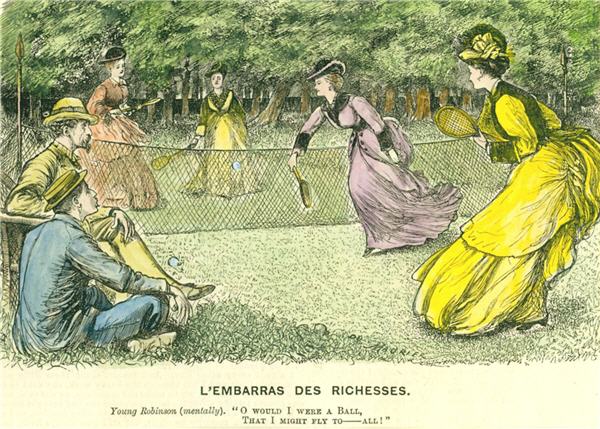
Punch Magazine ( black & white) Oct.10th 1874) but these hand coloured finishes of the original prints are very attractive.