 Tennis was established in the UK throughout 1874 thanks to the marketing genius of Major Walter Wingfield, who created the first boxed sets of portable lawn tennis equipment with rules for play on an hour glass shaped court. His brand name for this new game was “Sphairistike” which perhaps wasn’t a great choice since no-one found it easy to pronounce. The MCC took great interest in the early game and wished to reduce confusion surrounding the rules and scoring and working with the Major published a new set of rules based on real tennis scoring, whilst still keeping the hour glass court design. Having adopted lawn tennis in 1875, The All England Croquet Club decided to conduct the first major tournament in 1877 (Wimbledon) and further changed the game by moving to a rectangular court layout .
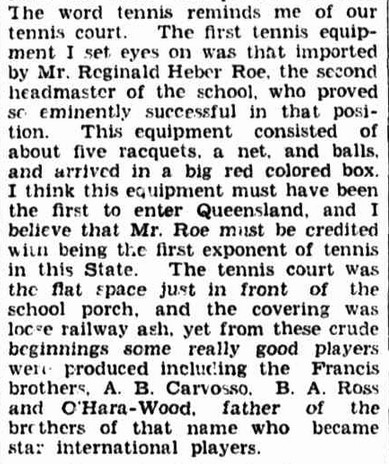
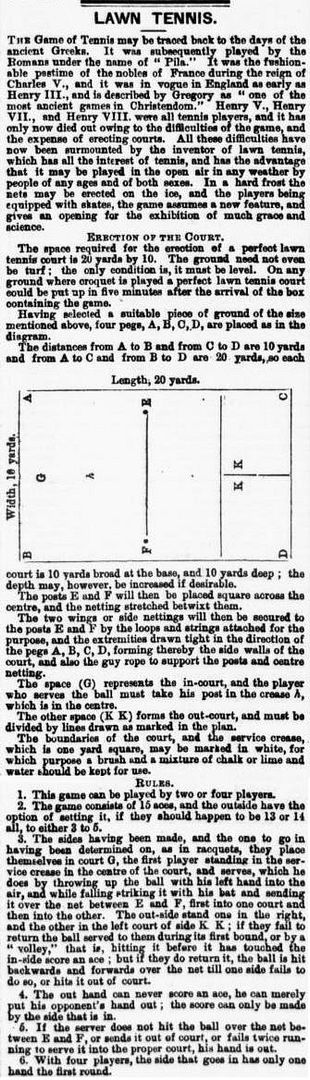
Tennis equipment would have been purchased from any number of companies already making and selling Royal Tennis racquets at the time and tennis sets would have made there way quite rapidly to the colonies of USA and Australia. Royal Tennis had been played for some hundreds of years and in 1875 in Hobart the first court was constructed and the first English professional arrived, so marginally in Australia, both games found themselves being played at much the same time. I can easily imagine these professionals packing a set of the all new outdoor “lawn tennis” sets. When we started our history of lawn tennis in Australia journey we were unsure if we would find early pointers to tennis arriving here. Luckily, to the left, we found this article published in the Sydney Mail, Saturday 26th September 1874, in the same year as tennis was launched in the UK by Major Wingfield. News did travel quickly even then. The article from Sydney may well have been shared with other state newspapers, but it clearly establishes the opportunity for NSW sporting retailers already selling UK/French sporting goods to commence importing the new tennis sets mentioned in the story. Another factor in the spread of tennis was due largely to Wingfield’s connections with English aristocracy and the military. The Prince of Wales and his family were one of the early buyers of a Sphairistike set and were reported in later years to be extremely competent players. As the focal point for Australian audiences interested in emulating royalty at home, this would no doubt have promoted the right “image” for the game. Newspaper articles and stories from home no doubt included mentions of this new game from the 1876-1877 period. Thanks to tennis historian, Clive Oliver, we have learned much about the arrival of tennis in Melbourne which has been published in the book ‘Amazing Grace’, The History of Grace Park Tennis Club. From this book and supported by Melbourne Cricket Club (also MCC) minutes, we know that a visiting UK player to Melbourne, found a set of tennis equipment in the confines of the MCC store room which in 1877 had remained unused. We also know that this gentleman Mr Robert Balfour-Melville was the brother of a UK champion tennis /golf player and was clearly well trained in the art of tennis. Some local Melbourne families already had asphalt courts in 1877 and their skills both surprised and challenged Belfour-Melvilles prowess on the court. Clearly the Melbourne players had developed their skills over a couple of years you would think? A sale of the Upper Toorak property of ‘Tooronga’ owned by Colonel Ward in May 1876 included the assets lawn mower, roller and lawn tennis which supports the early adoption of the game. Colonel Ward was the head of the Victorian Branch of the Royal Mint so no doubt was an influential member of Melbourne society at the time. The popularity of the game in Melbourne comes from an 1889 article identifying that Melbourne and suburbs had upwards 150 courts with the prestigious suburb, Toorak, having 32 asphalt courts. From Queensland, we have found that a private citizen introduced the Sphairistike game in August 1876 followed quickly by the establishment of a club, then clubs and competitions soon followed. See the Queensland section for a wonderful recount written in 1888. From an article published in 1878, the Adelaide Lawn Tennis Club, connected with the Cricket club, was granted permission to use a portion of the oval during winter upon payment of a subscription and that all players were members of the association. The club may well have started in late 1877. The Adelaide Archery Club also offered tennis as a substitute for shooting in 1878. The Wimbledon Museum advised that they have in their possession Major Wingfield’s Day Book, listing all the tennis items that French & Co (his manufacturer) dispatched from their depot in Churton Street, from 6 July 1874 to 26 June 1875. There was no listing of equipment bound for the USA or Australia mentioned so while there was probably no direct order fulfillment, it may well have been a family member returning from England loaded with an array of trunks of new fabric, fashion, furniture, household items etc that were currently not available in Australia. At the end of the day we are really unsure who brought in the first Lawn Tennis sets into Australia although the strong contenders would include the professionals from the UK who arrived in Hobart in 1875 to coach and manage the newly constructed (Royal/Real) Tennis facility. Of course, the well established cricket clubs may well have got wind of the arrival of lawn tennis via the connection with the UK MCC. Additionally, the UK sporting goods manufacturers already were selling them cricket goods and they were the ideal targets given they could readily afford to buy a set to be included in their next consignment of cricket equipment, they had the expertise to construct the courts and had keen and active members already playing other sports. The earliest documented story is the one about a Brisbane Grammar Head Master arriving from the UK with a set to use at school and in fact this lead to some great stories as tennis evolved in Australia. 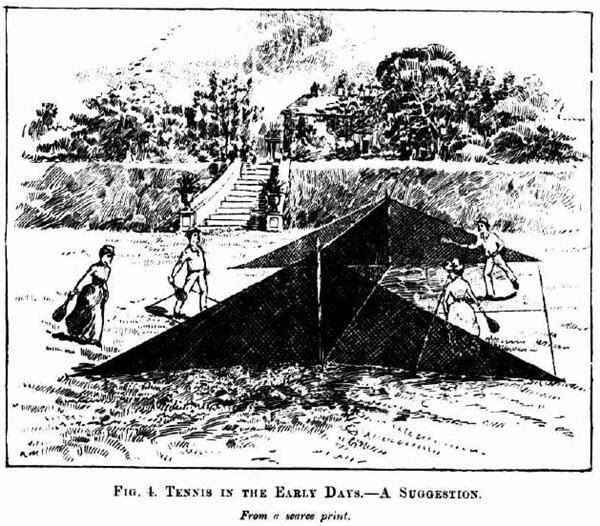 Note the net height was far higher in the original game.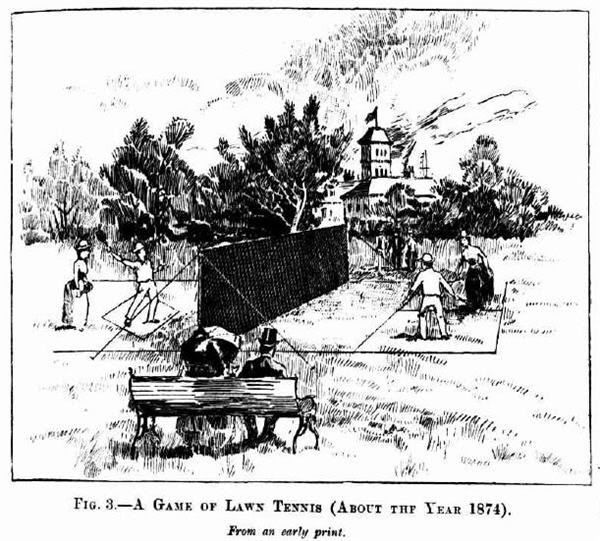
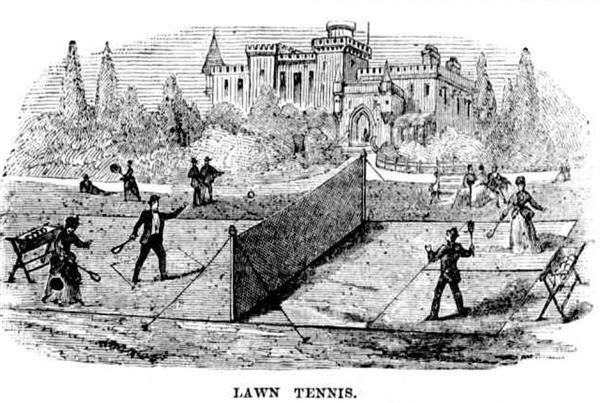
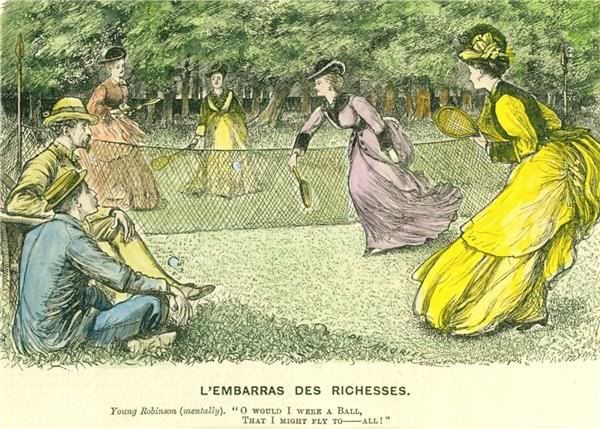
This illustration comes from Punch Magazine, October 10th 1874 and although originally black and white, some devotees enhance the originals with water colour paints to create a more realistic effect. Copies of this magazine would no doubt have been available in Australia to further stimulate local interest in the game. In Australia once main competition tennis began between states, the courts were erected on cricket grounds in Sydney and Melbourne. 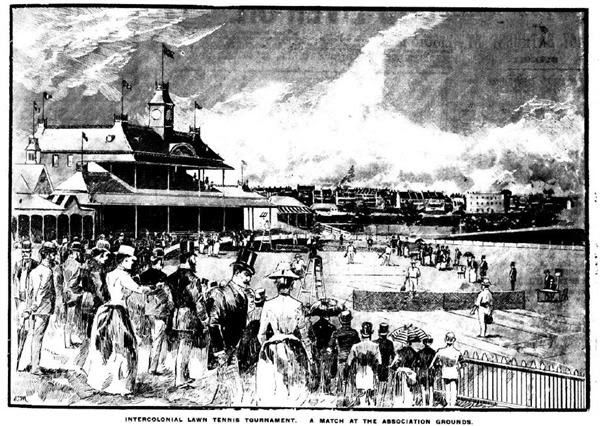 The intercolonial tennis matches attracted large crowds.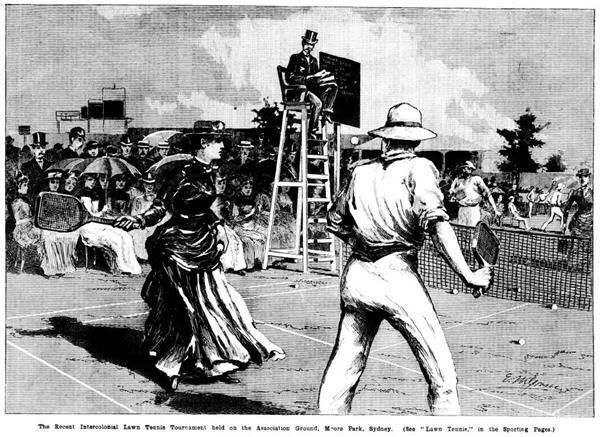
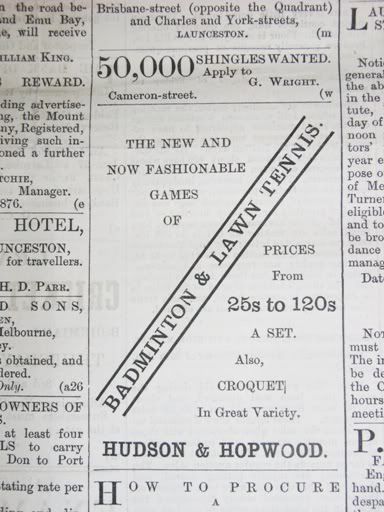

This ad above is from the Sydney Morning Herald on the 11th August 1876, and no doubt many sporting goods retailers followed suit.
Above, and ad from The Examiner (Tasmania) on January 27th 1876, we have the earliest known retail ad for tennis sets in Australia. But, you have to admit the wording throws up some questions. Had Major Wingfield’s original tennis sets arrived earlier in 1874/75 and was this the now fashionable game. Or, was the unfashionable game perhaps referring to an earlier form of Lawn tennis created in 1872 at Leamington, UK (unlikely). Certainly, it seems from the Queensland experience that Major Wingfield’s set was the first opportunity for locals to experience the game. A third most likely option, supported by The Wimbledon Tennis Museum is that the Tasmanian ad must be referring to the new rules published in May 1875 by the MCC (UK) in a book titled ” The Games of Lawn Tennis & Badminton” which did make tennis and the rules of play more fashionable. This means that the colonies must have had exposure to the unfashionable Wingfield version before the new rules and style was adopted. 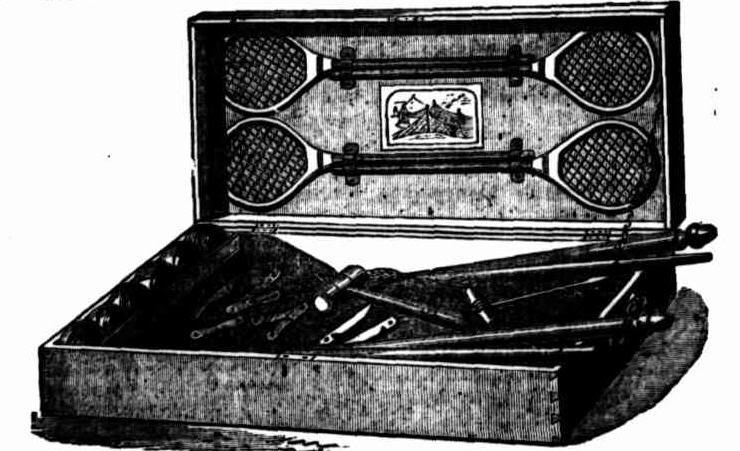 The drawing above comes from an 1882 ad for a retailer in Maitland NSW, named Robert Blair. Selling tennis boxed sets from 45s 6d, 65s, 75s 6d, 80s to 95s per set. There are some interesting features of this set. First, is that it seems to be a joint set containing croquet and lawn tennis equipment. Second, the racquets are diagonally strung and perhaps most intriguing is that the small drawing of the court looks like Major Wingfield’s design as charactersied by the side nets. See the complete ad under ‘racquet retailing’.
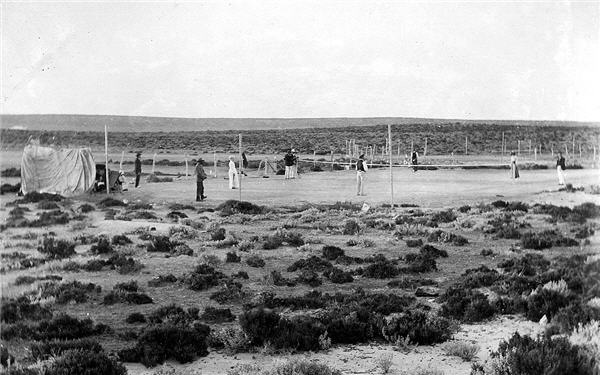
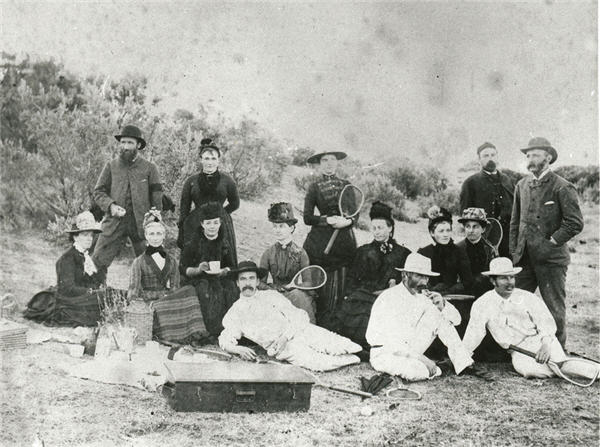
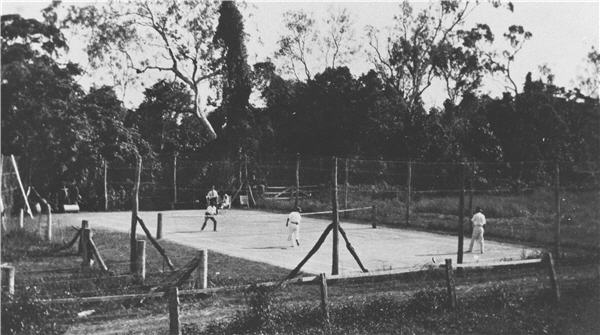
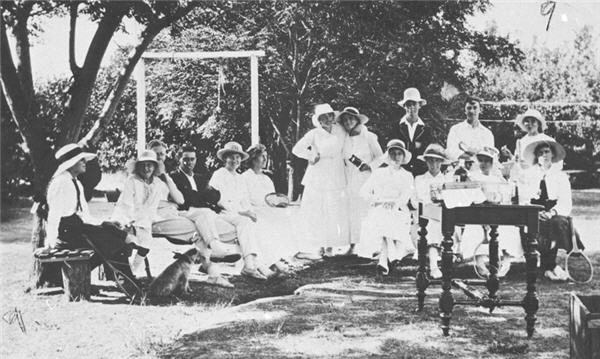
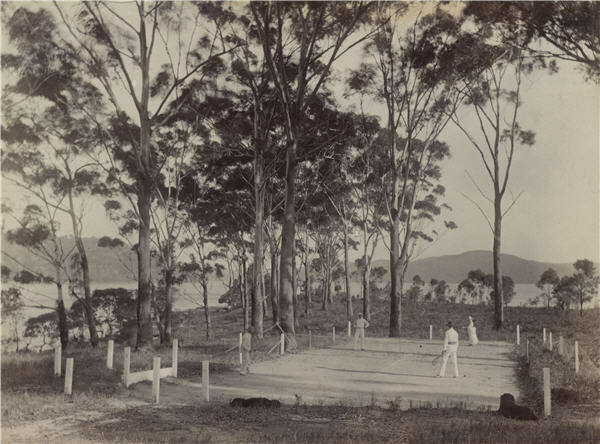
The following photos show some wonderful scenes where tennis courts were created in bushland settings all around the country. These were downloaded via Trove Images from the NSW, QLD and SA Library collections. The last photo came from the NSW Dangar Historical Society library taken in 1887.
I am pretty sure that the large group shot even has a boxed set in front of them which is the only reference I have ever seen.